The EU is not happy with the disappointingly small amount of people (currently only 1.5 %) who move from one European country to another to work. Free movement of people, goods, and capital are the founding stones of European integration, and while a lot has been done, not much seems to be happening. Thus, the current year has been nominated as a theme year for workers' mobility.
No wonder people are not moving. The policies focus on issues such as transferability of qualifications, waiving work permits, taxation, access to health care etc., which are of course very important as such, but ignore other, vital things such as the problems you face when trying to let an apartment in a foreign country, for instance.
Today I was told by an a*****e (no, its not amicable, doesn't fit) property agent that my grant does not qualify as income in Britain because the grant is "European", and, worst of all, it is in euros. I tried to explain that it is currently in pounds, as it sits in my British bank account, but to no avail. So, I will need a guarantor for the rent, as I'm not earning or in possession of real money. Needless to say that my family, relatives, and most friends are all excluded because they don't live in the UK. Only 16th generation independent inherited thoroughbred old money, Pounds Sterling for us, please.
Free movement of people & capital my butt. I wonder what my MP and MEP have to say about this.
(Pic europa.eu)
Tuesday, June 27, 2006
European Year of Workers' Mobility


Plausible explanations
 Scientific experiments, when succesful in producing statistically significant results, only answer the question that was asked, which usually is of the yes/no -type. Interpretation of the results is always up to the researcher. And researchers might interpret things in orthogonally different ways, depending on their background theories (or lack thereof). When an experiment produces an effect, it is often debatable what causes the effect, or what conclusions can now be drawn based on the verified existence of that effect.
A good example of very bad interpretation was demonstrated yesterday in the documentary on Channel 4. (Yes, I know, shouldn't watch C4, it's rubbish). They "investigated" the possibility that in heart transplants, part of the personality of the donor could be transplanted along the organ. This was backed up by a number of heart transplant patients whose personality had underwent a change as a result of the transplant, and their newly acquired traits were akin to those of the donors of their new hearts. In addition to the testimonies, they had some wacky Californian "scientists" explaining how there are neurons in the heart and that the network of these neurons is complex and it exhibits memory, and that's where these personality traits can travel from one person to another.
Where to start... Well, first of all, I think that organ donations should always be anonymous. In these cases, there has been mutual consent to reveal the identities of the donor and the recipient, which had then in some cases led to very emotional "let me listen to my brother's heart beating one more time" -kinds of things. This might help dealing with the loss of a relative or might be detrimental for both parties. One of the relatives of a donor who died in a stunt accident in his twenties, said he has found it easier to accept the loss now that he sees that the receiver had started doing sports and being very active, and was "making the most out of his new life". Imagine the pressure this puts on the shoulders of the recipient!
Second, I think nobody denies that a heart transplant is a life-changing event. To such an extent that it can affect your personality in many ways. People often see it as giving them a second life, so they might take up hobbies they didn't have before, or they might show a different side of their personality etc. And, often these new sides are more active, more creative, more open and agreeable than the old ones. Or feel like it for those around. Remember, the transplant is a trauma and a psychologically heavy process for the recipients' family and friends, as well. These active, creative traits are also exactly the kinds of things you tend to (want to) remember of your deceased relative. Bring the two together and you have a match.
If you take up sports after your heart transplant, it is not a surprise. It is more than likely as well, that your donor was an active sporty person, as a donated organs need to be healthy (no fatty couch potatoes dying of angina pectoris) and the donors often have died in accidents (active lifestyle, higher risk). Correlation, yes; causation, no.
Third, the neurons in the heart and them "remembering". Of course, we've known this for long. That's what keeps the heart pumping. There has to be memory in the neural network, of the previous cycles of oscillation, so that the next one can follow, and that there is stability in the system. That's all it does, however. Memory to sustain oscillation is different from memory about places, names or skills, such as poetry. Of course, our mind-body is a complex system, our cognition is embodied (I'm the first person to admit that, as it's a central tenet in my thesis), but before saying that since heart has neurons, it carries a part of our personality, you need to establish that there are sufficient, functionally relevant links between the brain (the parts we know are responsible for components of personality) and the "brain of the heart", as they called it. There are links, as both link to the same nervous system, but so do toes and all our muscles. While the neurons in the heart are like the ones in brain, functionally the connections between the two are more like the ones between brain and other internal organs or muscles than those between different regions and structures in the actual brain.
Finally, this connection between heart and the brain was what they told they were showing when they presented some experiments byt these wacky scientists. They had measured people's reactions to emotional stimuli and saw that the heart and the brain both react to them, and the heart anticipates some of the reactions. No news here: we have primary emotions that work pretty directly from perception to physical reaction (happiness, sadness, fear, anger), without needing any cortical processing. This concsious processing will then follow, leading to feelings. Evolutionarily it has been important to be able to prepare for fight or flight as quickly as the threatening stimulus occurs, without having to pause to think. We startle when we hear loud noises, for example. Our heart rate shoots up, hormones are released, muscles get ready to action etc. Again, showing this correlation is not enough to conclude that we "feel emotions with our heart and part of our personality lies there". Personality and these autonomic reactions are two very different things.
With this kind of an experiment, a "mainstream scientist" would take the results and talk about the experience of emotions and the embodied nature of cognition, and how the interlinkage between the autonomous nervous system and cognition are linked functionally and how there seems to be two pathways of processing emotionally valenced stimulus. In his/her case, the experiment has shed light on the issue and provided data based on which theories can be developed and better models built.
The wacky one would claim how he has now shown that heart thinks on its own and how the connection is so mysterious and magical that all previous knowledge about how we think is now invalid and transplanting hearts is probably bad and how it's all so new age. Muddying the waters, that is, and raising himself to a position of superior knowledge (while deciding what colour Porsche he should buy when the book advance arrives).
Lack of proper controls, relying on apparent coincidences, asking impossible questions, over-interpreting the experimental evidence and mystifying rather than clarifying are the telltale signs of bogus science. Check, check, check, MindShock ticked all the boxes!
(Pic: kzone.com.au)
Thursday, June 22, 2006
All those empty words...
Bingo!
Talking about a CC-license in one post and posting copyrighted material in the next... jolly old double standards? Well, first of all, this was so funny that I couldn't resist, and second, quoting is legal, and I think George Carlin says it so well: catchphrases and jargon are diluted in meaning and nothing but jingling is left after a horde of consultants has been let loose to chant them.
BTW, the bit about buying a microwave in a mini-mart and minivan in megastore reminds me of the minimega hamburger that a certain burger chain with South-Western Finnish origins used to sell...
Wednesday, June 21, 2006
Creative Commons
 Piracy, plagiarism and copyright always seem to come up in the discussions about the internet. Most typically it's the huge music industry conglomerates who claim that the new technology like internet & p2p/mp3/CD/audio cassette/8-track recorder/phonogram/copy machine/print/wheel/fire will bankcrupt them and steal their last pennies. In actuality, music industry has profited from each new step of technology. In addition to creating new methods for sharing music outside the control of the companies, the new technologies have created new ways for the companies to distribute their products, access to new customers, and new money-making opportunities for the use of their music.
I don't approve piracy, but I also think that the "all rights reserved" -attitude is not only inconvenient but also detrimental for creativity. If you try to close your work behind the walls of total copyright, you end up giving people only two options: to steal it or to ignore it. Creative commons licensing exists to give more options. You can choose yourself which rights you want to keep and how your work can be used by others. While I think that texts in this blog do not need to be protected (from the average of 7 daily readers) by license, I went ahead and did it anyway - just to see how simple it is and to join the bandwagon of creative commoners.
So, what the license says:
- attribution: you can use, alter, quote, re-mix, etc. any text you find on this blog, as long as you mention the source.
- non-commercial: my permission would be needed for any commercial use of the material on this site. I chose this for the sole reason that if anyone would be creative enough to find any commercial use for this chitchat, I'd surely want to hear about it! I can already promise to give my permission...
- ShareAlike: this means that if you use these texts I would like the results to be shared to the world with a similar license as this one.
Monday, June 19, 2006
Ordem e progresso
This blog seems to have become a more or less random collection of writings. Fair enough. Initially I thought it would become more like a continuing log of the progress of my PhD, a description of the writing process etc. It hasn't, mostly because there seems to be no progress to talk about at the moment. Not that there's any order, or much love either, I must admit. I remember the advice I got when I was still an undergraduate contemplating doing a PhD one day. "You must really love your topic, since you will be giving years of your life to it" said this Norwegian professor. So true. I guess the honeymoon is over, and instead of living the dull everyday life with the missus, I'm even secretely dating other topics.
I tell my PhD all sorts of excuses, explain lipstick stains in the collar, get tempted and turn to look at other, sexier themes and approaches. But I know I'm stuck with this one for now. We have a prenuptial that will leave we dry if we divorce before the marriage is consummated and the first-born thesis inspected. Nevertheless: motivation, where art thou?
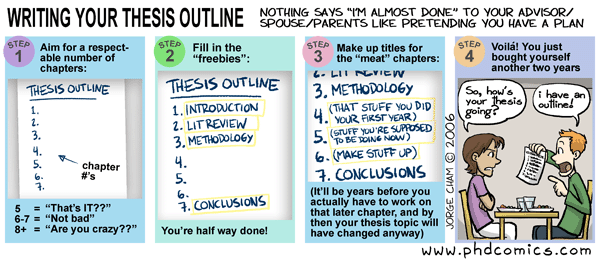
My thesis is like this blog entry. A brilliant idea but I keep rambling and don't have the energy at the moment to write it and polish it so that it would come across in such a form and shape that is not underwhelming and disappointing for the reader (and writer). The ingredients for this entry were: slow progress in work -> leads to order and progress -> which leads to the motto of Brazil and thus to the ongoing football championships; -> through which we get to passion and love, which is Augusto Comte's premise for the other two, order and progress, -> and while love's left out of the Brazilian motto, they are good at passion which I seem to lack in my work. Also, Comte and his positivism lead me to ( -> ) science and philosophy of science and the idea that science brings knowledge and that drives progress etc., which I do believe, even though I'm not really a fan of positivism as such -> which would lead me to promise I'd write something about the philosophy of science, as that seems to interest me more and more -> especially about the topic I've been wanting to discuss here for a while: purpose, relevance and ethics of science in general and higher education institutions in particular, all the things related to it from faked cloning research to plagiarism in student essays, and (here comes the term I'm planning to launch here this week) "soundbite science" a.k.a. how media and poor science policy drive research to unfortunate directions. Then ( -> ), I was going to make some sort of a loop back to football/love/Brazil.
Or, I could perhaps have exploited the fact that the film "O Brother, Where art thou" by the Coen brothers, a reference to which appeared by accident a few paragraphs back, is based on Homer's Odysseus -> avoiding the empty metaphore of phd as a trip or an odyssey I was planning to leap to ( -> ) Greek tragedies, the ultimate stories in this world, and how they deal with closure and destiny, and how eveI'm perhaps waiting for a deus ex machina (or should I say ápo mēchanēs theós) to save my play/thesis/"marriage".
Finally, I was going to apologise for the spurious nature of these connections and the loose associations between some of the links above, and I was going to blame Haruki Murakami's "Kafka on the Shore" for it. I'm reading (or should say devouring) it at the moment. It's a Book about fate, love, beliefs, setting things right in the cosmic order across different times, and finding purpose for lives and the missing other halves of ourselves. It reads like a thriller while being thickly intertextual and deeply philosophical with references to Greek tragedies and Kafka's surreal stories. It also has a lot of cats in it. Also, I'm 3/4 through the book and everything still hangs in the air, and while I begin to see the connections I can't wait for Murakami to tie them together. I'm reading the book when I'm supposed to do my work, hoping that it would inspire me and demonstrate how some order can finally be made, and that things can progress as a result. Seeing how someone can take multiple and seemingly non-related premises and link them in an surreal and fantastical way while still credibly talking about theories and corroborating and conflicting evidence would be beneficial, I think.
Then, if I'd be writing this entry properly, I'd probably decide to cut the Murakami-bit out and save that for a separate entry, so that I could write more about it. And I would just round off the blog entry with the triangle of love, order, and progress, and then decide to do like Kafka Tamura does in the book when things get too complicated - go to the gym.
Travelling
 One of my best friends got married in Finland on Saturday, and of course I had to get there. Unfortunately, I had to get back to Cambridge immediately after the party. Because I didn't want to blow my non-existent summer holiday budget for a two-day quickie, I took the cheapest options, which meant bus to Stansted, Ryanair to Tampere, train near the wedding venue, and finally my friends picked me up and gave me a lift to the venue - and the same happened in reverse order the next day. The beautiful, wonderful wedding aside, here are a couple of things I noticed.
- words like "please", "excuse me", "sorry" and "thank you" don't exist in the Finnish language. It is also possible that the government has introduced a new tax for the usage of these luxury items. Luckily, Finns have quickly adopted strategies to avoid these taxes and become fluent in going on with their lives without having to resort to these frills.
- speaking of frills, the term "no-frills airline" has a deeper meaning than I had realised. Terminals are considered as a "frill", so are chairs in the corrugated steel huts they call "terminals". At least in Pirkkala where Ryanair flies to in Finland.
- to provide their British-bound customers a proper dose of queuing practice before coming to the "land that invented the queue", the bus from Tampere city center arrives at the airport 2 hours 40 minutes before the flight to Stansted. To ensure distractionless learning, the Terminal 1 next door with all the cafes and shops is also closed during this time.
- Ryanair apologises for no longer allowing firearms to be carried on board their planes, following a company policy that came to effect on 1st April 2003. I'm surprised, and would like to learn more about their pre-2003 policies, considering especially that after 2001, even attempts to bring sewing kits to planes have been categorised as acts of terrorism and crimes against humanity. I also wonder how many arms traders, after having thought this is just an April fools' prank, had to leave their UZIs to the security control after this new policy was implemented.
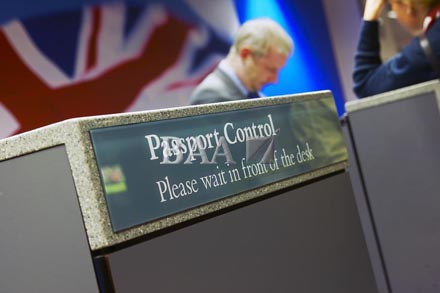
- There are three lanes to passport control in English airports: British, other EU/EEA, all other. There are always people who find themselves in the wrong queue(s). I don't understand this. I can see how sometimes people get tired and disoriented, and as all the airports look the same, they might be confused about where they are. But surely they should still be able to remember where they are from? Or be able to check it from the cover of the passport they're holding. My advice: next time you fail to stay at home AND fail to remember where that home is AND forget how to read, ask the staff for directions and take the "all other passports" queue. It also covers "outer space". P.S. United States is NOT a member of the EU. P.S.2 EEA is short for 'European Economic Area' and not 'USA' in French.
- I warmly recommend Finland as a travel destination, especially at this time of the year. It's warm, safe, and beautiful; the nightless nights, the nature. And also, the majority of Finnish idiots took the Ryanair flight FR2195 from Tampere to Stansted yesterday and are thus now out of the country.
- kind advise to some of the aforementioned idiots: it's not considered as a sign of bravery to shout stupidities about "slowness in emptying the tube" in Finnish to the non-Finnish flight personnel, who are trying to ensure that the families with small children exit the plane first. Also, it doesn't count towards your alpha-male score and is not considered as "a situation where you took charge and showed initiative and leadership skills".
- I've become ever so slightly British. I judge the status and respectability of estates based on how their lawns are cut. The wedding venue (a conference/golf hotel/castle) would get a perfect top score otherwise, but seeing a robo-mower parked at the edge of the rugged front courtyard lawn that was full of weeds and in general in a bad shape drops the score. It's not just that the lawn was overgrown; I could forgive it having some of those weeds (as they are extremely difficult to get rid of), and overlook the fact that the edges weren't trimmed and there was a more or less smooth transition from grass to gravel. I can see how the weight of snow during the winters and and the paths of melting waters in the spring contribute to the unevenness of the surface, and to the undefined overall oval-esque shape of the lawn. But the robo-mower is simply wrong. Just like with cutting hair, it's not only about getting it short, how it's cut also matters.
- continuing this stiff upper lipped cawing (I need to stop now, or I'll start feeling like reading the Daily Telegraph): the so called "sculpture park" around the otherwise brilliant Sara Hilden museum in Tampere is a joke, not only because of the lack of interesting sculptures, but also lack of tending of the "garden". If "how to cut it" is too difficult, at least get it short. Please.
- The world is small. I thought I could escape from my work for two days to ensure my friend gets properly married, and to meet friends. When I decided to get a drink from the venue's bar, the person in front of me in the queue turns around, turns out to be my aunt, and asks me why I'm there when I should be in Cambridge doing my PhD. :-) Forget Big Brother: he's an amateur, dilettante and a complete dabbler compared to mums, aunts, and the ladies next door. Anyway, very nice meeting them after a while and congratulations to my uncle on his "longest drive of the day" trophy!
- Finnish summer fashion still includes sandals with socks, belt bags and t-shirts tucked into the shorts.
- To ensure that people who return to Britain would get a smooth transition to the cold climate, the Stansted airport buses have their AC's set at 30 degrees. Conversely, to make the driver feel at home, the ones in Finland have their AC turned to 13 degrees.
- Consider it very carefully before becoming a North Ossetian folk dancer; you will have to wear a fur hat even when parading through the main street in Tampere under the scorching sun and heat, while performing acrobatics and singing Ossetian folk tunes.
- Finland in the summer is too beautiful to describe, and too nice to leave behind. Lack of politeness and sense of fashion, and badly mowed lawns are a small price to pay for a paradise on earth (perfect with mosquitoes).
Saturday, June 10, 2006
Invigilation
From my perspective as an invigilator of exams, the main task during a three hour paper is to stay awake. From the students' perspective, my main task is to give them more paper when they run out. From the university's perspective, my main function is to make sure nobody resorts to "unfair means", i.e. cheats.
The exams show is run by the examination office and the various departments, and overseen by the university internal police, the proctors. I was surprised to find out that the word 'proctor' has no etymological link with the Greek word proktos, the origin of words like proctology etc. Nevertheless, I suppose anally following and implementing largely irrelevant or archaic rules is seen as part of the vital tradition of the ancient university, as the sine qua non of its academic excellence. Never could I guess that allowing only water to the exam halls would be the "Ravens of Tower" of Cambridge...
The candidates are allowed to bring a small bottle of water with them for the three hour exam. In the invigilator training this vital issue is discussed in more depth and detail than any other issue, including fire alarms and people falling ill during exams. The only thing that gets an equal amount of airtime in the two hour training is how to prevent cheating. Cheating, to my experience, is the only thing that is even less problematic in the exams than the supposed chaos and havoc caused by orange juice and Lucozade.
During the exams, the proctors go around Cambridge, from hall to hall in their gowns and mortarboards, checking that all rules are followed. Since the drink issue is of the highest importance in running the university exams, it's no surprise that the purpose of these visits seems to be to spot potentially hazardous apple juice bottles among the Evians and Highland Springs. Last week, one of the proctors found two suspicious containers in the classroom I was invigilating. One guy had a can of Red Bull in addition to a bottle of water on the floor next to him. The Proctor was clearly deeply shocked to discover this, as he twitched (on the British Scale of Expressing Emotions this equals to 6.8 on a Richter Scale), and then told me "the gentleman up there has a can of beer." This shows how up-to-speed these people are with the so-called real life, and so I advised him that it's just an energy drink. To which he stated that it is still an "illicit drink" and that I should confiscate it immediately. So I did. He then, having discovered how I had completely neglected my duties and not properly screened the room for these hazardous chemicals, continued hawk-eyeing the room, and spotted something suspicious. He pointed to me that the "gentleman in the yellow shirt" had a "non-transparent bottle". I looked up and saw this dude at the back, in a faded yellow t-shirt, and he had a bike bottle on his desk. I confessed that I hadn't checked the contents of that bottle, to which he said "you probably should". I didn't.
I think bothering people with nonsense during their exams is not the best thing you can do, when you are there to bring them more paper so they can keep writing incessantly for the three hours the exam takes. It would be rather silly, wouldn't it? But, undoubtedly the illicit drinks debackle will only gain in momentum, as next year in the training session for the invigilators they will undoubtedly emphasise how important it is to keep this issue under control, as some students have been known to try to smuggle beer into the exam halls.
Tuesday, June 06, 2006
Not working
 Just can't start working yet. Can't waste my time in here doing boring work. Finding a proper work/space/time -combination is becoming more and more problematic. Now, it's all too nice, I like the view too much to bury my eyes to an article, or even worse, to some datasets. I feel I should have the next 4 hours off since they are going the be the last ones Edinburgh has for me for now.
This was an easy decision, and I'm kidding myself to believe it's due to the exceptional circumstances. (Not even so) deep down I realise how skipping work has become easier and easier lately, and I barely need an excuse. My attention will jump to an interesting newspaper article about genetic makeup of lemurs or the 78th anniversary of the beheading of a Kirgisian union activist like a paperclip to a magnetron. And these diversions have a gekko-like hold of my mind, while the the mountain of work seems to be made of hot-oiled nanoparticle-coated glass that is impossible to take a hold of.
Volumewise, my work has been rather down lately. Somehow the celestial constellations of work-enabled timepoints and good-vibed places have not been in conjunction. Surely, I'm droning on, doing stuff, but having lost virtually all perspective and much of the motivation it has been a struggle. I haven't been inspired, but I must say, I haven't really perspired much either. I've given up too easily; if the work hasn't been progressing or didn't "feel right" I have avoided it, tried another time, another place, but rarely successfully. And I've been annoying myself in the process, obviously. The stuff I'm doing now is important only for me and nobody else will be screwed if I do it late or leave undone. In the short run, that is. On the longer timescale, the timescale of graduations and getting proper jobs, there is of course an impact to others around me, but somehow I've not paid any attention to those issues. That's what cloudy horizons and lack of perspective do to you.
So, what to do now? As I said, Edinburgh has restored some of the motivation (as visiting nice places and getting positive feedback in conferences does) and so I guess I just have to start making better plans and force myself to stick to them. And pay less attention to those genetically modified Kirgisian gekko-lemurs and their atrocities against labour union activists.
(written 05/06/06 in Elephant House, Edinburgh)
Sunday, June 04, 2006
Edinburgh
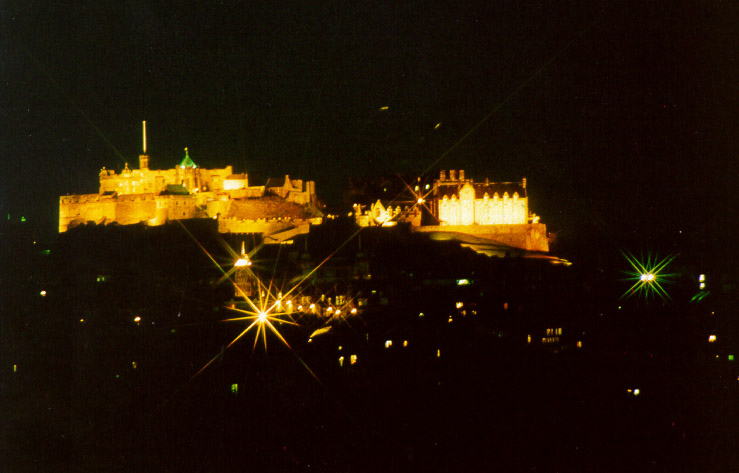 I like this city. After stuffy Cambridge it feels like a breath of fresh air. Not just academically, but also in terms of the surroundings, the hills, sea, the wind... I'm always "surprised" to see that not all of Britain is boring and flat like East Anglia. But then again, we're in a different country now.
I've been here for a couple of days now, in a conference, how else. I now have about a day of "free time" before I'm heading back down, "south of the border" as they say. And I feel revitalised and refreshed - partly because the conference was a resounding success, but also because my brain had somehow got stuck on this very short track of thoughts and the trip up here seems to have broken the loop, and my mind flows more easily now.
There's a whole different vibe here, a dynamism, easygoing but sturdy feel, that somehow is similar to Ljubljana, or actually, Helsinki. Cambridge is about keeping things as they've always been, and while it's very beautiful and nice, it somehow feels stagnated and boring. And I'm not even talking about the university yet... :-)
Our host was right - the spirit of the Scottish enlightenment and David Hume is still around.
(P.S. Most Scottish football fans have started to support Trinidad & Tobago, since they play against England in the World Cup. Similarly the German football fans are now donning Scotland jerseys - it would be too rude for the polite hosts to be openly against England, so supporting Scotland (who unfortunately didn't make it to the final tournament) is the next best thing. The jerseys they are buying en masse are replicas of the 1978 Scotland shirts, voted most stylish ever by a magazine. But, I like the political statement there more than the fashion statement.)
Saturday, May 27, 2006
Super Mario sucks
Literally.
No, I think this is a very cool hack. Who would come up with this thing? What was the original idea, or the original "need" that made him do it? Boredom and too much free time? Anyway, great stuff, I'm eagerly awaiting the Roomba-orchestra!
Tuesday, May 23, 2006
Sunday, May 21, 2006
Monsters Inc.

They did it! As BBC put it, "Lordi came. They rocked. They conquered."
The first ever victory for Finland in the Eurovision Song Contest, and it was a sweeeet one. It's so easy to be cynical about the ESC; how the music is so bad, the performances so cheesy, how it repeats itself year after year and is just a waste of time and money. In one word, it's Eurotrash.
What these cynics forget, is that ESC is entertainment and a bit of tongue-in-a-cheek fun. It has immense camp-value for exactly the above-mentioned reason: the songs and performances are cheesy. We like to hear the mock-ABBA -tunes, the johnnylogan-esque power ballads, the freak shows and hare-brained entries from "weird" countries. We like the fact that the show follows a clear formula, and that we can mock the frocks and laugh at the jerky dance moves and banal choruses.
This doesn't mean it's all a joke. No, you have to take it seriously enough, but not be serious about it. It's about entertainment and putting on a show people can enjoy. Lordi did just that. For too long the Finnish ESC-establishment has had a false idea that it's about the tune. But, ESC is not a competition for composers, it's a competition for performers. And the Finnish acts before this year have been bland, boring, and insignificant. Some of them might be good artists, some of the songs have deserved better than the 3 points they got, but now for the first time we sent a full, proper show.
To win the ESC you need to grab the attention of the masses, make yourself known.
Finns are usually not very good at that, but this time the show was so strong that they didn't need to push themselves - the media was after them. Rather than trying to do it with sex, they did it with fire and a hell of a stage show.
Undoubtedly there will be copycats. But as much as people like the repeating formula of ESC, they like uniqueness, and the more outrageous your idea, the more likely it is to work only once.
Just like any entertainment, ESC can be seen as more than it is, a symbol for - well, many things. For example, for the Estonians and the Ukrainians, winning the ESC was about belonging in Europe, being accepted as a nation after decades behind the iron curtain. While that's a bit grand, it seems that the ESC has often been seen as a force that brings Europe together, promoting understanding and plurality. The freaks and weirdos have been knocking on the doors of Europe and the Europe has welcomed them in. Odd countries, strange LBGT-types and Nordic monsters, all in harmony with the pretty boys and girls in white suits and their good old three chords.
(cynical post scriptum: I wonder how valuable the ESC victory will turn out to be for Lordi commercially...)
Edit: The Eurovision website has a nice interview of Mr Lordi that ends in a typical way: a quote from Mr Lordi: "‘Kitos’ means ‘bye-bye’ in Finnish.” ESC replies: "Kitos, Mr. Lordi."
(Pic: Eurovision.tv)
Thursday, May 18, 2006
High horses
This must be a world record in hypocrisy and double standards. Fox News "debating" with the Westboro babtist church (yes, the ones who hate Sweden for being gay-friendly etc.) representative about whose side God is on in the Iraq war and what he wants etc. It's either hilarious or appalling, depending on your point of view. No, I couldn't watch all of it either - 15 seconds is my personal record of continuous Fox News watching in general. Scary thing, I almost started to agree with the Westboro nutcase.
Wednesday, May 17, 2006
Just a bicycle
 They say Cambridge is a city of cyclists. At least it seems to be full of them and they are the only sane mode of transport that can get you to places in the town centre. It might not be the city FOR cyclists, however. The facilities for cyclists - well, I've seen worse but I've seen better. There are good bicycle lanes here and there, there is access to the historic city centre (that is closed from cars other than buses and taxis) and there are places you can leave the bike while shopping, at lectures etc.
On the other hand, many cycle lanes are shared with the buses, who don't give a damn about cyclists, the city centre is so full of tourists walking here and there on the roads that you can't really cycle through the centre without killing a few of them every time, and there are not nearly enough parking places for cycles in the centre.
So, some good, some bad. I'd still rather cycle in Cambridge than drive a car in Cambridge. But that brings me to the issue that has annoyed me a lot lately. The behaviour of car drivers, and the utter disregard of cyclists. When turning across the lane, pulling over for parking, making a u-turn or doing anything else similar, any driver would first need to make sure the road is clear for them to do the manoeuvre. And for 95% of the drivers, the road is clear if there are no cars. For the rest 5%, the road is clear if there are no cars larger than the one they are driving. No one gives a fiddle about cyclists.
Today I almost crashed to a car that was coming towards me on the opposite lane, but just in front of me changed to my lane, stopped, and started to pocket park to the parking space on my side of the road. She would have left any car to go first before doing this, but since I was just a cycle...
Cyclists are better off crossing roads with pedestrian greens rather than waiting for the car signal to go green, since the cars turning right across your lane will not look, stop or wait for you to cross the road first, they are cars and can comfortably mow a few cyclists down without blinking an eye.
Sitting in the inevitable queue in the car is a skill as well. Most people already know to stay in the middle of the lane or closer to the centre line, so that cyclists can pass from the left, between the sidewalk and the cars. Some people don't. Some people will move to that space without looking, possibly to give more space (a lane and a half) to the oncoming vehicle and to save their precious wingmirrors from scratching. I will personally thrash the other mirror of the next idiot who does that, since I'm getting rather pissed off with these I-can-only-see-it-if-it-weighs-two-tons-and-has-four-wheels -bimbos.
BTW, how come so many crazy people still cycle without helmets?
(Pic: answers.com)
Tuesday, May 16, 2006
Another talk
I gave a talk in my college last week. With my parents and girlfriend in the audience, I was feeling a bit more giddy than normally, also because this was the first "popularisation" lecture I've given. On the other hand, since the theme was more general than my own work (actually, I didn't talk about my own work at all), I found it easier. It was easier to truncate things, leave irrelevant or uninteresting stuff out, just surf on the waves of anecdotes, and in general, just have fun with it rather than worry and frown over the academic validity and complexity of the issues.
Other than being half an hour late, then failing to get the data projector to work, and having to cut the talk a bit short as a result, I think it went OK!
It was a bit hilarious, actually, I was sure it was supposed to start at 6, and at 5.30 a friend of mine calls and asks whether I was planning to attend my talk: they all were there at 5.30... Luckily they had some wine and crisps to keep themselves content. The data projector just refused to power up, I suppose a fuse had blown somewhere, but since he projector was permanently fixed to a high ceiling, there was no way to even reach it properly, not to mention repair it or change the cord or anything. So, I had to just speak, try to explain things without the help of graphs and figures, and try to keep the audience entertained without the help of the funny stuff and visual jokes I had put in the slides.
It was a positive experience, and the dinner afterwards very nice.
Google Notebook
 In their quest to organise ALL the information in the world, Google (and other companies involved in the search-business) are doing great services to scientists and students, who often spend most of their time trying to find and organise information. And often, the crucial info turns up too late: as the article or thesis is being submitted, a random search produces hits of previous research that should be referred to. In the worst case, the stuff you find last minute demonstrate your approach wrong or second-grade, or at least not as innovative and unique you thought it to be. Nobody likes to make major changes last minute (or after), and while everyone is aware that there is no way they can find all the relevant information, researchers like to think they've got the major parts.
Google entered the "academic market" with their Google Scholar, a search engine that searches databases of scientific publications, providing links to abstracts and full-texts (which you of course can access only if your institution has the subscription to the services it links to). Google Scholar saves time, as it searches several sources at the same time. It still has a bit to go in terms of integrating the search results to a form where they can be manipulated and downloaded to citation managers, but it's great in finding what there is.
Google Books has been in the centre of a debate over digital copyrights, as have been other similar initiatives to digitise books and publish them in searchable form in the net. In spite of its limitations, I've found this service useful for the purpose of quickly checking the reference or quote I vaguely recall, and verifying the "correctness" of other people's quotes, especially if I think they are being misquoted or quoted out of context.
Now another product hits the campuses, and why not homes as well. Google Notebook. It's a beta-version, i.e. not a finished product but a test version, which in Google lingo means it is available through "Google Labs". (Actually, Google Scholar and Google Books are also beta versions, although they've been around for longer). You download a little item to your toolbar (for those using Firefox, as you all should, it's just another extension that shows up as a icon in your browser bottom bar) and you are ready to go. While you browse the net, you can highlight stuff and by clicking "add" in your notebook toolbar, add that text, picture and the link of the source to a notebook for later use.
This is brilliant, and I've unknowingly wanted one of these for long. I've done my explorations by arduously copying stuff from browser to TextPad or Word, with the result that some text is huge, some tiny, and all tables look skewed and corrupt. And then I often have to copy the links separately, and of course I can't be bothered with the pictures. Naturally, the Google notebooks that users have made public are searchable by everyone, and your private notebooks are searchable by you. Good stuff, having just downloaded this thing makes me feel I accomplished something worthwhile today! :-)
Wednesday, May 10, 2006
Florida
If baby buggies are large in the UK, everything is larger in the US. Even the pensioners. Rather than being the tiny shrinked-down grey-haired grannies and old-timers with their cuppas and teacakes, the US third-age population, at least in southern Florida, seems to be well-tanned, blue-haired and wide, gulping down huge lattes and carrot cakes the size of Wales.
And they tend to be very demanding and unapologetic, it seems. They want service, know how to demand it, have the green to pay for it and are stopping for no-one in their pursuit to get it. Including other guests or customers. That's what I heard from the local graduate students, who have the pleasure/pain of doing academic work in what is basically a beach resort. Florida Atlantic University's modern campus is in Boca Raton. Relatively unimpressive and unidentifiable architecture, surrounded by huge parking lots and a lot of nothing, it probably provides very nice functional facilities for higher learning and research, but doesn't really impress you like some campuses do.
Cambridge is a tourist attraction as well, but unfortunately we don't have the beaches or the sun. But, we don't get the type of tourists beach resorts usually get, which is a good thing. One-all score, I suppose. All in all, even though the trip was nice, the morning swims in the Atlantic really great, I'm glad to be back home. It all seems a bit more real and genuine. I'm sure it's just in my head.
It's not just the SUV's...
It's not only the SUV's and other gas-guzzlers that are getting bigger. The baby buggies are going through the same thing. Just saw a mother trying to push the baby in a pushchair through a crowded cafe. The pram had all-terrain wheels and the same aggressive look we're used to seeing in the Humvees and other Chelsea tractors. Also, the modern muscle-buggies seem to be loaded with similar useless extras as their motored counterparts: cupholders, storagespaces, disc brakes, suspension systems and cooling/warming units.
I guess having huge cars means that you don't need to worry about how to transport the buggy, so you can boost the size of both. In this case, both the baby and the pusher seemed to be size XL as well, so perhaps I just landed to a strange Swiftian parallel reality.
Tuesday, May 02, 2006
Certainty and scientific method
This brilliant article on certainty takes me to a topic I've long wanted to address in this blog, as it's one of those issues that every scientist deals with every day, and which at the same time seems to be the most difficult to convey to the "general public".
Won't write more now, as there's too much work to do at the moment (I'm off to Florida for a workshop in two days, and it's +35 degrees there!!), but perhaps the necessary evil of transatlantic travel, the endless hours in airports and jumbo jets will produce the next post on these topics.
Meanwhile, think why Woo Suk Hwang wanted to make up research results, and why he didn't get away with it, and why a seemingly "proper" British scientists come up with formulae for perfect toast, most depressing day of the year, or perfect ways to dunk bisquits to their tea? And in return I promise to think why I didn't feel guilty for passing my opinions and impressions as scientifical results to a TV crew last week.