 So, this blog was supposed to be about tracking my progress towards PhD. As even a quick glance of the index of the blog tells, I've been rambling about, blogging about this and that and even avoiding work-related stuff. It's time to change that.
So, where are we, now that the end of the final year is getting closer?
Not quite at the end. I promised to make sure I'd generate more text to my thesis than to my blog. That hasn't quite worked, as I realise there isn't much more text that I could call PhD thesis now, compared to when I started the blog. While, of course, there is a lot of stuff in the blog. Luckily this doesn't mean I haven't been working, and it doesn't mean I have skipped work to write this blog either. It just means I haven't reached the writing-up phase yet, not properly anyway.
I feel so much better about my work now than what I did a couple of months ago. I have now run enough experiments, so I don't need more data for my PhD. Remember when I was contemplating whether to learn to use the gear properly or just get on with the experiment? I actually ended up learning how to use it, as it was the only way to proceed, but needed the extra unit anyway, as it was somehow broken and couldn't stretch to doing what I needed it to. So, not either or, but both... :-)
The BIG conference in Bologna was a success and I'm pleased to report the follow-up has been interesting. I've got many emails from people, wanting to know more about my work, I've been emailing people I met there and whose work I've been interested in, and in general I feel much more confident about my work now than ever before. I think I have been putting off writing up, and I have been putting off writing those articles I need to churn out, partly because I haven't felt I have the "command of the field" that I need. Now I feel that I know what I'm talking about, and while there are still a lot of things that I need to clarify and learn more about, I know that my data is good, the methods of analysing the data are solid "industry standard", and that I have enough knowledge to interpret the data and discuss the implications of the results.
So, what's going to happen now? I'm currently looking at a couple of promising analysis methods, but they might be superfluous and not worth the trouble trying to apply now. Once I've checked them out (sounds much simpler than it is, as there's a lot of physics and maths involved, plus some new software etc.) I will write up the first article: I've decided to submit the new data as a "brief article" which means the referee process is much simpler and the paper should come out quicker than normal.
After that I will progress to reanalysing and writing up two other articles. These will form the core of my thesis data chapters. I know I will need to do a different write-up for the articles and for the thesis, the latter taking priority. So, if it seems like I'm running out of time, I'll just focus on the thesis and leave the articles for later. The fact is, I will need those articles to get a job afterwards, that's why I'm even thinking about them.
Hmm, there's a scary thought, a job. I haven't really given it much thought yet, but of course I should be applying for post-doctoral positions as we speak. Again, I will try to, but at the moment it seems that my head is not big enough to hold both thoughts at the same time, finishing the thesis and finding a new job.
In general, I'm approaching the cut-off-point. That is the point to which your thesis is up-to-date. The point up to which you know everything about your field, but after which you don't include any new stuff, no matter how relevant that might be. It's the point where you stop searching for new methods to analyse your data, stop adding to the theoretical background and stop honing your "approach". No more approaches, it's all about arrival.
(Pic: © Voodoo8Witch)
Monday, September 25, 2006
Work update


Amazing work...
Happy ends are great. Remember the Chinese vases in Fitzwilliam museum that were smashed to pieces by a spectator? The first one has been fixed, and the two others will be soon. The first restorated vase was displayed in an exhibition called "Mission Impossible", where the "ethics and choices" of restauration were displayed. I saw it on Saturday, the second last day it was on.
The exhibition occupied only one gallery, but it was a very interesting entity, showing how different materials decay over time, how environmental factors like excess light contribute to the damage, and most interestingly was asking questions about what is the "right thing" to do with a number of exhibits. Fixing old things is not always as straight-forward as you might think.
For instance, a number of paintings have been restorated over the years, some better than others. As modern technology such as x-rays and ultralight would allow you to see what's original and what is added, would you try to restore the painting to its original state or just keep it as it is? What if the painting was last fixed 300 years ago by someone now famous? Or, if you have an old musical instrument, which of course is not a display item but whose function stems from it being used, and using it would mean that you would eventually need to replace its moving parts, strings etc., and perhaps eventually lead to structural damage, would you keep using the instrument as it was supposed to or do you deprive it of its function and make a showcase item out of it?
The centerpiece of the exhibition was the Qing-vase now glued together by the amazing Penny Bendall. The vase was safely inside a strong glass box (that looked bullet proof...). Accompanying it was a video that showed the process of fixing the vase, from dividing the staircase into areas, collecting each piece and spec of dust that might have come from the vases into labelled boxes, then proceeding to assemble the puzzles, glueing them together, restoring the glazing and decorations...
Brilliant work, but I didn't realise she needed to do so much repainting of the decorations. This issue was BTW discussed in one showcase, where they showed examples of Eastern restoration style: in China and in Japan they also traditionally have fixed broken vases and plates etc., but unlike in the Western tradition, where the restauration is made as invisible as possible, they tend to make the restoration as visible as possible, and the items become demonstrations of the conservator's skills. The cracks are filled with lacquer, and the lacquer is eventually gilded with leaf gold, so that the fault line shines and at the same time the object gets a new life.
Tuesday, September 19, 2006
Allsorts
First for everything
Being an atheist and having diametrically opposite views on some things with the Catholic church, I have to say to my surprise that I do side with the Pope on the recent "clash". Being misquoted on Islam seems to be easier than falling downwards nowadays, and thus one could perhaps argue that he/his speechwriters should have been more careful with the wording of his original speech at Regensburg. But, I think the damage control was done in an excellent way, the Vatican immediately issuing clarification and then the Pope himself regretting his words, which is pretty generous, especially considering that the Pope is supposed to be infallible. Those who didn't accept his apology and keep demanding that he'd jump through more hoops they arbitrarily have set, are just plain insensitive and have no respect for the Pope or his status, or the religion he represents. How can they ask for respect for their prophet when they themselves are not willing to show any for other religions and their leaders?
(I oppose organised religions in general, but accept the fact that we can't really get rid of either Islam, Christianity or Judaism, and also think that that would not solve the problems in the Middle east or anywhere else, as the source of the problems is not the religion, even though the problems are exacerbated by hostlie actions, inflexibility and bigotry fuelled and excused by religions and differences thereof.)
No such thing as a stupid question
Hmm, not sure about that... Here's a top 3 of funny questions tourists have asked me when trying to find their way in Cambridge.
3) Excuse me, how do I get to Mill Road?
(a guy in the van, about 2 miles from Mill Road, on the exactly opposite side of town, facing the wrong way)
2) Excuse me, where is Trumpington street?
(a lady on Trumpington Street (one of the main entry/exit roads to the city centre))
1) Sorry, is this restaurant called 'Browns'?
(a girl, pointing to the sign on top of the restaurant door saying "Loch Fyne Restaurant". Browns is almost next door)
Bubbling under: Mate, can you tell me where the station is?
(a guy in a car, next to a sign pointing to the Railway station)
Well, at least these people found what they are looking for (perhaps apart from the first guy, because he was so far off that I could only point him to the general direction, tell him he has to drive around the whole town centre and then stop again and ask for new directions). I wonder how many men are still aimlessly wondering around Cambridge as they are too proud/stupid to ask for instructions.
Food. More food.
I made sandwiches at home and brought them to work to eat for lunch. Then on the way to work, I stopped at a sandwich shop to get some sandwiches to eat for lunch. All I need to do now is to forget to eat any of them. Seen my brain anywhere?
EDIT: the food is proving useful as my supervisor came back from holiday today, wants to have a meeting with me tomorrow and so I'm basically pulling an all-nighter to get ready.
EDIT2: forgot to include the following item:
Drivers counter safety measures by being more reckless
This phenomenon has been documented before, I think. When ever new safety systems are put on cars, people driving them get more careless and take larger risks that offset the safety measures. The introduction of ABS brakes, airbags and all sorts of computer-based safety features have made cars safer, but made drivers more complacent and willing to take risks. Now it's been shown that car drivers are offsetting not only their own safety measures but also those of cyclists. Overtaking drivers leave more room for people cycling without helmet and women cyclists. (The male researcher was actully run over twice in the course of the experiments, both times he was wearing a helmet, luckily.)
Maybe I should wear a wig under my helmet so that the Barrys and Nigels in their white vans would give me some space...
Monday, September 18, 2006
More ding dong
The "premature Christmas" -watch continues. It seems that the policy to start carefully by putting up one shelf of X-mas stuff is a general one. In addition to Co-op, at least Debenhams has it already. Travel agencies are also on the move, which is a bit more understandable as hotels and flights are generally booked more in advance than boxes of chocolate.
Friday, September 15, 2006
Ding dong merrily on high...
 And so it is Christmas. Soon anyway. In fact, only 102 nights until Christmas day, and the shops are getting ready. Of course, this shop in Edinburgh is always ready, but yesterday our local Co-op supermarket started their yuletide promotions with boxes of candy on sale, on a shelf appropriately decorated in red and green ornaments saying "Buy Early for Christmas". At least they admit it's a tad early with temperatures over 25 outside and people shopping for icecream and barbeques.
(Pic: Kevin Duffy)
Tuesday, September 12, 2006
Climate change - links to hurricanes
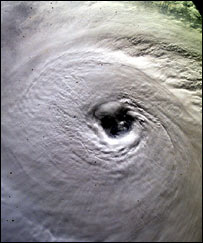 Now that even the most stubborn sceptics have accepted that human activity is causing global warming which in turn has potentially catastrophic consequences, they are still not convinced that the recent increase in the intensity of storms and the damages storms and hurricanes cause have any links to human activities.
The theory has been out there for a while. We know how hurricanes work: they are vorteces that spiral around the eye where the air pressure is very low. Warm, humid air from the bottom rises up in a spiral, while cool, drier air from higher up falls down the eye, as it gets sucked in by the low pressure. Hurricanes are born and bred over the sea and they will rapidly weaken as they hit the land, as they quite literally run out of steam, or the warm and humid air. The theory linking global warming to the intensity of the storms is that even a modest rise to seal water temperature would boost these systems, as the air down at sea level would be warmer and more humid.
While the hurricane season, incidence of tropical storms at certain time of a year, is a natural phenomenon that would take place regardless of human activity, the question is whether the amount and intensity of hurricanes have actually risen, and whether this is due to global warming (which now finally is accepted to be largely antropogenic, or originating in human activity). Showing that this link exists would have a major impact on the debate on climate change and what could or should be done about it. To be blunt, it would allow a price tag to be put on how much the American taxpayers are currently paying for the damage their carbon emissions cause. This, in turn, would help to put the costs of lowering those emissions into proportion and make the economic impact of carbon emission cutting more acceptable for politicians, businesses, and citizens.
So far it has been an uphill battle to show that a) climate is changing, b) this would have bad consequences, c) the change is our fault and, d) we can do something about it and finally f) we can afford to do it, in fact, we can't afford not to.
Recent studies, as reported by BBC today, suggest that the link between human activity and storm intensity exists. The researchers at Lawrence Livermore National Laboratory in California concluded that "84 percent chance that external forcing (such as human-caused increases in greenhouse gases, ozone and various aerosol particles) accounts for at least 67 percent of the observed rise in SSTs in the Atlantic and Pacific hurricane formation regions." SST means sea surface temperature, the critical factor in brewing strong storm systems.
So, 84% chance that two thirds of the rise of SST is caused by humans. Doesn't sound convincing enough? Well, to put it the other way around, it is very unlikely if not completely impossible that the rise could have happened without human involvement. And this is the crucial message to take home.
Of course, since climate research is a science, not religion, there is no such thing as "proof" and as the systems involved are mind-bogglingly complex (remember the chaos theory pet example of a butterfly fluttering wings in the Amazon causing hurricanes in the Gulf...) we will never get more than a probability and a theory corroborated by some data. A field day for sceptics, who can complain that the models are missing crucial variables, the results are not bulletproof, historical comparisons of measurements is dodgy due to lack of reliable old data etc.
But, the evidence is cropping up to support the antropogenic theory. And while the cost to deal with the issue is huge, not dealing with it is even more enormous, and is more likely to involve massive loss of human lives, not just inconvenience or loss of property. Just how much more costly it would be not to act, we are beginning to find out.
(Pic: BBC)
Monday, September 11, 2006
Thursday, September 07, 2006
Wednesday, September 06, 2006
Test the nation
 Good old Beebs run a national IQ test again. Some of you might already know that I'm against IQ testing because it is useless at best and often misleading, and gives people the wrong idea about intelligence in general, their own abilities, and those of others'. But as the whole thing was done under BBC Entertainment rather than their otherwise excellent science and nature section, let's look at it as entertainment.
As such, it was boring. Going through all the questions one by one, twice, was mind-numbing, and while Anne "The Weakest Link" Robinson is fab, the other host wasn't. He probably thinks he's the funniest guy alive, but unfortunately nobody else thinks so.
I liked the idea to bring a bunch of groups to the studio to do the test and be compared. There they were, public school kids taking on the state school kids, butchers battling it out with vegetarians. Estate agents are probably generally hated and considered stupid and useless, at least in relation to the fees they charge for their "services". Footballers wifes, or WAGs are modern bimbos that are known for their imaginative ways of spending money but aren't necessarily otherwise considered as the sharpest tools in the box.
The climax of the programme was when Teddy Sheringham's girlfriend confessed that she really, honestly thought that Winston Churchill was USA's first black president. It's anyone's guess why she thought he was the president of the United States, but she had a very good explanation on why she thought he was black: there's a statue of him close to where she lives, and the statue is... yes, black. Priceless... BTW, funny, how they all looked like clones.
I must make a couple of points about the actual methods and "scientific" content of the otherwise entertaining (not) show. First, I don't quite understand why they had visual illusions such as the Muller-Lyer illusion as test items. Second, as the programme was at parts trying to be educational, as there were two experts explaining the test items and what was being probed, they could have said a word or two about sampling (or I might have missed that in the beginning). The audience at home scored higher than average and higher than most studio teams, which reflects the availability of broadband at home, those with higher level of education are more likely to have it, and as we know IQ tests measure primarily your ability to score in IQ tests, and secondarily this correlates well with the number of years you've spent at school.
Finally, while the public school students scored the most correct answers, the vegetarians scored the highest IQ of the studio teams. This is because converting the scores to IQ points takes your age into account. Ageing is of course highly individual, especially when it comes to your mental age, and so the error from using a universal conversion table for everyone is likely to be large. The person in the studio getting the highest score was an old but very active lady, one of the vegetarians. The highest scoring member of the audience at home was funnily enough a policeman. The scale ended at 146, and both these and one of the celebrity quests scored 146, so there's a slight ceiling effect there. This is understandable, as the test gets very unreliable outside the score range that about 95% of population will get, between about 85 and 115.
As you'd expect, WAGs, butchers, estate agents and the studio team of "celebrities" scored lowest, the differences being very small. School kids are being tested constantly, and this was reflected in their higher scores. I suppose the vegetarians had a relatively high education level, and they were helped to the victory by the age-sensitive conversion.
Looking forward to the next one in a year? Not really, I prefer the Weakest Link.
(Pic: BBC / Wikipedia)
Tuesday, September 05, 2006
Social responsibility
 The end is nigh... A report by Oxford Research Group sums up the global threats and places them into four interrelated baskets: climate change, competition over resources, growing socio-economic divisions and global militarisation. There aren't any "news" in the report, it's just a nice summary of things most of us know are going on, and it does a good job in showing how they are all connected. The report is very anglo-american in its point of view, as it primarily aims to show that terrorism is not the number one global threat, contrary to what the news say in the UK and the US. In fact, the report claims that the global war on terrorism is not working and it is just exacerbating the real problems while failing to fix the ones it is supposed to.
But, What can scientists (or perhaps I'd better say academics) do to prevent the looming doom? Some are directly involved, as they develop cleaner energy sources, try to find a cure for HIV/AIDS, or try to solve the puzzles of global economy. How about the rest of us? Of course we all have options to act as individual citizens, through our choices as consumers, donating to organisations etc. But being in academia gives us something most others don't have. Credibility. For some reason, people think that professors and other academics are smart and when they say something it's more profound or important than when a teen-mom from Croydon says the same thing. Could it be the accent? :-)
Actually, academics often know very little about anything outside the scope of their own research and are often more ignorant about the goings-on of the "real world" than others. Regardeless, I think it's still a good idea to harness some of the brain-power of the doctorati to the good cause of saving the planet. Politicians have had ample chance to do it themselves but it doesn't look promising. Non-governmental organisations are needed as partners and people who know how to network internationally, analyse and synthesise huge amounts of information, generate theories and find solutions are needed. Sounds like jobs for scientists?
It's very rare that a scientific conference hosts a political meeting. We had one in the end of our conference in Bologna. The convenors made it very clear that we were meeting as individuals, the meeting wasn't part of the actual conference and none of the scientific societies present endorsed the meeting. ¨This reminded me of those licence agreements no one reads when installing new software.
About 10% of the participants attended, which must be considered an OK turnout considering it was the final evening of a week-long conference, and many people took the opportunity to visit the beautiful Bologna and perhaps do some shopping. It also felt a bit difficult to switch off the "conference mode" and so it was a bit "academic", and not many concrete results were obtained.
Everyone was challenged to propose actions that would take place by next conference in two years. I don't think people were ready to take that step yet, these things take a bit of time, and everyone needs to get some information first, look into options, find partners, use a bit of time to consider the best approaches and most importantly discuss the plans with their home institutions. In that way the meeting was a disappointment and I think the aims of the organisers didn't meet the expectations of the attendees too well. I was hoping to spend a bit more time on discussing how we are planning to work together for these goals. I expected some kind of a support network to be formed, some framework or structure, a website or a blog that would bring us together after the conference and help us to find more information, partners etc. I do realise that the projects we were expected to propose and commit to would be small-scale local projects and individual activism, and not institutionalised endeavours. It would be impossible to engage academic organisations for essentially political work, but I was hoping we could have set up a network, some sort of support structure and run that as a common project, without having to commit to the content of everything that goes on within that structure.
So, perhaps that could be the thing I could do? Plan, develop and propose, and then get involved in running and moderating this support structure. There are already plenty of organisations and networks of conserned scientists and artists, and if all the energy goes into running the frameworks nobody has time to do any proper work. But, we need a "homebase" within and across these organisations, and surely what needs to be done first is to raise awareness and offer tools for people who want to get involved but don't know how they could do it. The threshold for getting involved in social projects should be as low as possible.
But I guess I'd better write my thesis first.
(Pic: fragilecologies.com)
Friday, September 01, 2006
Causing scenes
Feeling a bit ashamed about the tone of the previous post already... It makes me look like such a stiff: a boring and humourless, one-eyed, cardigan-donning, bespectacled, obsessive-compulsive old fart who thinks everyone should read physics to understand how the universe works since without such knowledge it is impossible to function properly as a human being.
Be that as it may, but rather than talking about it now I'd like to divert your attention to this movement. The Improv Everywhere has been causing scenes for 5 years, and their latest, slow-motion shopping in Home Depot is hilarious, and so is the Cell Phone Symphony.
Brain melt
 I promised to write more about the social responsibility of scientists. I'm doing it at the moment (can you imagine a better way to spend a Friday evening?) but two current stories in HS made my brain go to irritational overdrive.
I was writing about how academics can and should do more than just their share as individual citizens to help humanity combat climat change, social injustice etc., because they have the credibility and the platform to influence others, and thus they can carry more weight than most people (will post it tomorrow). This is another reason why all the zero/pseudo-science is "harmful", as it not only tarnishes the reputation of the individual wacky hacks making formulae for dunking biscuits, but it eats our common capital of credibility as well. Also, every self-evident research result that gets published during the silly season will have an effect on how people feel about their tax money being spent on research.
Journalists, working at the interface of science and society, have their share of responsibility as well. There is often real research behind the bleeding obvious results, and there are critical questions they could ask to separate hacks from the real things. Too often the journalists are either too bored to do their job properly or they just like the silly soundbite too much to interfere with the entertainment with high-brow questions. Some might even feel they are doing a service to the society by showing how tax money goes into waste when you give it to humanists, social scientists or in general, to academics, and showcasing inanity or simplifying findings beyond triviality is their version of "critical science journalism".
The two stories illustrate the point. First, the longevity of your marriage depends on how much you want to stay together. We knew that already, before Tuula Pukkala's PhD thesis about this was published, or the story about the research was released. But, this tautologous triviality is not the main point of the thesis (haven't read it, I'm guessing based on the article and the press release), as it actually deals with a whole host of factors and points of view to marriage. The idiotic headline is made by the journalist who wrote the story about it, or perhaps it was cooked up by the editor. Unfortunately, it will be attributed to the researcher who indeed identified motivation as one of three factors that contribute to long marriages.
The second story: Professor Andrew Oswald of Warwick University has recently published research on how the political opinions of parents seem to shift to left or right based on the sex of their children: having a girl will shift them towards labour, while having a baby boy will make the parents more likely to vote tories. We are talking about correlations between 2 % changes in reported likelihoods of voting behaviour and gender of babies. Not exactly solid as a rock as findings...
In the story, the journalist admits that since professor Oswald is friendly and humble, and doesn't seem at all like a chauvinist or provocateur, it is easy to believe that his results have a firm scientific basis. Ahh... give me a break. Is that really the analysis? Since when was the relevance of research determined on ad hominem -criteria? Did it ever occur to him to ask questions about how prof. Oswald defends his interpretations of causality when the results are simply correlational? Or any interest in discussing how significant (not just statistically) the 2% effect is, in actual terms? Any comments about the reliability of the self-report method used to gauge the political opinions? Or, whether the results are just specific for the UK or could they be generalised to other European countries or internationally?
I don't want to challenge prof. Oswald's numbers or his dexterity in quantitative methods. And, his explanation for the findings (in short/bluntly: girls need more "protection" and so parents think more about how the society will be like, while boys are more competitive) sounds relatively plausible, especially since the research was conducted in the UK, which is notoriously conservative in gender roles. And he clearly is a serious researcher who's done important work on for instance happiness (so I'm told). But this study reeks of soundbite science and should be shot down for closer inspection by the journalists, as they have done in Britain. And not only by the feminist ones who don't like Oswald's news, but also those who care about the quality of social science and responsible use of statistics in it, and those who want to put things in perspective.
HS, the biggest daily in Finland, the one with the best resources and most credibility, has failed again, twice in one day, to write anything sensible, critical or vaguely interesting about research when given good opportunities. I'm purposefully being cruel and stiff in the case of the Oswald-story, as it is perhaps not supposed to be about his work, but about the person, and as such it is decent (difficult to tell from the on-line version, as you don't see the context in which it is going to be published on paper). But, the readership would have deserved better in both occasions. And so would the researchers themselves. And while these stories will not hurt the credibility of academia and university research in general, or even the credibility of the paper, they don't really manage to serve as the interface between science and society either.
Rant over, I'm going home to watch some silly DVD, to complete the process of turning grey matter into fondue.
(Pic: "Brain Melt" by George Curington; www.georgecurington.com)
Sunday, August 27, 2006
Conference over
It's done. Yesterday was the banquet to mark the end of the 6 day conference. It has been exhausting and tough, but also very fruitful. My talk went well, and people have come to me afterwards to tell that they'd enjoyed it, and of course to ask questions.
We had only 15+5 minutes, which is too short. Especially the 5 minutes for questions. People have flown it for hours from all the corners of the world, just to have 15 minutes to speak and the chance to answer 2 questions from colleagues they are not likely to see until in the next conference in two years time. And perhaps for that reason, the social side was so important - every coffee break and dinner was spent in discussions about current and future projects. Of course, under the italian sun, and the starts on warm nights, it is impossible and undesirable not to digress to all sorts of issues... And that is why, in this time of broadband internet, webcasting and blogging, we still make the effort to convene in a piazza somewhere.
The conference was of a good quality, although not ground-breaking. And the conference digressed as well, as in the end of it a "political meeting" was organised. We discussed the role of scientists in the world. I'll write about it later. Now I must go and see Bologna. It's very beautiful and so far I only know the route from the hotel to the conference venue, and I really would like to see more of it.
Monday, August 21, 2006
Political purge
Sorry, have to do this every now and again... Purge my thoughts about Finnish politics - or about the impression I get from the papers, when I have time to read them.
First, news just out: the parliamentary groups of the two main parties in the coalition government have started their summer meetings. These have to do with the state budget plus other policy issues for the autumn (I was tempted to resort to an awful pun and use the word "fall") - last before the elections early next year.
The Center Party has praised how well the coalition works, while the social democrats have praised themselves. Hmm. Sounds like a happy marriage.
While this was just a joke, there is a more serious issue that emerged last week. The social democrats will try to woo the green party voters by trying to profile themselves as an "environmentally friendly" party. This must be the world record of hypocrisy. As just one example, the social democrates, the workers' unions that support them and the leading faces of the party were the key players when Finland decided to build more nuclear power. And in general, these guys have previously only cared about "keeping the factories running" and even loathed the more eco-friendly knowledge-industry (ICT, services etc.) for being elitistic, not to mention opposing all environmental taxation, conservation and anything that might cause their contingency to "lose jobs". So, when their current head-honcho Eero Heinäluoma, the finance minister, preaches green values, it reeks of election tactics.
For instance, in the interview by Suomen Kuvalehti, he suggested that as Sweden tries to get rid of it's oil addiction by 2020, Finland should do the same, but by 2030. This means that we can start scoring political points on this, but as Sweden will try to do it in 14 years, and we set our aim to 24, we don't actually need to do anything for ten years. In 2016 Heinäluoma will be 61 years old and ready to retire, so he won't be there to carry any responsibility for this. I hope voters will see through this.
Bologna
 Ahh... I've decided again that I never fly Ryanair again. I had unfortunately bought these tickets already before my first ever experience of the budget airline, which made me swear never to fly them again. After today's endless queuing and delays I can renew the decision and hopefully now be more resolute about it.
This morning, at about 4.15 I started the journey to Stansted Airport to take a 7.15 flight to Bologna. Or actually, to Forli, which is supposedly at least a bit closer to Bologna than Cambridge, but judgeing my the time it took us to get from Forli to Bologna proper, not much so. With all the recent commotion about security, we were adviced to be at the airport two hours before the flight. We were there, and so were all the other passengers. But Ryanair wasn't. The check in didn't open until later, and then due to a conveyer belt failure they couldn't check people in, as their luggage was just piling up at the desks.
This was only the second or third time I take the express lane through security control, as I got my boarding pass only 5 minutes before the flight was due to depart. Of course I already knew that we weren't going to depart any time soon, as all the luggage was still piled behind the check-in counters. But, with Ryanair you never know if they will just take off without your luggage... As I got into the plane, they announced a 40 minute further delay. Having not had time for breakfast or even a cup of coffee in spite of early arrival to the airport I decided to try to sleep through it, which of course is difficult in the non-reclining seats. At least I had the leg room as I was sitting next to the emergency exit.
I don't know if it's funny or just sad, but they didn't have water in the plane. Some people were asking for cups of water while wew were waiting to depart, and all they could come up with was a cup of hot tea water with ice. The ice had of naturally immediately melted leaving the water lukewarm.
Finally we arrived, to a terminal which is almost as horrible as the one in Pirkkala, Tampere. The loos were in a container unit outside the building, for example... No frills indeed. The bus, as always, was much more comfortable than the plane, but we hit some standing queues on our 40-minutes-became-2-hours busride.
But boy, was it worth it! This city is so beautiful and charming.... It might be that not having anything to eat or drink for 15 hours made me a bit less critical than usually, but the food we had was also divine. I wasn't looking forward to this conference trip, partly because I haven't yet written my talk, but now I'm looking forward to it. More than 500 papers in 5 days will be tough, but the surroundings more than make up for it.
Also, the historical centre of Bologna is covered by a free wifi network... Very civilised.
(Pic: the venue of our conference)
Thursday, August 17, 2006
Look, a parus major, another, loads of them...
 I was doing some final planning of my experiment that I'm running today and tomorrow (not a moment too soon, as the conference starts on Monday...). As I was sipping the oilpan-boiled coffee I'd got from the campus buttery, I was sketching the various factors of my experiment to make sure I had all the bases covered and all the stimuli in the right place.
I needed to make sure that my two participants (t1 and t2 for short) were assigned correctly in the right conditions. So I started with an empty sheet of paper, jotted down the levels of factor 1 vertically, cross-tabulated with the levels of factor 2 horizontally, noting t1 and t2 to the various slots as I went along. And once I had managed to fill all the slots with with 't1' and 't2', I took a long sip of the coffee, glanced around the central lawn and the raised faculty building; builders at work here, a few people there, going to the library with their transparent plastic bags (UL is years ahead of Heathrow and Stansted in screening your hand luggage upon your entry to the premises), some early-bird tourists taking photographs of Lord Foster's Law Faculty building... Ahh, such a nice, early summer morning on the Cambridge Sedgwick site. Another sip of coffee and a glance to my satifsactorily filled notes - a page full of handwriting, seemingly repeating tits, tits, tits, tits, in a nice 5-by-5 array...
Luckily I managed to avoid choking on my coffee, and no-one else saw my Freudially (Freudianially? Freudistically? Freudianisically? in-a-Freudian-way?) loaded notes, and not many people were scared by my manic chuckles as I was heading back to the faculty squeezing my notes.
(Pic: Richard Ford, digitalwildlife.co.uk)
Monday, August 07, 2006
Milton Keynes
Ahh, the city of roundabouts!
We made a Sunday excursion to Britain's newest city. Unlike the other human habitations in Britain that still have most of their pre-Norman architecture in place (and in use), Milton Keynes is about two weeks old. It was built overnight according to a master plan involving roundabouts and shopping malls using a compass, a ruler, a lot of UPVC-glazing and concrete tiles.
It is the fabulous place where the indoor skiing facility is conveniently located next to an indoor beach, for maximum contrast. There is no city center apart from a huge mall. All roads are straight, named with two-digit codes and have a lot of roundabouts. In fact so many, that they don't need an amusement park, all they need to do is take their cars and drive around town. In about 30 minutes everyone is feeling sick enough.
It's a plastic town. While in normal cities you have layers of history, an old building here, a new development there, in Milton Keynes everything is new. While in most parts of the world there are buildings with some shops at the bottom and housing on the top, in MK there is a central mall and housing areas a few roundabouts away. While in other towns there might be some bare land, grass, gravel etc., in MK there is conrete, asphalt, and landscaped lines of trees with flowerpots in between. All placed according to a plan: this should look nice.
There is a football team in all English towns and villages. They were all established about a hundred years ago and have grown as the villages that fed them grew. They have changed names, getting the right to use the term "City" in the name after the town they are in grew up, were re-named "United" after two or more of them merged. In Milton Keynes, however, you have MK Dons. A club that used to be Wimbledon FC, got into financial trouble and was bought by businessmen in MK and replanted to a hockey stadium with plastic grass in it. I don't know how many fans they bought and replanted in the process, but it wasn't that many. Many people did the unthinkable and moved to support the old arch enemy, Wimbledon AC, that was playing a few leagues lower than the former FC.
MK is a weird experience. It feels very American somehow. I mean, the mall could be anywhere in America and is every bit as sumptuous and excessive. Shops, services, entertainment, and a matching number of parking spaces. Some housing areas are actually quite nice and the Open University main campus that's on the outskirts is very pretty. And I had a fun day, made some good purchases from discounts, and am actually a bit tempted to try the indoor skiing, but I can't help that I was feeling a bit weird, like there was something wrong. If that would be my "world", I'd be seriously thinking that I would be in a Truman Show or some other human experiment. It's too smooth to be real, too new to be charming and too concrety to be comfortable.
Any real town has the signs of the numerous compromises the planners have had to make over several generations - here it seems like one group of constructors has planned the whole thing on a tabula rasa. No problems with old buildings being a bit too close together for this, the roads being too narrow for that... No controversy, no quirkiness, no fun. MK is like adult-oriented soft rock, Michael Bolton (before hairloss), Eros Ramazzotti and Il Divo on tour, Helmut Lotti goes Shopping. All that white keys only, please drive carefully and buy 2-for-1 -niceness. I can stomach it in small doses only. Or perhaps it's the roundabouts.
Saturday, August 05, 2006
Summer reading
 One of the best things about summer holiday is that there's nothing to do. So there's nothing stopping you from reading, book after book...
Richard Muller-Freienfels (1941): Menschenkenntnis und Menschenbehandlung - Eine praktische Psychologie fur Jedermann I read this in Finnish, the translation is from 1953, and it was already 4th Finnish reprint. I found a German original from a German antiquariate web site, and that opus was printed in 1941. RMF's main work seems to be focused on soul and its mysteries - which explains why the only people who have ever taken him seriously (based on looking at who refers to the book) are some esotericists and art psychology people keen to explain how art is more than its physical features.
RMF:s writing is a collection of culturally-biased examples and rule-of-thumb types of solutions to anachronistic problems. It makes a funny summer read.
He can be counted as one of the cultural psychologists, and he was vehemently opposing the behaviourist school and their reductionism. While his Russian colleagues and contemporaries such as Lev Vygotsky actually managed to provide a viable alternative to the behaviourists, RMF - well, didn't. He is committed to the idea of a soul separate of the body, so it is unashamedly dualist, or Cartesian. He argues how important and special the human soul is and how we will never fully understand it, and how it doesn't reside in any of our physical organs.
Oddly enough, he then takes a full turn and a rather comtemporary view by explaining how our cognition is embodied. Not using those words, obviously, as they are a later addition to the psychology jargonator. And his argumentation for embodiment is OK, too bad he still insists on hanging on his dualist views... And as his starting points are skewed, the progress on the slippery slope takes him to funny places. He deals with graphology and physiognomy, believing in them as well as in the many sexist, ageist, racist and cultural stereotypes as useful psychological categories. Interesting, and even funny at times.
Oh, and not completely useless: I have to thank RMF for pointing me to Théodule Ribot's (1839-1916) work on attention. This is a glaring example of the black spots that are left when only reading stuff in English - I must admit that I don't even remember hearing the name before, even though he is considered as the father of French psychology... How sad is that. (Note to self: must do a literature search or two in French)
Dan Brown (2003?): Deception Point
Of course not all summer reading is high-brow, even if it's tongue-in-cheek. It needs to be feet-up and hands-down, also hopefully bottoms-up and eventually eyes-closed. So, I read a couple of thrillers as well. First, the best-selling book in Finland in May 2006: Dan Brown's Meteorite. I read it in Finnish, so some blame might go to the translator, but still I must say it was the worst book I've read in ages. I mean, most tabloids are more thrilling to read. On their bad day. The only consolation is that it didn't take me long to read, but it was still a total waste of time. It is also a waste of time to write any more about it, but I'll do it anyway. Might be that someone reads this and decides not to read it, and for that worthy cause I'll spend a couple of more sentences. The characters are one-dimensional, stereotypical and uniteresting. It's been a week now, and I can't remember one single character from it. I didn't really care what happened to them. From after about 5 pages I was sort of hoping they would all die very soon.
The plot is predictable and the screenplay style of the writing is annoying. With very short chapters that are like scenes in a bulk b-movie. And shorter sentences. Plus, the technical details and lists of things that are supposed to provide the credibility sucked. For instance, it just stands in the way of the story and annoys me if you list 10 symptoms of hypothermia when someone in the book is supposedly freezing. No, it doesn't make me symphatise with the character. In one word, this book is cheap. In another, it's bad. Don't read it. Ever. If it's the only book you have, burn it. I promise you, it's better that way.
Boris Akunin (2005): Turkish Gambit
Next book was by Boris Akunin, the second in the series of detective novels starring Erast Fandorin, a young, talented detective from St Petersburg. These adventures take place in the second half of 19th century, and have all the humour of Wodehouse's Jeeves stories, all the wit of Christie's Poirot's and all the suspence of Doyle's Sherlock Holmes, and it all takes place in the sort of 19th century jamesbond-esque international espionage scenarios. Brilliant stuff, brilliantly written. The characters are crazy, there are so many counts and barons and whatnot that you start losing track. Plots, schemes, conspiracies, lies, hidden identities and all that are abundant and the reader has to constantly update the list of good guys and bad guys (and gals). The only one you can trust is Erast Fandorin, very polite, determined and quiet character.
Ilkka Remes (2006): Hiroshiman Portti
So, Akunin has mixed genres, has crossed detective stories with tales of espionage and peppered the whole hting with humour and flamboyance. This already is more interesting than the techno-thriller that Brown put together. But, as Alistair MacLean and Tom Clancy have shown (and James Bond films continue to show), no matter how strictly your genre defines what you need to have in a book and how you write it, you can do it right, or you can do it wrong. Brown failed, but Ilkka Remes has succeeded. His new book (only available in Finnish so far), Hiroshiman portti (Gate of Hiroshima) is a good techno-thriller. It reads well, is not annoying even though it shows that Remes's team has done their homework of the details, and you actually only disentangle the plot in the very end. It is entertainment rather than "high" literature, but it works.
Karel Capek (1936): War with the Salamanders
The name of the author sounded vaguely familiar. But I never connected the dots until looking him up in wikipedia. Yep, he's the Czech science fiction writer who's credited as being the father of the word "robot". While the term was actually coined by his brother, Josef, Karel went on to write great books, including the "dystopian satire" that has been translated as "War with the Newts" as well as "War with the Salamanders". I read the Finnish translation, "Salamanterisota".
A Czech sea captain (yes, from the country that has as much coastline as Switzerland) discovers a new species of newts, finds them very clever, trades with them (knives to pearls), and things start to roll. International cartells exploiting a monopoly of newts, them being recruited to do underwater constructions in ports etc. And the newts spread around the world, learn to speak, write, do science... The title tells the rest. The book is very daring in its satire, and both communism and fascism get their share of it, and so do all European powers, industrialists and businessmen, and politicians. And while it was written just before WW2, it is still very topical and feels fresh. Partly because the themes it discusses are eternal, partly because the book is so well written. I especially liked the guy who worked as a custodian in the house of the indusrial magnate who financed the first pearl-trade operations. He blamed himself for the whole mess, because he had let the captain in to present his idea, even though he didn't have an appointment. Meanwhile, all the nations, politicians and businessmen were busy blaming everyone else...
(Pic: thegreekshop.com)
Guns, Germs and Steel
 Why are human societies in different parts of the world so different? Why do the Europeans and the North Americans have more than they need while many Africans have nothing? Why do some societies have very complex political and social structures while other peoples consist of bands and tribes and no central government? Some say it's genetic. They point out to the colour on people's face and make a racist conclusion that those with lighter pigment are smarter inside, and therefore their societies are more "advanced". Others conclude that if you live further north you need to build things to adapt to the colder environment or you die, therefore the countries in the North are richer than those further down south. This is the favourite explanation of modern Finns and Swedes but unfortunately almost as wrong as the first one.
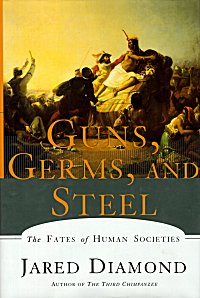
Jared Diamond provides a compelling explanation in his book. The book is almost ten years old now, and a bestseller, but for some reason I hadn't read it before. I must say that I hadn't really given much thought about the "civilisation-level" dynamics of world dominance, apart from playing Civilization myself... But, I've had more interest in the individual and small group cognition and "intelligence". And so I've refuted racist claims that tap into these issues without trying to find alternative reasons from the large-scale dynamics.
For instance, some people claim that there are IQ differences that are associated with "race" or nationality. I've not wasted much ammo to showing how tedious the whole notions of "race", ethnic group or nation are, instead I've gone straight to attacking the validity and reliability of the IQ-tests themselves. There are several problematic issues about them. First, they (and there are various around) only measure a narrow band in the vast spectrum of human intelligence. No matter how narrowly you define "intelligence" (leaving out for instance the now fashionable "emotional intelligence", which BTW is a stupid term as such) you will still end up with a definition that outreaches the test's subject matter. Second, they are very culture-specific. The whole idea of pen-and-paper tests is very Western, but even beyond this slightly patronising notion, the tests fail to cover what's considered significant or natural in other than the Western schooling/oriented societies. Even within our societies the test only manages to measure stuff you learn at school the way you learn to learn at school; and, the way you have learned to be tested on stuff you learned at school. That's why you can't even directly compare scores from different times. The scales are adjusted following the overall rise in schooling in the population.
So, if you can't really use the test to compare how smart you are compared to your 15 years older cousin, how can you possibly compare scores across continents, to people who don't share your language, have different societies and schools, and value different things? In short, you shouldn't. The IQ tests also only measure your current performance which might differ from your actual abilities because you're tired etc. The test results have been shown to change along with your arousal level, and for example when you get to listen to your favourite music prior to the test you are likely to score higher points. The test results always need to be taken with a pinch of salt, but the pinches for cross-cultural comparison would need to be so big that they would constitute an unhealthy dose.
I'm babbling again, but as you see, nowhere in here do you need to actually answer the counter-arguments most racists are too stupid to make, but that have influenced them in the first place: the human societies are vastly different in today's world, others are undeniably more advanced, with almost any measure (not only the elusive IQ; I say almost any measure because "happiness" seems to correlate somewhat negatively with "wealth" which correlates positively with health, education, level of technology use and other measures that usually are associated with "development"). Diamond answers to those claims. He shows how today's uneven situation is a result of historical trends over at least the last 13 000 years, and that these trends were molded by environmental factors, not differences in the faculties of the people who make up the populations of these societies. He poses questions like 'why was it the Spanish conquistadores who with a relatively small troops in short time conquered the Inca and Atztec civilisations after 1492, and why didn't Atahuallpa's Incas sail to Portugal and Spain and take over Europe instead'.
The parts that are most detailed and convicing are his explanations about domesticable plants and animals in each of the continents. He sees the transition from hunter-gatherer lifestyle to agriculture as the main driving factor, as this allowed people to release some of their time from providing sustenance to themselves to innovation, political organisation, war, etc., and also motivated them to develope technology, tools and larger structures (such as irrigation and castles etc.) as they didn't need to constantly move with all their possessions or use all their time collecting food. As it turns out, the Eurasian continent is by far the richest in plants that could be (and eventually were) domesticated, and similarly boasted the best selection of domesticable large mammals, essential for agricultural lifestyle as providers of food, power, hides etc. But this is only the start, what follows is the interesting bit.
So, the folks in Eurasia had cows, pigs and sheep while the South/Americans only had their llamas. What is interesting is the fact that so much of the "technology" was adopted from others and so little was self-developed. In the whole world, the main crops were domesticated only a few times, the rest of the people got them through trade and conquest. Again, Eurasia won the race as everyone else very quickly adopted the cereal crops and animals that were domesticated in the Middle East. Here comes the second environmental accident: as the main axis of the continent lies in the east-west direction, the length of the growing season is more or less the same across a wide area, which facilitated the spread of the plants, animals, and pleasant life at the countryside. Much more effort was needed to trasfer crops in north-south direction due to rapidly changing circumstances. These, Diamond argues, are the ultimate causes for the different trajectories of human societies, on their way to becoming the haves and the have-nots of today.
Oh, the germs-part might need an explanation. Pizarro and the other conquistadores didn't need a big army, as they had people who carried smallpox and other deadly diseases. These diseases wiped out much of the population in those ancient, Southern and Meso-American empires, including their emperors. Not much was left to conquer, after the little bugs had done their part. These germs originated from the animals that European peoples shared their shelters and living spaces for thousands of years, and while they did their damage in the European populations as well, the Europeans had already developed some resistance to them, over the thousands of years of exposure. The incas hadn't, and the result was almost a total annihilation. This was unintended biological warfare, and another "gain" coming from the domesticated, settled lifestyle and the combination of animals there was initially available or easily adoptable. Malaria and other tropical diseases in Africa and Southern Asia are of course working "against" the Europeans, and as a result these areas were colonised much later, with the aid of modern medicine and the instant "adaptation" they provide to these illnesses.
The picture Diamond paints is compelling and manages to convince the reader of his main point: geographical features of the continents and the environmental "accidents" are responsible of the "ultimate causes" behind the different trajectories of the development of human societies around the world. He sees the increases in complexity of human societies a direct result of increased population size, increased technological standard as a direct consequence of the available resources and time to exploit them, and the transition from hunter-gathering to agriculture as the major shift in the history of humanity. At his timescale of 13000 years and his scope of the whole world this might be (at least for a 400+ paged popular science book) fair enough. It is however important to also look at what he leaves out.
In human evolution (which of course takes place over longer timescales than what Diamond looks at, and it can be argued that no significant evolutionary changes have taken place at least during the last 30 000 years) the emergence of language, tool use etc. have been posited to much of the same causes that Diamond discusses. Growing population sizes, food availability etc. have been seen as factors that have on one hand driven evolution as it exerts a pressure to select for certain traits, and on the other as the consequences of these evolutionary advances. Now, with this mill churning for thousands, even hundreds of thousands of years, humans had overtaken the world from other species, and thus it was the humans domesticating the pigs and not the other way around. Just as the evolution tends to be a complex mixture of forces and factors creating consequences over longer timescales, the later developments within the species homo sapiens sapiens are similarly increasingly complex.
If it's not the genes, it's the environment, but how about cognition? The early humans developed cognitive abilities far more complex than any other species, and these skills seem to be inextricably linked to the social environment of the individuals. Language, theory of mind, intentionality, music... just name any cognitive ability that humans seem to be especially good at and I show you how it benefits living together in larger and larger groups and more and more complex societies. While Diamond would argue that there are no significant differences between the cognitive capacities of a modern hunter-gatherer in Kalahari and a university professor in Cambridge, and I would agree, it would still be interesting to see how the different development trajectories were influenced by the ways these "universal" cognitive capacities were used in different places. Diamond discusses different languages and to some extent religions on a very superficial level, but leaves the rest of it to others. Of course, these are only proximal causes, as he says, not the ultimate ones, but I firmly believe that while all humans share the same mental machinery we use it in very different ways, and those differences are interesting and important. I don't like our understanding of our most fascinating organ and at the same time our understanding of ourselves as humans to be solely driven by research on Western brains and their users.
Finally, as I opened provocatively with comparing "Western" riches to African poverty, I must emphasise that any understanding of the causes of current distribution of wealth on the earth can not be taken as a valid excuse to leave things as they are. Europeans, not Africans were the ones to colonise the others' continent, and the development leading to the differences in the societies until then can be explained by Diamond's factors. But what happened then and keeps happening now was caused by political, military, and religious decisions and deliberate choices rather than "forces of nature", and the responsibility of those decisions still lies on the hands of the nations that took them.
Moreover, just as cultural evolution took over biological evolution as the shaping force of the humanity, the industrial and technological revolution should take over environmental and religious determinism and we should fulfill our moral obligation to rid the world of poverty and undue suffering. We are the first generation that can afford to do it. I believe that we can't afford not to.
Jared Diamond 1997. Guns, Germs, and Steel: A Short history of everybody for the last 13000 years. London: Random House.
(Pic of the cover of the original edition, published by W.W.Norton & Company Inc.)