The genre was supposed to be as dead as the cold war. Battling for world domination against a communist regime but having to do that in the dark provided a great setting for Bond and other agent heroes. After 1990, it was the former Soviet generals gone AWOL, rogue media moguls and assorted terrorists, but none really had the same potential for developing saving-the-world -stories than the combined threat of Soviets and SPECTRE used to.
While covert action seems to be taking the spotlight again, the new Bond film has taken the story back to its beginnings.
Let's face it, Bond was tired. Lack of ideas led to forgetting the character and just focusing on the brand: Bond cars, Bond girls, Bond theme tunes, Bond gadgets, the Bond storyline with the evil genius and his plot to take over the world, his underground lair that gets blown to bits in the end. The main character just needed to deliver the witty and chauvinistic lines, introduce himself in a trademark way and go through the moves looking suitably blazé.
While Bond was going through a midlife crisis or perhaps was sitting at a desk at Vauxhall Cross filing inter-departmental performance reports for meeting government guidelines on transparency and accountability, another hero was revived: Robert Ludlum's Jason Bourne was brought to big screen. The focus was in the man himself, a trained superagent with special skills but a hazy purpose. As he was fished out of the sea, there were no gadgets or cars to begin with. He couldn't introduce himself in a trademark way because he didn't remember his name. But there was a story, turns in the plot, and you didn't know how it would end and there was at least some ambiguity as to who the real bad guys were.
In Casino Royale, Bond returns to the head of the main table in agents dining hall and dwarfs every other secret agent out there.
If you haven't seen the film yet, go now. Go see it on big screen, it's worth it. If you don't think Daniel "The Blonde" Craig makes a good Bond, go see the film before judging him, you're going to like him. If you saw the trailer and didn't like it, don't worry, go see the film anyway - it's much more than the trailer suggests. If you usually don't like Bond films, go see this one, it's a proper film with a proper plot and all those kinds of fancy things. They even hired a director who directed the actors and made them act, not just some bloke to coordinate the explosions and car chases.
Most importantly, Bond is not just a shell, they've made him a real character. As the story is based on Ian Fleming's first Bond-novel, and it follows him through the first missions as double-0 agent (you know, they are the ones with licences to kill), there's more scope to make him vulnerable, fallible and human. This doesn't mean he's not every bit as charming, self-assured, efficient and strong. It's not the Bond for the emo-types, au contraire. It just makes the whole thing more believable, more unpredictable and more exciting. If anything, Bond is more hard and tough, but only partly because of the job, and partly because he doesn't want to show his weaknesses. That's at least two dimensions of a character, and it's one more than we've used to seeing in agent thrillers.
Best Bond ever.
(Pic: © imdb.com)
Thursday, November 30, 2006
Bond reborn


Wednesday, November 29, 2006
Sunshine
 For the record, the weather is wonderful today. Just so that I wouldn't be blamed for constantly dissing the local ambience. East of England is the driest part of Britain, and there are several sunny days every year.
There. Positive posting about the English weather. I'm wondering how many times I'm now allowed to complain about wetness, coldness or fogness... or maybe there's a time limit, I get a free trial period like with cable tv: three months of free weather complaints, absolutely no charge! And like with the cable tv, there's probably a section in the small print that explains how "absolutely no charge" translates to £49.99 per month and how you've actually signed for 3 centuries and not three months as you thought.
So, how's work? Slow. There's a lot of inertia around this week, and everything seems to take a lot of effort. Getting up in the morning (this is not surprising) and everything during the day and even going to bed in the evening (this I can't explain at all). Perhaps there's something in the air. They should add this to the weather forecasts, just like they do with pollen and UV radiation. "Stronger than average inertia can occur in the East of the country, with occasional showers of procrastination and indecision. This will clear by next week, as more proactive air flows in from the South."
This is the week when teaching stops. It's been a ridiculously busy 8 weeks of term, and now it all comes to an end. For me, this means that supervision reports need to be typed, final essays marked, and schedules and plans made for next term. Also, I'd need to come up with some "holiday work" for my supervisees, and I'm not at all sure if spending much time in coming up with interesting and well-framed tasks is worth the while, as they probably won't even look at their books before they come back in the new year, and then scrape something together in the 3 hours before the next supervision. Me cynical? Slowly but surely. :-) Anyway, given that there's an odd chance that at least one of them might do some work during the 6 week break, I'll try to come up with something challenging and interesting.
Monday, November 27, 2006
World's slowest Monday
As I've mentioned, Monday is my new favourite day of the week. The full working week ahead, and so much that can be done and so many things that I can dream of finishing by the end of the week.
Well, today's been so slow that I don't even dream of anything, and definitely not about finishing it. There has been absolutely no brain activity today, I can only read two rows of text before I totally drift away, and I remember nothing of what I've read. I'm struggling to write understandable sentences and therefore put off any email writing I'd have. I'm not alone: out of 6 students that I have, only 2 returned their essay in time, which means that rather than marking them today in time for tomorrow's supervision, I'll need to spend time on them later this week, or whenever they get around to writing the bloody things. It seems that everyone is getting totally drained by the dark, miserable, wet, gray and annoying weather, and the demands of the last week of the term.
At least I managed to help a colleague of mine who had a data analysis issue. That made me feel somewhat useful, even though the problem was a clitch in software and shouldn't have been there in the first place.
Friday, November 17, 2006
Not my day
 It's just not my day. Usually you'd say "I wish I never got out of bed". But, in my case, I wish I'd got out of bed earlier.
Sometimes I sleep in. Today I did. Not only do I feel guilty about it, but I have great difficulty to get the day started at all if it doesn't start properly. And today it doesn't. As my girlfriend is visiting Finland, I'm left to my own devices. The device that didn't work this morning was the alarm clock.
So, it was late (almost 11) when I managed to get up. A bowl of porridge, my usual breakfast, would hopefully get me going. Well, it did, but in a wrong way. It got me cursing as it boiled over and messed up the microwave.
I'm not going to mention the horrible weather, because predictably it was raining this morning. So, after struggling to wake up, having burned my fingers in the scalding hot water when trying to wash the porridge off the bottom plate of the microwave and in- and outsides of the bowl, I headed out to the refreshingly moist and invigoratingly cool outdoors. Our bike shed is under renovation. As it's now two months old, they need to replace all the sideboards, doors and drains. Quality building work. It has 5 compartments, and the builder had decided to set up shop at the one where I keep my bike. After a bit of a wrangle, I managed to get the bike out, carefully lifting it over the debris, table saws, axes, hammers and power cords.
And then the typical Cambridge traffic. Men in their white vans, speeding and trying to knock over as many Chinese students swaggering on with their low-ride bikes as they can, taxis loading and unloading at junctions, pedestrians crossing streets at a whim, without looking, buses too large for the lanes powering through the ranks of students plodding from a lecture to another. The usual stuff.
Finally at work, and going through my normal routine of news- and blogreading before starting work proper, I found this. I found it at MusicThing, and liked it a lot, and decided to link it here. I went to the YouTube site, logged in, and already wrote a cheery entry about how this saved my day as I found it both witty and skillful, not to mention original (perhaps the best compliment you can make these days). Then I found out that since I changed to Blogger Beta, the link between my YouTube account and blog that allows me to embed videos with just a couple of clicks doesn't work anymore. So, I needed to delete the old association and add a new one. Then I found out that Blogger has a huge delay and signing in doesn't work at all, and so the association can't be built.
Now, finally, Blogger works, but the YouTube-association doesn't. So, you'll need to follow the link to see the video.
Meanwhile, I'm starting my work proper, and hope that me having a bad day means that Nick is having a great one, as his viva voce examination is today and he will pass the final hurdle in becoming a PhD. Balance of karma, or something. Not that he would need any luck, he's our star.
Edit: just went to a library to return two books. And of course, what started as a loan had again turned into a rental, and I had to fork out £6 in overdue fees. £6! That's ridiculous, this library has probably the highest overdue fees in the country, and of course the online-renewal system most libraries here have, doesn't work in this one.
As I was heading back, my bike key broke in the lock. So, I had to get a janitor with a wrench to bend and twist the keystub in the lock to open it. Of course, now I can't relock it, so the inevitable errand-running thing I have to do this afternoon will take about an hour longer as I must walk everywhere. Even locked bikes are stolen en masse in Cambridge, I don't even want to think what would happen to an unlocked one. Especially if it's mine, especially today. I've now put my bike indoors at the faculty, of which I'm going to get told off, as that of course isn't permitted.
Edit2: So, I went to run the errands. The rain has picked up, and now it's pouring, and so I'm soaking wet. The main reason for having to go out now was that I needed to renew a prescription. There were two items I had asked for, insulin and test slips for my blood sugar meter. The insulin, which the pharmacy had plenty, was just so I don't need to go again before Christmas. The slips, which the pharmacy had none, were the original reason for the renewal as I will run out of them during the weekend. So, after completely soaking myself and waiting for about an hour, I need to go back tomorrow morning to actually get the bleeping slips.
I don't know who wrote the hideous Christmas song that has the most annoying chorus that says something like: "we're all having, a wonderful Christmas time". It doesn't have a verse at all, as the song consists of repeating this chorus-bit about 154438 times. I wish that whoever wrote this and everyone who has ever recorded this song would be slowly disembowelled with a blunt and rusty penknife and then chopped to minuscule pieces starting from their toes. And whoever decided to play the extralong live version of this song while I was queuing for the non-existent slips at the pharmacy should be made to perform this operation, as s/he clearly has the sadistic tendencies required.
Tuesday, November 14, 2006
Supervising
What makes Cambridge education special is the amount of individual attention each undergraduate gets, in one-on-one or small group supervisions and tutorials. As the more senior academics are responsible for the courses and papers, it's often the graduate students or junior researchers who supervise the learning in between the lectures, make student write essays, check that they do the required reading and in general keep up to speed with the courses that usually cover huge amounts of material and issues.
The supervision system reflects the dual structure of the university, as the papers are organised and lectured (and eventually examined) by the university department, while the supervisions are paid for and organised by the colleges. There's no fixed method or content, or even a set amount of work you need to do in the supervisions, and so two students taking the same course might end up doing very different amounts of work and focusing on different issues in the course. Of course within the theme of the paper and the main content, set by the lecturers.
Tuesday is supervision day for me. I try to get all the supervisions done on Tuesday so that it frees the rest of the week for the infamous writing up. It works ok, apart from days like this when the supervision goes spectacularly wrong and manages to ruin the whole day.
I had three groups of 3, or actually one group of 4 and another of 2, as one student needed to switch because of other things. While one of the groups was ok and the discussion lively and dynamic, the other meeting was just a drag. For some reason, I didn't manage to explain anything properly, got messed up into nitty-gritty details that have almost no significance in the big picture and in the end I felt I had just confused people rather than being helpful at all. And I felt all drained afterwards, and have no energy whatsoever to read, write or do anything.
So, now I'm off to a seminar where I'm just going to focus on the wine and pringles (the other special component of Cambridge education), as I didn't manage to read either of the two texts we are supposed to discuss. And I actually liked one of them. The other paper I didn't like, the problem being that it's difficult to relate it to anything as the authors almost exclusively quote their own earlier work rather than anything anyone else might have read. They've created a bubble of their own and are happily within it, just replicating their own work and finetuning the experiments etc. Good luck, let me know if you decide to link it to anything in the real world.
Tuesday, November 07, 2006
Freedom of speech
 As a follow-up of the previous slightly messy post on web debates, today's post is about the Reporters Without Borders and their annual list of countries that violate freedom of speech online. In these countries, bloggers, online journalists and activists are harassed or imprisoned. The list is shrinking - it's size is down to 13 from 15 last year. Check out the online freedom of speech campaign site and show your support.
The list (in alphabetical order):
- Belarus (151)
- Burma (-)
- China (70)
- Cuba (66)
- Egypt (70)
- Iran (105)
- North Korea (-)
- Saudi Arabia (70)
- Syria (93)
- Tunisia (51)
- Turkmenistan (142)
- Uzbekistan (151)
- Vietnam (111)
On another but related note, Transparency International published their ranking list of countries according to perceived levels of corruption. Finland, Iceland and New Zealand top their Corruption Perception Index, and are therefore the countries that people see as being the least corrupt. In the Finnish news this is usually taken as an ego massage, and passed on as the good news of the day, but without really thinking about what this means. As I've said, I'm really proud of this Finnish achievement, much more so than any medals we've amassed in the driving-cars-fast-around-a-circle-until-bored-to-death -championships.
Freedom of speech and low corruption go hand in hand, although they are different animals. Corruption can be said to be a result of lack of freedoms of expression. The numbers in brackets after the list of freedom of speech violators are the Transparency International CPI rankings. "Lack of transparency" as a concept sums it well, and transparency is provided not only by having clear policies and rule of law, but also by having journalists and bloggers around to expose those who have wronged. The best way to reduce bribes, lubrication money and gifts with strings attached is to make the risk of getting caught high enough, and the punishment public enough.
Another, even more significant factor fueling corruption is poverty. The poorest country of the world, Haiti, is at the bottom of the list, while the countries on the top of the CPI list are all very rich. If public administrators are skint and there's no money to pay proper wages for the police etc., they are likely to abuse their position of authority and supplement their income by charging extra for their services.
But, it's not that simple. Russia, where freedom of speech has recently been hit hard by concentration of media ownership, harassment and even murders of journalists, has a strong tradition of corruption as well, but has enjoyed strong economic growth for a while. Even with a boom in economy and relative stability of government, the brown envelopes still change hands often enough to merit a dubious 121th position in the rankings. The Finnish-Russia border has been dubbed as the largest economic gap in the world; it's also the largest contrast in terms of corruption - a challenge for the border routines. In China as well, the economic boom has first resulted in increase of corruption, and now they are getting measures in place to curb it, and even very high party officials have been indicted. The problem is, at the same time freedom of speech is still going downhill, as if those in power were afraid that bad press would damage the economy.
One problem is that freedom from corruption is taken for granted in most European countries, so is freedom of speech. They usually only appear in speeches and policies, mentioned when you need some really high principles to associate yourself with. Unfortunately, it's much easier to praise one's own country for doing well on these than it is to start concrete action to improve the situation in places where problems arise. Short-term economic and political gains far outweigh the moral loss of dealing with corrupt regimes. I guess someone should calculate the value for freedom of speech and clean reputation, just like Stern et al. have calculated the value of environment.
Take Belarus for example. A country twice the population of Finland, located about as far West as Finland, except for being 500 kilometers more southern. Minsk is closer to Berlin, Paris or Brussels than Helsinki. Its area is almost the same as that of the Great Britain. Yet, we know nothing of it, and most Belarusians only know of us what the Lukashenko regime tells them. A country that is at the center of Europe is a reject, backwater black hole of a country, due to totalitarian and corrupt rule, without any transparency or freedom of expression. And we've been unable to do anything about it. I think we haven't wanted to, not enough.
(Pic: thanks to Khalidah Mufleh, found it on her blog entry about freedom of speech)
Monday, November 06, 2006
Teaching
 Ahh, dreams... I had one last night. I was teaching a class. It started as a relatively advanced class, as I was giving people essay topics. Or actually, I was trying to match each student with a topic they know most about. As the lesson progressed, we moved from writing essays to me teching them the alphabet... And still, I was explaining to someone how I liked teaching very much as seeing your students learn and progress is so rewarding!
Thursday, November 02, 2006
Web debates
The social dimension of the internet is getting more and more important. Even the "old media", newspapers etc. who publish their news and other "print" material in the web, have adopted interactivity and are combining the traditional editing/publishing models with "new" interactive possibilities of the web. This means, that in addition to printing the news you'd otherwise read in the newspaper, you can now discuss in the forums operated by the publishers. So, in addition to organising information in a web-sensitive way (by interlinking documents and sources of information) these services now allow different ways of social engagement with the information, in addition to the traditional transmitter-receiver -model.
This is not just an extension of the good old "letters to the editor" -function that most newspapers have provided and still do, it's more about having a social way of making sense of the events and news provided by the service. The same news can be covered in so many different ways, depending on your "ideology", background and opinions. In Britain, your choice of newspaper tells quite a lot about your political views (or lack thereof if you read pretty much any of the tabloids). For example, whether tax cuts are good news or bad news depends on your political views.
Social networking is the hot thing right now. MySpace, Facebook, Orkut and countless other sites are growing at an insane pace, as people sign up and create their own pages and then link them to their friends' pages, join communities and discussions etc. There's a very "teeny" sense of competition, as the number of contacts serves as a quantifiable measure of your site credibility, but these sites have real importance as well, Orkut seems to be popular among young professionals especially in India and in Brazil, while MySpace has been used as a promotion channel for musicians and bands. Facebook has focused on college students and has lately been used more and more as a recruitment tool by companies.
All these websites and other forums (and of course online games) allow you to connect with people from around the world, and that obviously can have positive effects. But, I have grown very skeptical about these lately.
This could just be phd-angst, but I'm annoyed by discussion forums, most comments on some of the blogs I occasionally read (TechCrunch, for instance), and the behaviour of people on these places in general. It seems that the option to comment or to interact has increased people's willingness to talk, but nobody is listening anymore. It's not rare to have 5 people say exactly the same thing in comments to any post on TechCrunch, for instance. Also, these discussions tend to get more polarised than ever in real life, so rather than bringing about compromise and understanding they tend to just "radicalise" people or at least their internet personae.
In the Helsingin Sanomat website the new feature is to link news with discussions on the HS forums, and the first comments are shown underneath the news. And from those you'd think that most readers of the paper are cynical right-wing bigots. I try to think of them as sad unemployed bald little men sitting in front of their computer writing their little rants here and there, but they still can ruin your day. If there's something in addition to prejudice and racism that I really hate, it cynicism. People so often confuse it with being analytical and critical, and it often blends with incessant and equally intolerable smugness.
Anonymity is an opportunity, as many people couldn't openly share their views under their real name. It can also act as the great equalizer, you can be respected based on your opinions and argumentation rather than title or status. The former issue is actually very important for freedom of speech and development towards (hopefully) democracy in the otherwise oppressive countries. But, the good idea of having a freedom from status and personal history and benefit of being judged by actions not appearance is spoiled by people who don't know what these freedoms are for and why they might be important. Being anonymous is for some people the same as being irresponsible. Most of these people spoiling other people's fun or even useful projects are probably American or European teen-aged boys testing their limits.
Wikipedia is a good/bad example. Allowing anonymous editing has resulted in bitter editing wars in most political or politically sensitive topics, or topics that are related to religion. There's a parallel project now, called Citizendium, where anonymous editing would not be allowed and there would also be editors who would have decision-making powers on what to edit and how. I heard somewhere that wikipedia was contemplating disallowing anonymous editing as well, not sure if I was dreaming or if it is happening or has happened already. It seems that the idealistic paradise of an open and universal, socially, racially and economically "blind" internet is never going to happen (even within the societies that can afford mass-access to web), and balancing control with freedoms seems to be important.
Great sport
 I thought this was a joke. But it seems that they are at least taking the joke seriously.
(Pic: wcbo.org)
Tuesday, October 31, 2006
Is this loud and clear enough?
The Stern review report on climate change was published today. Undoubtedly it will be discussed a lot, its message will be understood as well as misunderstood and as always, what will be done in the end is a whole other question.
The review was commissioned by the Chancellor of the Exchequer (finance minister in the rest of the world, one of the coolest titles you can ever have) Gordon Brown, and the purpose of the report was to look at climate change from the economical perspective. The review group tried to answer the following five questions: what are the risks and costs of the impact that climate change has; what are the options for reducing greenhouse gases and how much they cost;what policies and strategies should be developed for mitigation of climate change; how should we adapt to the inevitable changes and how should this adaptation be financed; how do the processes of mitigation and adaptation work in the international level.
In short: what's going to happen, what should we do, who should do what, and how much is it going to cost and who's footing the bill.
Where this report is successful is that puts things in terms that all politicians and business managers will understand - money. It's hard to put a price tag to your lifestyle, especially if that lifestyle involves the countryside in any way. Also, it's difficult for a consumer in England to see a link between their car driving habits and Bangladeshi floods. So far, putting things in terms of how many degrees the temperature will rise has failed as spectacularly as in my recent example on effects of bad diet to life expectancy. Just as people prefer to party hard when they are young and not to worry if they live one or two years less, people generally think that if temperature rises a few degrees it is actually a good thing. Both are dangerous fallacies, as the report reiterates, and putting things is more direct and concrete terms works. The doctors should have said that so many thousands of people more die at the age of 40-50 rather than 60-70 due to their diet and lifestyle in North of England than in the South. Similarly, the Stern report says that if we do nothing now, the cost could be up to 20% of global GDP by 2050, whereas if we act successfully, the cost will be as low as 1%.
To illustrate the 1% cost, it would mean that the economy would continue to grow, but at a slightly slower rate, so that the level we'd reach in 2050, we reach in 2051. Putting it this way and it doesn't feel like an insurmountable cost. Of course this way of calculating doesn't take into account the "finding" of the Stern report that the business-as-usual model would actually end up being so cataclysmic and costly that constant economic growth would be impossible.
There are of course caveats, and they have to do with the huge variance in the predictions of different climate models, and the natural inertia of the atmosphere, which means that any change now will take a long time to take effect. What this report is successful in doing is that it says that we need to act now, and we need to do it internationally, and the costs are not that big compared to the risks we face with inaction. Also, the report states that economic growth can still be sustained even
So, switch off those computers and TV's for the night, unplug your cell phone charger when not in use, and take a train instead of a plane at least once. It's the least we all can do, no statistics needed.
Sunday, October 29, 2006
Weekend
Turning the clocks back... Already, how can that be! I thoroughly enjoy this day, as it gives one more hour before having to get up. The bad news is, it is now practically the end of the year. As it says up there, the final year of the PhD... Well, it is, the problem being that the thesis is nowhere near being ready. I know a lot can change in a short time, but I'm beginning to think I'm counting on it too much.
Am I waiting for a miracle to happen, and the thesis to write itself over a couple of all-nighters? Not really. Am I progressing steadily towards completion by writing a little each day? Definitely not. The truth lies in between those two extremes, the miraculous crunch and the sensible smooth. I think I will be spending more and more time in front of my computer, binging here and there, and after a while there will be something to show for it. Meanwhile, days are running past faster than ever.
Tomorrow it's Monday, my new favourite day of the week. The new beginning, the new "now". It'd better be good...
Friday, October 20, 2006
Veiled faces
 The biggest issue at the moment in Britain seems to be the integration of muslim communities to "mainstream" population. The threat of home-bred terrorism materialised in the 7/7 attacks, and ever since then everyone has been balancing on a tight rope between prejudice and safety, tolerance and segregation.
Just like many times before, as the discussion moves from abstract principles to concrete proposals, the focus is be turned to something relatively irrelevant, but visible. This time it's the veils some muslim women wear. They come in many forms, but the discussion is now about the niqab, the full veil that covers everything but the eyes. There was a big controversy in France a few years back about veils in public schools, and now the issue is being hotly debated here. Jack Straw, the speaker of the commons and former foregn secretary opened the game by insisting that people who attend his surgeries at his constituency office will need to reveal their faces. Other ministers soon showed support, Tony Blair for instance admitted that he thought the veil is a sign of separation and thus it is understandable that it will make other people feel uncomfortable. One substitute teacher was suspended for refusing to remove her niqab when teaching English, and the school claimed this was depriving the pupils of proper education, as seeing the mouth when learning languages is essential. The court supported her, awarded her damages for victimisation and instructed the school to remove the suspension.
Here's my 5 pence to the discussion. Perceiving faces is special. We have specialised brain regions for perceiving faces, and latest research shows that so do chimps. Infants show preference for faces over other shapes very early. In a way, one could say that faces have a prioritised shortcut in our perception, just like human voice does, and all this is part of our fine-tuned primacy for social relations and sociality. We are social by nature and nurture, and our faces are the most significant part of the system of communication and mutual understanding we have. Hiding your face is a very strong statement, as it renders all these systems obsolete. Darwin was a frontrunner on this field as well. In his 1904 book, 'The Expression of Emotions in Man and Animals', he drafted a theory about emotions, their links to physical states, and how they are communicated via postures and facial expressions. He drew similarities between animals and humans, but also showed differences. Paul Ekman followed up with this work, and even today many psychologiests still use the same set of faces in their emotion studies that Ekman used in his ground-breaking studies. (BTW, you should check out the new edition of Darwin's EEMA, which is annotated by Ekman - fascinating read).
Also, it is no coincidence that the Big Thing in artificial intelligence at the moment is expression ' of emotions. The Japanese have done this for ages, their idea of 'kansei', or emotional engineering, has given them the lead in AI and interactive bots. Human communication and interaction is not just about exchanging information, large part of it is about emotions, expressions, and so called phatic communication, keeping the channels open, ensuring that the two conversants are "on the same page". Facial expressions, nods, grunts etc. are important when determining if the other has understood what we are saying and we can then move on in the discussion.
I'm not saying that there is scientific proof that you cannot communicate properly with a veiled person. I'm just saying that it is not a wonder that people feel they are lacking a dimension when talking to a veiled person. It's rather like discussing with someone over a telephone, and we all know there's a difference. I haven't ever tried to communicate with someone with a veil, so I don't personally know how much is missing. Also, I need to emphasise that to understand the problem is not the same as to agree with the proposed means to overcome it. Also, I see a huge difference between asking a muslim woman employed by a publicly run school to reveal her face to the pupils she is teaching and the request by "random" men to remove it in front of them. The first is reasonable and can be enforced, the latter should only be seen as a kind request which the women should be allowed to turn down. Common sense and sensibility, one would think.
Personally I feel that the full veils, niqabs and burkhas, could be banned from those holding public jobs, and schools could have the right to ban them from their pupils. Headscarfs and various other kinds of "modest" dressing up on the other hand should be accepted, even though some people would like to go so far as to forbid all kinds of religious symbolism. Sikhs wear their turbans and that's fine (even the armed forces give them the provision to do so), some catholic nuns wear their habits, which again is fine (understandably no need for the army to say anything about this :-) ), and some muslims wear headscarfs, which again should be ok, just as is jewish people wearing their bangles or kipas. I think freedom of religion should mean that you can accommodate to both the customs of your faith, and the customs of the society at large. But there seems to be a need to draw line somewhere. It's the uncomfortable difficulty of drawing the line that has put people off, and so instead made them favour the full ban of any religious symbols. One BA flight attendant was forbidden to wear a minute cross visibly. Political correctness gone mad, I think, and any full ban will just propome segregation, and make integration impossible.
I realise in the case of the veil there is a problem for some people, as they see the hijab as a sexist thing, a form of oppression, and I recognise the need for everyone to give in and help finding a middle ground. For instance, I am not fully comfortable with the full veil either, as I resent the notion of being stereotyped an being a sexual predator jus for being a man. The origins of the hijab are of course in Quran, a book I know precious little about, but what I've understood from my friend Wikipedia, the idea is that as a muslim you (men and women) shouldn't dress so that it draws the sexual attention of the opposite sex. Again, times and fashion changes, and what is needed for drawing sexual attention with it. What was considered modest a century ago would be overdoing it nowadays. While I wouldn't mind someone getting some sense to the heads of those young girls that go around wearing practically nothing, or those boys who go around playing pimps and gangstas and groping their own crotches, I also don't accept the notion that the only way to hide from my or anyone else's predatory eyes is to wear a burkha. We need more communication, not more walls, not even as thin as silk, to prevent it.
(Pic by Jon Heras and Lakshmi Harihar, www.bluesci.org)
Wednesday, October 18, 2006
Language barriers
 Funny thing that, language. It's funny how language competence is very domain-specific, especially when it comes to the languages learned later in life. Finnish is my mother tongue but I wouldn't dare give a talk about my work in Finnish - I simply lack the vocabulary. When I've been making grant applications to Finnish foundations, the most difficult bit has been to write abstracts/summaries in Finnish.
I've almost completely forgotten any French I learned at school, although I'm sure it would come back after a brief activation. Same goes with Swedish. Occasionally I've tried to use Swedish here, with fellow Scandinavians, but I find it very difficult. I think I speak better Swedish in Finland than I do here. Switching to Swedish from Finnish is OK, but having to switch between two foreign languages, Swedish and English is for soem reason very difficult. I just end up speaking English workd with Swedish accent, and it's so comical that most Swedes will just have mercy and switch quickly to English. :-)
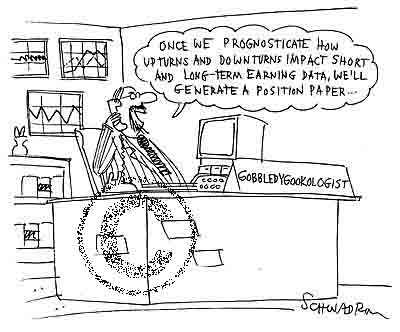
And there are some things I still can't do well in English. I discovered one of those things today. I can't get my jargon-generator and spin-engine to work in English. After a few years in politics in Finland I am pretty good at writing stuff that sounds impressive and important in Finnish. You know, stuff you'd put on reports, advertisements, web sites or funding proposals. How the "new institute has a proven track-record on capacity-building in various international contexts and how it's research output has attracted wide interest and how it intends to strengthen its multi-disciplinary connections and continue to attract the best talent by offering courses of unparallelled quality and scope with a strong individual focus and insight on the development of lateral skills..." You get the idea. It just doesn't seem to work, and flow. I've tried to write a chapter on the future directions of our research centre, and I find it very difficult. Would be easier to do that in Finnish.
There's a fine balance between a slightly sexed-up description that says all the right things and conveys the view of an exciting future, and horrible pretentious and clicheic bulls**t. I wonder if I got that right...
(Pic: cartoonstock.com)
Tuesday, October 17, 2006
One Day in History
 Today, hopefully thousands of people contribute to the British Library blog and help them record "One Day in History". You can also sign a declaration and post your views about why history matters, but that's an ongoing campaign. Tuesday, October 17th 2006, they wanted people to upload their blogs, or just write about their day, for the future generations.
Here's what I wrote.
A working day at the Faculty of Music in Cambridge, as usual. Seems that a PhD student trying to write up never gets a day off. Even at weekends the voice inside keeps nagging to me... It used to be that Mondays were the awful, as the whole working week was still ahead, while Fridays brought relief. Now it's the other way around - Mondays feel OK for the very reason that the whole working week is still ahead, while on Fridays you realise that yet another week has passed without not much visible progress. Time surely flies, as the deadlines crash one after another... Graduate guilt - must end soon.
Today was good, though. Progress in work, finishing some reading I needed to get done. More importantly though, the first supervisions for undergraduates taking the "Introduction to Music and Science" -course. Teaching is great, as you get to interact with people rather than just immerse yourself in your own world. It's also like mwoing lawns or sweeping footpaths - you get an immediate gratification for being able to answer the students' questions.
Now I'm preparing for a seminar - some dynamic systems stuff on interpersonal interaction, how body movements of two interlocutors can be plotted together and analysed in dynamic terms and then it shows how they are synchronised... making the obvious visible in quantifiable terms. Interesting but might be just a fancy and complicated way of telling what everyone knows already. but if that's what it takes to convince a cognitivist that communication is about bodies and that the meaning is constucted in human-human interaction, so be it.
It's also my father's birthday, so I called him - they are in Lapland, and I'm not at all envious... Oh, I must remember to write a blog entry about the One Day in History to my own blog as well.
Thursday, October 12, 2006
Microsoft update
 It was Patch Tuesday this week, and so Micro$oft rolled out a new set of security patches. I hate Microsoft Update. I had severe computer problems when at the conference in Bologna, and the culprit turned out to be Microsoft automatic update that had hanged. And today, I've lost a couple of hours of good work time getting my laptop and the desktop I use at work updated.
Especially the laptop (running XP Professional) is a mess. It takes absolute ages. And I hate that a) you need to use IE to update b) you need to lower the safety and privacy levels for it to work c) you first need to add the windowsupdate.com etc. to your "trusted sites" list. Funnily, normally the IE7 trusted sites function comes with the "only allow secure (https) servers on this list" -option checked, but you even need to uncheck that, as the windowsupdate is on non-secure server...
Most computer users know to expect security updates on the second Tuesday of the month. If not from anything else, from the stories in the press that start to mount every month about a week after the Patch Tuesday that there is a yet another new vulnerability identified and perhaps Microsoft should speed up the release of the next patches and not wait for Patch Tuesday. And usually Microsoft refuses, because it wants to keep thigs clear and predictable.
Oddly enough, then, the Microsoft automatic updates thingy doesn't know about Patch Tuesdays. It shouldn't be too problematic to program it to check for updates on the morning of the second Wednesday each month. But, alas, it doesn't. It usually wakes up to it's task when I'm already manually updating the computer via IE, causing the whole thing somehow to slow down. I'm not sure if that's what happens, but I only manage to update my computer by turning the automatic updates off completely for the duration of the download and installation of updates.
On my old computer the microsoft update page didn't work at all. I occasionally downloaded updates manually and installed them, but since the process is supposed to be automatic, it is not easy to find which updates you have and which you don't. Also, you have no choice but to download and install every stupid update, even if they are for porgrammes you never use, like the abysmal Outlook. I once tried not to install the ones I thought I didn't need, but the automatic updater never stops nagging about it until you give in and install everything. And finally, now that the updates and security patches are installed, Firefox and Thunderbird are no longer set as default web and mail applications. Luckily these two can restore the setting when I restart them. This is yet another reason why I like Macs more and more...
Wednesday, October 11, 2006
Chimps are people too
 Check this out. The host, Danny Wallace is a loudmouth and does this partly tongue-in-cheek, but he is discussing a very interesting point: Chimpanzees are not human, but are they people? This is something the BBC is pretty good at: the follow-up of the programme broadcast yesterday is on the web, and you can see the main points and give your opinions. I saw just a part of this yesterday (because CSI was too engaging...), but it featured some interesting experiments with chimpanzees in captivity, and ground-breaking research among wild populations. The "usual suspects" were at play, the labs in St Andrews and Max Planck Leipzig are the main hubs for comparative studies in cognition.
The most interesting parts to me were the experiments on cooperation and culture. I'm not really impressed by the fact that we share a lot of our genes with chimps, as we also share a lot of them with tapeworms and algae. Brain size and physiological comparisons are somewhat trivial, and I'm not too impressed by the stuff done on language learning (with Kanzi or other human-reared animals for instance, reported at length in the show). But what gets me is the capacity for culture, and the complexity of mind required for collaborating and sharing goals, organisation and goal-oriented planning.
As was discussed in the programme, humans wouldn't really be people without the social relations to others, without society and culture. A bunch of tissues becomes a person largely due to the upbringing and learning by other humans. The complexity of human society, its achievements (in good and bad) are the result of generations of humans having been able to cooperate and learn. Language was the key to this process, as information needs to be transmitted from indivudual to another to share responsibilities in a task, and from a generation to another, to give the offspring a better start to life, but language is still only a tool; the interesting bit is how that tool is used.
This is the hotspot of research at the moment - animal culture and collaboration. Only a while ago, it was suggested that animals didn't possess a theory of mind, the understanding that you have thoughts and beliefs, and so do others around you. Now new research suggests that this isn't the case, and most of the subsequent demarcations are falling down as well, as more and more sophisticated experiments are pursued. Cultural learning has been demonstrated, as well. There are issues with these experiments, and the debate is hot about what they actually prove, but in my opinion we are clearly moving towards accepting the idea that in terms of cognition, the difference between humans and apes is more like the difference in degree, not so much a difference in kind.
(Pic: BBC)
Sunday, October 08, 2006
Sine qua non
 Educated people like to flex their mental muscle so that others around them can see how wonderfully smart they are. One of the best ways to prove your worth (and silence others) is to quote stuff, preferably in Latin, or in ancient Greek.
I remember a cartoon by the late Kari Suomalainen, The Political Cartoonist of his days, where he criticised the show-off yuppies for toting their mobile phones in public in order to look cool. This was at the time when they were so expensive and huge that only the rich could afford them and only the strong could carry them. In the cartoon he says: small bosses show off their mobile phones so that people would think they are big and important. But big bosses don't have mobile phones, they have secretaries. Spot on.
And, there's also an inverse relationship between the size of your briefcase and your status. The smaller the case, the more important you are, as you have someone else to carry all the files for you, while you only need the case for the actual contract. Or, if you are important enough, like the Queen, you only have a small handbag and never have to carry anything else.
And it goes with the education and upbringing and enculturation as well. If you have something really important to say, you don't need to shout. If you are smart enough, people will notice it without you telling them, and there's no need to try to make others look stupid so that you could stand out as the smartest. Actually, truly wise people make other people in their presence feel smart, not dumb.
I'm not sure where I'm heading with this. I think I wanted to say that there are different ways in which you can try to change the world. You could climb the ladder of power, use sharp elbows and in general silence everyone who doesn't agree with you. You make "your way" the only way, and make sure that those who don't recognise your wisdom will feel stupid. This is the zero-sum game of life: if you have something, other's can't have it. Therefore you must take it from them in order to get it. The have's and have not's.
Or, if you believe in added value instead of the zero-sum, you can try to inform people, get them to make up their own mind, equip them to analyse and come to their own conclusions. If what you are doing is smart, they will see that and support you. Or if they don't agree, you can learn from them, because you might be doing something wrong. Says the idealist.
Whether it is democracy or science, openness and acceptance of other people's opinions is vital. You can not advance either of the two unless there is some sort of a core of values, a method for discussing competing evidence, a method that ensures transparency and at the end of the day accountability. Drawing analogies between how society and science work is an old hobby of philosophers, Thomas Kuhn's writing's about the structure of scientific revolutions is possibly the best known for us. But, you could also say that one could not survive without the other, and either can survive for long unless they both subscribe to the principles of openness, transparency and accountability; the method being simply the freedom of speech.
The freedom of speech is the sine qua non of both democratic societies and progressive scientific communities. There's my latin quote. It was the one thing that came to my otherwise empty mind when I, in disbelief, read the sad news. Anna Politkovskaya was one of those writers whose stories are so important that they have a need to be heard. And now, they will be heard even louder. Every loudspeaker is made of a vibrating element and a resonating box. A coffin as a loudspeaker; it is so very sad but also true.
Her torch will hopeufully be picked up and carried on. Without Anna Politkovskaya and her stories there is no Russia.
Friday, October 06, 2006
Happy New Year!
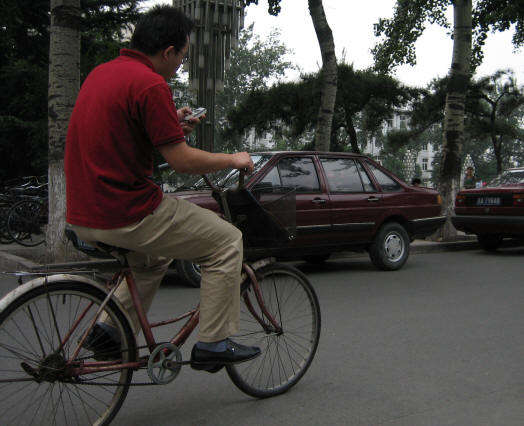 The new academic year has begun. This means that the city has again come to life, as thousands of students are frantically going from event to event and induction to another, finding their place in the social soup of Cambridge. Eager to add new people and groups to their Facebook profiles, they're all contributing to the manic feel the city has at the moment.
And there are so many societies and clubs. Literally hundreds, 40 more than last year, at least if presence at the Freshers' Fair is a good indicator. They were all there, from the macho alpha-males of the university army/navy/airforce clubs, sportsmen and -women from tennis to tiddlywinks, the international societies (including the Finnish Society, of course) and a number of other societies, groups, initiatives, projects and clubs. There they were, the palefaced velvet-corsetted CU Goth Society reps, alongside the inbred-looking folks of the University Heraldics and Genealogy society. I suppose the Ramblers' Society and Hillwalking Club reps needed to explain people what the difference between the two was, as they were next to each other trying to encourage people to go for walks with them.
All this in a sports hall full of people after freebies, drowned under staggeringly loud bad popmusic. Anyone would be dumbfounded. And yet, as the evening comes, they all roam the streets of Cambridge dressed as angels, demons, pirates, schoolkids, or in their pyjamas, heading from one society squash to the next college bop, and then to the afterparty by a drinking society, in order to meet people and learn what the Cambridgin words "squash", "bop", and "drinking society" mean.
Next morning, nobody is out before 10. And when they are, they are blocking the streets with their new bikes and stopping in the middle of cross-roads reading the maps upside down. Nothing wrong with that, but I still feel I would like to stop and tell them that if they would rise the seat in their bike a bit and pedal with toes rather than heels, they would be going faster where ever it is they are trying to reach. This style of cycling that I call the "Chinese swagger", is very common especially among the Chinese contingency. The seat is at its lowest setting, regardless of the height (or lack thereof) of the cyclist, the heels are on pedals, and the knees are pointing outwards, just like cowboy's, also so that they wouldn't hit the cyclist in their face. As this is a very uncomfortable, slow, and unstable position, the bike swaggers along the cycle lane incontrollably, but you can't pass as the whole thing is so wide and could be turning across the lane at any time. Well, at least the student discounts are back!
(Pic: brianf.com)
Friday, September 29, 2006
Great Divas
 Why do we even have male singers? Who likes them? Who needs them?
I'm looking at my iTunes library and Sting is pretty much the only male singer there, and definitely not for his singing, just for his songs. OK, there is Lenny Kravitz who seriously rocks, and R.E.M. / Michael Stipe, and U2 with Bono, but there we go again to the songs rather than the singing being the "beef".
Could be that it's just because I'm a guy and like girls in general, but I think in jazz this should be a strict rule: female singers only. The various cringe-inducing scatting franksinatras can take their scooby doos and scaba dahs and go to Country Clubs and sing to the overweight and post-middle-aged matrons. And wear a thong for tips.
But, as I'm passing the evening hours at work trying to finish a paper, I'm being mesmerised by the great Divas. Ella Fitzgerald, Nina Simone, and of course the unfortunate, delicate and spellbinding Billie Holiday. How can Lady Day sound so strong and so fragile, so harsh and so tender at the same time? The list of amazing vocalists goes on: Aretha Franklin, Patricia Barber, the contemporary Billie Holiday-soundalike Madeleine Peyroux, Diana Krall, Susheela Raman and on the more pop-py side, Patricia Kaas, Eva Cassidy, Lisa Nilsson etc.. They rule.
And even though all these songs have lyrics, I can easily ignore them and just listen to these voices as instruments, wrap their smooth sounds around me and keep tapping the keyboard in the dark, autumny evening.
If you haven't already, go and buy Verve's Ultimate Diva Collection. Now.
BTW, thanks to DJ Bunny for most of these songs and having a great voice herself.
P.S. Found the exceptions to the rule (the general rule, not the jazz-one): Jeff Buckley and Rufus Wainwright. I listen to both because I like their voices. Funnily, both are (or in Buckley's case were) gay. :-)
(Pic: William P. Gottlieb)
Wednesday, September 27, 2006
Funding
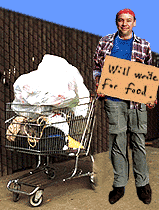 Agghh, I guess nobody likes it, but I hate it. Asking for money. Which involves filling in applications, writing research proposals, polishing the CV, asking people to be your referees and then printing, copying and mailing everything somewhere, in X copies.
The most awkward part is the asking for referees -bit. This means asking for professors, supervisors and other very busy people to write a couple of pages of praise of you and your work for some other busy people who are not likely to read it anyway. Putting overworked and underpaid people under even more stress so that you can also get to be an underpaid and overworked person for a while.
It's that time of the year, the new academic year starting and deadlines for every possible source of funding coinciding with this nerve-wracking season (great planning, whoever is responsible for this...). I'm only trying to find someone to pay for my last months as a PhD now, but soon I'll need to become a professional beggar to secure a post-doc somewhere. Not looking forward to that process at all.
(Pic: www.lonelyplanet.com)