The restlessness in Belgrade is of course big news. And so it is the number 1 news story in the Finnish Channel 4 news, as well... and their angle is the Eurovision song contest. They've uncovered that the organisers (at EBU) are keeping their eye on the events but are at the moment convinced that the preparations for the contest are on time. They also interviewed some of the Finnish competitors, and even they didn't believe this was Ch4's take on the shocking events. They were trying to make comments about how the first consideration are the people in Belgrade and in Kosovo, wishing for a quick resolution to the tension etc., but the journalist pressed on and wanted to know if they were ready to travel to Belgrade if they were picked as the Finnish representative.
Same company, different medium... Afternoon newspaper, massive headline on Friday: Don't get sick in these countries!! And then they list the countries where hospital treatment costs the most, if you DON'T HAVE INSURANCE. For Pete's sake, who travels without insurance? That would have been a better take for this story: give an example of how expensive treatment and evacuation might be if you aren't covered. In pretty much any country.
Finding the solid core from all the mush is getting harder and harder, when even hard stories are being wrapped to layers upon layers of fluff. Yes, I'm a bore.
(Pic: icanhascheezburger.com)
Saturday, February 23, 2008
Rubbish


Concepts
One of the blogs that I read, Yankodesign, often posts about designer concepts rather than actual products. Sometimes it makes you wonder what the concepts are for. Too often you see the un-innovative and plain lazy "fusion" concepts, where you take two seemingly unrelated things (like an MP3 player and a hairdryer) and combine them. Design/steal a shape for your "new concept", use a 3D-software to render pretty pictures of this thing and Bob's your uncle. You probably will get your study credits and 15 seconds of blog fame, but that's it. The problem is, although it is new, it is probably useless.
There are a number of reasons why some products don't yet exist. They might be unnecessary or plain stupid. Not everything needs an integrated MP3 player or videoscreen. Hairdryers, shoehorns and soup bowls do fine without them. Not everything needs to be called iThis or iThat. Not everything needs to be white and green or round and translucent. In short, these concepts are often trying to solve problems that don't exist; they are asking the wrong questions.
Then there are the tweaks: teeny-tiny alterations to everyday objects like plates or chairs, meant to add or enhance some part of their functionality. Unfortunately often sacrificing the original functionality.
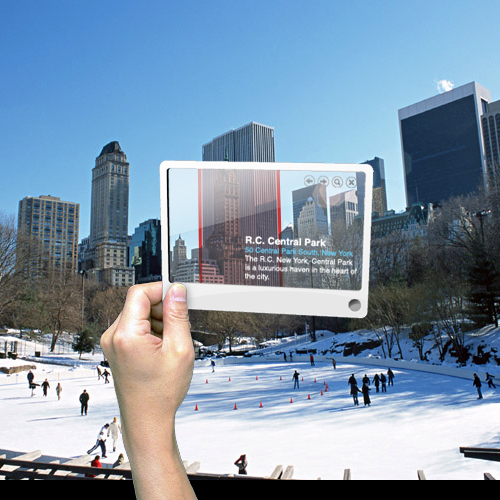
Sometimes, however, a concept comes up that shows exactly the opposite: a new purpose, new functions. This mobile internet search device is one great example. Anthony James of Yankodesign calls it "the Looking Glass". It's a great name and I like it because it's a great concept of what could be. It's not about mimicking a trendy line of products, it's not spinning cliché design vocabulary. It's a great example of innovative design because the looks of the product are irrelevant. Actually, it's not so much a concept of a product, it's a concept of a platform, or an interface.
It is an internet tablet, combined with a camera, WiFi internet and a number of other components. The idea is that you look at the world through this and it displays you information about what you see, based on what it finds in the net about it. Point to a monument, the camera takes a snapshot of it, GPS locates it, the picture is analysed, compared to the info on the web and then relevant information from wikipedia and elsewhere is displayed. Point it to a restaurant, it could display the menu and let make a reservation. Point it to an office and it will find you contact details to the company. Point it to text and it tells you where the text is from, which typeface was used and what colour. Etc. The possibilities are absolutely endless. Try it yourself: how many uses can you come up with in a minute?
What would it take to build one of these? How far in the future is this concept? The designer Mac Funamizu sees this in the NEAR future, and hardware-wise it is not that far. I'm actually more interested in the software-side. According to many commentators in the designer's site, many big companies are working on similar concepts already. The information integration that would be needed for this thing to work is what the so-called semantic searches and ontology projects are trying to do. Or, what the web 3.0 will be about, to use web 2.0 terminology. While developing better search engines is of course a task noble enough to drive innovation, research and business ventures on the field, these kinds of products are needed to capture the imagination of people and to give these products clear and inspiring aims and applications.
That is what great concepts are about.
(Pic: petitinvention)
Friday, February 22, 2008
Celebrating the Semicolon
This is a wonderful story. I don't know which is cuter, that the NY Times would write an elated story about a punctuation mark, or that they had to append a correction after missing a comma in "Eats, Shoots & Leaves". But they are absolutely right. Semicolon is an indicator of certain "depth" in thinking about writing. One of the first comments I got for my writing from my PhD supervisor was that I should learn to use it. Not for the depth of it, or even style, but there were a number of points where I should have used it instead of the period or something else. Folded ends of toilet rolls in hotels, magnetic power chords in Macs, semicolons separating phrases. Signs of civilization.
read more | digg story
Wednesday, February 20, 2008
Do you Digg?
Swarm intelligence, emergence, social networks and all that jazz. After Google started ranking search results based on essentially what people think is important, crowd opinion and popularity has been an important factor in trawling the sea of online information for the tuna of knowledge.
So-called social bookmarking is one way of facilitating this. And now, after they've been around for a few years already, I'm jumping on the bandwagon, or at least taking it for a spin. Why now, why not earlier? Well, when it comes to news, I have my habits. News for me isn't just about being up-to-date, it's about the ritual of reading it. It's about the sense of being in control, the familiarity and connection that I have with the trusted news sources.
One of the best things in life is opening a fresh newspaper on the kitchen table, with a cup of steaming coffee on one side and a bowl of porridge in front of you. The physical paper is an important part of that ritual, and a ritual in itself. My broadsheet comes in 4 sections, with one extra section on Fridays and Saturdays, and two extra sections on Sunday. These extras are taken aside first, and read last. I read a section at a time, skipping much of it but basically starting from the beginning. Etc. Everyone has their way.
Reading online is a different ritual. By reading news from just a few selected sources gets you close. I revisit the news site a number of times during the day, depending on the levels of procrastinatorfin in my blood and being familiar with the sites I immediately see if there's something new or if stories have been updated. This is important, every site has their own logic in displaying news headlines and unless you know how it works there's no way of knowing what you don't know yet.
But too much routine is soo middle-aged. And as an early sign of an emerging mid-life crisis I'm trying to break my online news-reading ritual by customising a google news page and signing up to Digg. And that's the funny box on top of this post as well, now these ramblings can be linked and "dugg". Now both my readers should sign up for Digg and click the link there, as the more times a story is dugg the higher it climbs in the rankings and the more often it gets offered to people as relevant news. We all might need to set up some fake accounts, but only a couple of hundred diggs usually gets you on the lists. :-)
Actually, the reason to this is just the curiosity to learn how these work. While I haven't had much use for these, millions of people have, and from the point of view of social cognition this is important. And also, I wanted to see if expanding to about 10 000 sources instead of the 3 I normally use would open new perspectives or be useful at some level.

Friday, February 15, 2008
Ignorance
It's so easy to laugh at the ignorant Americans, like that girl who thought Europe was a country and was surprised to hear Budapest was in Hung(a)ry, a country she had never heard of. Unfortunately this isn't, by any means, a phenomenon limited to the US.
It might be true that (for instance, us Finns) we don't have quite as many stupid TV game shows exposing people's ignorance in front of cameras on an hourly basis; it is probably true that we are less outspoken and open than Americans and therefore say fewer stupid things; but the basic attitude Susan Jacoby and others talk about in that NY Times article is there.
For instance, motivation for learning languages at school is plummeting. This is probably due to the ubiquitousness of English, and fewer people see the point of learning any other languages. They'll probably regret this later on in life.
In a recent study by Danske Bank on financial literacy it transpired that less than half of 18-19-year olds know what interest means. Six out of ten couldn't pick the cheapest of three alternative loans. No wonder all sorts of companies have started to offer short-term (very expensive) loans you can take quickly by just SMS:ing their number.
This loaned money goes to pay for nights out, buying new clothes or gadgets, and more and more often to pay out old loans. To me this reeks of wanting the results without putting in the work. It definitely isn't fashionable to push yourself, especially intellectually.
And this is amazing, given all the hype there's been lately about innovation and top quality in universities. Here as well, people are looking for quick, magic solutions. Making administrative changes, trying to solve problems with money (by taking it from one place and promising to put it to another) show how shallow the understanding of what makes top quality research and education is. At the moment, the actions that have been taken to push the quality of the Finnish university system have always involved either whole universities or even combinations of them. Larger is better, that's the philosophy. Well, to some extent it is, but "university" as such is the least important administrative level for achieving high quality. Research is carried out in departments or groups, teaching is planned and administered in departments and degrees approved by faculties. No matter what the "university" does, unless its parts do well, there's no quality.
And "success" at the university level is no guarantee of success in the department or faculty level. There are bad seeds in even what are considered the best universities, and great units in the bad ones. Most of the ranking-lists (like the Shanghai list) rank universities, which is useless information from the point of view of research and teaching, and should be for higher education policy, as well. What should matter is comparing faculties or departments within disciplines (although just ranking them would be stupid, a proper evaluation is much more productive). Of course, the macro-level (national and university-level policies and mechanisms, especially funding and quality control) needs to be healthy to allow the micro-level units to strive. But no matter how smart the macro-level policy is, it can be wrecked by bad decisions in or about the micro-level, or, at the university level. Like changing the quantitative funding indicators to cut funding from a faculty that quality-wise has been awarded three national centres of excellence. This of course has to be an imaginary case, no one would really do that, right?
Thursday, February 07, 2008
Of course
I got a delivery today. A spanking new 20 inch Mac Cinema Display. And oh boy, does it look great! (not just externally, but the picture is brilliant, too)
The funny thing is, when I was plugging it in to my laptop, I had a problem. If I close the lid of my laptop, it goes to sleep. But, I know it is possible to use an external keyboard, mouse and display and keep the laptop closed. So, how to do this? I remembered seeing a menu somewhere, where you could change the action for closing the lid. I didn't find it, so I googled. The first hit was on Apple's website, and it had a list of instructions. Plug in computer and display. Done. Plug the DVI, USB and FireWire of the display to the computer. Done. Power on the computer. Done. Close the lid. Wake up computer using the external keyboard or mouse, and the Cinema display wakes up, the laptop display stays asleep, and the screen resolution will automatically be adjusted to fit the Cinema display.
Of course. It was so much simpler than I thought. I should have known it was all automatic, nd not try to be too smart for my own good. This is great. Now if I want more desktop real estate, I just pop up the laptop screen and actually have 17'' plus 20'' side by side, which is very handy for data analysis, so that you can run the analysis on one screen and display graphs and results on the other.
Tuesday, February 05, 2008
Musical universals

They play South-Indian classical (Carnatic) music, which is as intricate and complex as any classical music can be. Western classical musicians practice for a lifetime, Indian classical musicians train for generations. Dr Subramanian, for example, is a vina-player in the 9th generation.
I always listen to Indian classical music with somewhat mixed feelings. There's the feeling of being outside, a feeling that's in stark contrast with how I feel with "Western" classical music, where I'm an insider. A symphony concert is very familiar to me, I'm "in" in all the jokes, tricks, scripts, and know all the nuances and can tell if someone's excellent or only very good. In Indian classical music (or Chinese, Japanese etc...) I can hear and appreciate the mastery of the players and the complexity and subtlety in the music, but I don't really know what it "means".
On the other hand, music is universal in the way it moves you, enchants you, teleports you from this time and place to somewhere else. And there tonight's performance just worked like magic.
(Pic: vina or veena, by Ingsoc)
Wednesday, January 23, 2008
Department staff meeting
There's a newspaper clipping pinned on the notice board of the research lab in Cambridge where I used to work. The columnist writes about leadership in academia and management in the universities. He concludes that while the most common metaphor for what the VC or rector does is that of steering a ship, the university in fact is not one big vessel but a massive flotilla of ships, boats and dingies of different sizes and descriptions. Each of the boats have their own captains, and they are ready for a mutiny for even very small things. MOSTLY for the very small things, I might add.
To extend his analogy, it seems clear that some of the boat captains won't take orders from the admiral or are steadfast in doing exactly the opposite. Many captains also never talk to their crews. From the central administration's point of view, even establishing communication links within or between the boats, or between the admiral and the boats is challenging (I, as an academic and a Navy communications officer can attest to that), not to mention trying to get the whole carnage of boats (this is a new collective noun that I'm suggesting, it used to be a fleet of boats, but based on experiences from Cam, this is more accurate) to move in the same direction.
Why is it so difficult? Well, to start with, the selection of people for leadership positions (at all levels of uni admin) is based on rather unhelpful criteria: usually there are none, at least none that have to do with the ability to do that work. The personal motivation to take up one of these positions falls into one of these three categories:
1) they made me do it, because it is my turn
2) I'm a power-hungry bastard
3) I'm so frustrated with admin interfering with my research that I've decided to avenge by starting to interfere with the admin
None of these are especially good motives, and none of these feature in the top 10 ways to impress in the job interviews (luckily there aren't any, for these posts). While most people have chosen university careers because they have a calling for it, the calling very rarely extends to admin. In fact, many have taken up research in order to escape from admin (or anything classifiable as "real work") altogether.
Of course, for academics, "real work" becomes impossible because of the high level of qualifications and education. Rather than getting their hands dirty with real work in the real world, academics operate on the constructive nature of concepts that operationalise a number of dimensions pertaining to the discourse on certain aspects of the theories that govern the frameworks within which it becomes possible to observe the rate of change in the development of patterns in the indicators reflecting the real world in this context.
And of course, being the only person in the world who has written a thesis on how this constructive nature... applies to the mimetic and ontological analysis of 19th century German literature on health care reform, makes you a qualified specialist in everything, naturally including management of a university and the various flotation devices sailing under its flag.
On the other hand, taking part provides you with unlimited opportunities to procrastinate.
(Probably should put a disclaimer here about fictitious characters, places and events, make it clear that this text was merely inspired by the string of meetings today, and also say that any references of real work are strictly based on hearsay.)


Wednesday, January 16, 2008
Confession
I'm a Mac fanboy.
This doesn't really come as a surprise to those who know me, but it's more about admitting this to myself. This means that I can't be cool and aloof about these products, there are no rational arguments that would stop me from wanting them. So all that remains is to try to rationalise why I like them.
First and foremost, I'm thoroughly impressed by the attention to detail and the depth of innovation that has been invested in all these systems. For example, take the absolutely gorgeous, amazing, beautiful, graceful and stunning new MacBook Air. It was launched today at the annual Macworld event that features the "Stevenote", or the keynote address by the Apple CEO Steve Jobs.
This beauty is so thin, it fits in an envelope. But Macs, although they are also among the most powerful personal computers out there at the moment, are never satisfactorily summarised by numbers only. In Macs, the design really means more than just stunning looks. This one, BTW, has a family resemblance with the new iPod nano (which doesn't impress in pictures, but see one live and hold it and you will most certainly want it).
Design for Macs goes deep. It's in the clever little things, like the Magsafe, which means the power cord attaches to the notebook with a magnet. So if someone trips on your cord, it just cleanly snaps out and doesn't drag the computer to the floor with it. Or the latch that also works with magnets, eliminating hooks that are ugly and inconvenient. Or, in the MB Air, there's this drop-down door with connector ports, which looks good and is convenient. It is in the multi-touch pad, which recognises a number of gestures, like pinching for zooming in and out, swooping to change page and rotating for... well, rotating things on screen.
But it goes deeper than that. The problem with ultraportable laptops is that because they need to be small and light, they compromise on other things, usually battery life, speed and hardware features like displays, keyboards, optical drives and ports. Now, the Air seems to be fast and have a decent battery life, it has a proper-sized display and keyboard, but I really like what they've done about the last items: they've not just left out the optical drive and LAN port, they've eliminated the need for them.
There is a HUGE difference and in my opinion this is what sets Apple apart. They think holistically about these things, it's a heritage they have as a house used to doing everything themselves. On the PC side you have thousands of companies, all carving their small specialist niches. This has its advantages, but it often means that it is easy to just leave any problematic issues at someone else's responsibility if you ever get around to thinking about them in the first place.
So, Apple doesn't need a LAN port or an optical disk, because they have other ways of doing things. It's all wireless. And the most impressive feature of this new wireless existence is not the stuff you can do on the net with the iTunes video rental (which is cool) or other media services. It's a close tie between their new wireless backup system, Time Capsule, and the Remote Drive -innovation.
The Time Capsule is cool, it's like all those 500GB external hard drives that everyone sells and buys these days (I got mine a couple of months ago), except that it is wireless, automatic (if you want), it looks cute and is "aggressively priced". But the Remote Drive is the winner. Every MacBook Air comes with a piece of software that can be run on every Mac or PC, and allows the MB Air to "borrow" their optical drives, again using a wireless link. And as most people who would buy an ultraportable also have a desktop or other laptop, they can use it to do all the optical drive work that is necessary, such as install new software or burn music disks. This is simply brilliant, and I think it shows how the people at Apple really thought this one through. It wasn't just a simple "optical drive is obviously too fat, so we will just leave it out" -issue, or just a simple PR trick to try and convince everyone they don't need the DVD drive in their ultraportable. They innovated, solved a problem. And just to be safe, launched a USB-powered, small and cute external DVD-player on the same day.
This similar focus on customer experience and ease of use dominates all their user interface design and system design on a deeper level. This is impressive. It is something that you get very quickly used to when using Apple products. It is therefore good that there is the annual Stevenote to remind us about all the ways in which Macs are cool.
(Pic: apple.com, the new, extremely desirable MacBook Air)

Monday, January 14, 2008
Catching up

But when it grows too big it stops the train altogether. Overwhelms you, ceases to be a backlog and becomes a mountain of guilt.
I'm making this up, I'm not sure if I believe any of this.
But there's this feeling you get... well, have you ever changed video rental stores? At least the ones I've frequented (the one in Cambridge, on Victoria street, and the one here in Jyväskylä, on Kauppakatu) are relatively small. So after a while you start to get a feeling of what's in there. And sometimes, when you go in there, in an open-minded mood, you find lots of films you might want to watch. This is good, because there are other times when you feel like you want something but you don't know what it is that you want. Something. A film, probably. That's why you're in the shop. But you get the feeling you've already seen it all, although you obviously haven't. So you dig into your reserve, the one that you built last time, when you had to just choose one from a number of films you'd like to see. And if you for some reason lack in open-mindedness, changing shops is the best way to build up your reserve. Just by seeing films in a different place, in different order you see them in a different light. You find films you never thought about. Give them another look, quite literally.
Then there are the suggestions. They build your backlog. Oh, you really should see this and read that (yes, this goes for books too, and probably music, although I rarely do this with music. Music means differently.) And then there are the freaks who are (or claim to be) up to date and see and read everything as soon as it gets out. Or not all, but everything they decide is worth seeing/reading, and that's why everyone else believes them, and take their suggestions. The early effing adopters with their perky smiles and cardigans... What do they do in a bookshop or a video rental? "Oh, I really want to see this one again." "Look, they have it in paperback, now. I don't like the sleeve." I'm years if not decades behind, and proud of it. It just means I'm not following trends (or I am, but with such a long delay that no one notices).
The backlog. Reserve, if you think positively. Let's call it reserve, as there are no deadlines., unless you are one of those freaks. Layer Cake, Coffee and Cigarettes, and Walk the Line. This was what I got from my reserve, the one that by changing shops has recently grown quite a lot. They used to have a 2 DVD offer, but the new year brought new offers, so I had to take three films instead of just two. I don't remember which one of these was the third, the one I would still have in my backlog had they kept their pricing at place. But I'm rather glad the offer had changed, just as I'm rather glad that I had changed shops, because these were all jolly good films.
(Pic: poster for Coffee and Cigarettes by the great Jim Jarmusch)
Friday, January 11, 2008
Research day 1

This is supposed to be my first only-research -day. It's not the ideal start... For a number of reasons I arrived at the office rather late today, and of course writing a blog entry isn't what I'm supposed to be doing right now. I'm actually doing this to clear my mind, because there are so many teaching-related issues, emails, plans, lecture hall reservations etc. on my plate that shifting to research isn't easy.
But, I will do that now. I'll get a cup of coffee and start writing two abstracts. One about the latest bits of my research and another about the very next thing I'm planning to do research-wise. There is a big conference in Japan next summer, and the submission deadline is next week. I'm putting in two pieces of work, hoping that one will be accepted as a presentation and the other as a poster. It would be nice to see Hokkaido in the summer.
It's been snowing heavily all morning, let's hope it's a good sign, just like the snowfall in Baghdad.
(Pic: A shot from top of Pyhä from this new year. It has nothing to do with the text, it's there just to get me on a positive mood.)
Sunday, January 06, 2008
New year - new ideas?
As I'm writing this, new snow is falling on the frozen ground. The last few days have been cold, crisp, wintry, just like they should be, except for the lack of snow. And that is being fixed now, too!
Just before Christmas I read the first paragraph of a newspaper column, some idiot was writing about how lack of snow and thus climate change is good, as it makes driving more pleasurable. I didn't read the whole thing, so I'm not sure if he was being ironic, but I think not. I thought that was the extreme in egocentricity, but unfortunately this guy was just one of many, many, many, who only think of me, me, me.
Reading the afternoon newspapers is bit like eating an expired yogurt: it tastes bad so you give it up half way through, you start to feel slightly sick and decide not to do it again, until the next time, of course, when that expired yogurt is the last thing in your fridge and the shops are already closed. I read some of these papers over the holidays, and found them mostly incomprehensible. They are full of celebrity gossip and so-called lifestyle-stuff, and they only make sense if you know the celebrities and care about those lifestyles. Reality TV stars, new pop singers, actors... mostly it looked like an appendix to a TV, and as I don't have one, I didn't know any of the people.
There were some news, as well, and the newest fad that has taken over the morning papers as well: comments and opinions by the so-called "normal people". Most bigger nest stories now come accompanied by comments of 3-5 members of public, who get their pics and opinions posted to the paper. Usually there's a link to the newspaper website where there is a discussion forum where the "debate" can continue. This is all good, although I'd prefer to hear the opinions of people who know something about the issues, either because they study it, work with it, or are influenced by it.
It was notable, however, that most of these people had similar trains of thought than the guy with a gas-guzzling 4X4 who prefers snowless winters (I have no clue what car he drives, it just seems fitting to assume that a person with such idiotic opinions has the most idiotic car imaginable). Whatever the issue, ALL the commentators based their opinions on their personal situation alone. The price of alcohol: "they could rise it even more, I don't drink", or "I never buy vodka, it could be more expensive, I buy wine and it should be cheaper". The availability of firecrackers: "They should ban them, I never use them anyway", or "they should not be banned, I like them". Is it just the way these questions were asked, the way the answers were edited, or do people really have their heads so deep in their own asses they can't even formulate a proper opinion about a NATIONAL POLICY?
Well, whichever the case, actually the epitome of egocentricity is doing a PhD. And I need to get even more selfish with my time and energy to be able to crunch mine to the finish. I have decided to surrender to a calendar and have booked weekly slots of research time. During this time I will be invisible to everyone and also blind to everything but the work. Last term I tried softer approach, and everything else seeped to my research time. Whenever lecture preparation was going slow, it ate the time I had planned for writing. I was a bit too generous in offering supervision times and they broke some otherwise solid research days. Et cetera.
So, I suppose in keeping with the zeitgeist, my new year's resolution is to add some me, me, me to my world, at least until the damn t***** is finished.
Sunday, December 02, 2007
Free rice

Freerice.com is a great idea. You play a game and earn rice that will then be donated to people in need, via the UN World Food Programme. The site is funded by advertisers.
And the words. I like words. I have a list of words I especially like and my alternative definitions of them. I'm a nerd.
I have learned new ones while playing this. The game has 50 levels, from very easy to extremely difficult, so anyone can play. And increase their vocabulary (I like the word vocabulary, my alternative definition is that it is a large spanner that has a loop at the other end, and it is inch-sized so you can fix old Fords with it) while playing.
Your starting level is set at the beginning automatically, with the first 4 questions, so there's no frustration to go through easy levels for those who are more advanced. This feature alone would qualify this as the game of the year. The game goes on indeterminately, and every time you get a word correct, 20 grains of rice are added to your total, and donated to WFP. If you get three in a row correct, you go up a level, if you get a word wrong, you go down a level. This keeps it challenging all the time. The method is essentially the same as in experiments where our sensitivity or best performance is investigated. It's called adaptive testing, I think.
So, you start with quiet, assistant, achieve and icing. At level 5 you get traitor and distinguish, at level 10 words like wriggle, footnote and endure. These are all great words, but it gets better. Level 15 greets you with emaciated, stalwart and glitz, which are great apart from glitz which I don't like. Compliant, adorn, salve at level 20 lead to level 25, where longitudinal, esteem, cumbersome, insurgence and procure set the pace. Laud, expedient, piscine, volpine, vacuous, tantamount, ligature, tatty, moribund, sumptuous, bedaub, pallid, staunch, assuage, and coalesce get you through to the goldmine of great words at level 40.
Perambulate, unctuous, tintinnabulation, excoriate, turbid, cervine, effulgence, unguent, soporific, prognostication, sapiential, pithy, equivocate, perfidious, odium, assiduous, parsimonious, conflagration, edentate, expectorate, precipitant, attenuate, foist, pernicious and expiate all rock, and from here it gets very hard. Propitious, bromide, sartorial, acclivity, catamount, tumescent, lignify, eructate are words you encounter at level 45 and you need to get all the way to the end, to level 50 to be greeted with compendious, paludal, scrofulous and objurgate.
I've managed to get to 48 under my own steam, and then once I cheated a bit just to get to see what words there will be at the very top. But I still play, I still learn new words, and whenever the question and answer are both equally incomprehensible, I turn to the Free Dictionary.
Thursday, November 15, 2007
Inspiration
This guy is great. His mission statement says:
"I want to reform education in America from top to bottom. I want to be the individual responsible for making an entire generation of college graduates consider teaching before business or law school. I want to make it easier for smart, successful, and qualified people in their 30s and older to become teachers as well. I want to get America ready for an Education Tax if that's what it's going to take. But most of all, I want to be the spokesman for teaching's nobility, the poet laureate of passion in the classroom."
And here's some of his most famous poetry. Ladies and gentlemen, Taylor Mali.
Wednesday, November 14, 2007
World Diabetes Day

But, just quickly, I wanted to point out that today is the World Diabetes Day. It's a day that's endorsed by the UN, organised by the International Diabetes Federation and is celebrated worldwide. To mark the day, monuments are being illuminated around the world. For instance, the Empire State Building in NY is one of the partners of the campaign.
The day is focusing attention to this chronic condition that almost 250 million people have. There has been a lot of discussion lately about type 2 diabetes that is linked to obesity and is spreading in the rich countries very fast. The main focus of this day is a bit different. The IDF wants to point out that there are 240 000 children with diabetes in developing countries, and some of them are still dying due to a lack of proper care and awareness about the condition.
Being a type 1 diabetic myself (for 3 years now) I know that when diagnosed and properly treated diabetes is something you can live with and it doesn't limit your life in any significant way. But it takes constant monitoring and treatment. I need injections everyday, in average 5 times a day, and measuring blood glucose level almost as many times. Things can get very dangerous very quickly if either injections or monitoring aren't available. In developing countries, juvenile diabetes often goes undiagnosed and even when diagnosed, medication isn't available or affordable. IDF currently supports the treatment of 700 children in developing countries and is looking for more sponsors to increase that number. To donate for this worthy cause, go to Life for a Child -website. (It should work with PayPal and with credit cards, although I just tried and it refused mine.)
Other ways to get involved are to donate to Diabetes UK, or in Finland by going to this website, where you find a bank account number to donate to, or for a more continuing involvement you can join the D-support ring by filling out the form here.
Wednesday, November 07, 2007
Testing last.fm widgets
Web 2.0 provides many interesting ways to study taste in music and patterns and habits of listening to music. Dividing music into genres is an activity that music makers, vendors and researchers are interested in doing, although their motivations might be very different. Early musicologists were obsessed about musical style and finding objective ways to categorise works and composers. The activity goes on, and now we also do that socially. Most online music shops use metadata, or names of artists, songs, years of release, and genres so that customers can search for music they might like to buy. The genre allocations in iTunes for instance are sometimes quite ridiculous. Rufus Wainwright is rock while Maija Vilkkumaa is pop. A genre of a song turns into soundtrack once it has been released on one.
Since having meaningful searches from the audio is so amazingly difficult, describing music, tagging it, is the best way to label the stuff so that it can be found later. One way to do that is to hire a bunch of music students to do that for you, as they did in Pandora. The service is based on the idea of musical genome, characterisations of the songs and pieces of music that can then be used to find similar songs from a database. Very interesting, but listening to these web radios gets boring very soon, as you quickly find out that there really is much more of the same, no matter where you start from.
Last.fm has another take on this. Similarity is based on the listeners. Just like Amazon's recommendations, last.fm uses the data that members provide of their listening to make recommendations for you. Those who listened to this song, also listened to that one. And again, you can listen to a web radio that compiles its playlists based on these algorithms.
From music research point of view these both are interesting services. And especially the social aspect of musical taste that last.fm has created. One thing are the genres themselves. You can tag the music you like and listen to in any way you want. And others see those tags. These tags are now being researched. See last.fm blog entry on the topic.
I'm now getting interested in the various ways in which we could obtain, process and analyse the eams of data people leave behind in last.fm when they use it. Just looking at my own iTunes listening behaviour (more than 11 000 songs played) after I had my iTunes play history scrobbled to last.fm was interesting. And perhaps mostly so because I think it is different from how I would reply to a questionnaire about my music listening. From methodological point of view, this is important. Collecting real world data about how people "use" music interests researchers, but observing has so far been tedious, required people to keep diaries of their listening habits. This is intrusive and makes people very aware of what they are doing, and that they are now being monitored, and this skews the result. With last.fm, we can obtain their real data, as the data is collected all the time, before they even know they are going to be asked to take part on a study.
And from social psychological point of view, the opportunities that a community based on what music people listen to gives, are immense. People are being linked based on their musical tastes. In the "real world", the causation often goes to the other direction. How does it influence your music listening that you know your choices are being scrobbled and made available to the world? That when you look at anyone else's profile you see you "musical fit" with that person? That your friends and "neighbours" are being constantly ranked based on how much music you share during a given week?
A lot to do there, I'd say. I'll test some of the widgets that last.fm provides here. If you are not satisfied with the audience last.fm gives your musical identity, you can use these kinds of widgets to broadcast your habits even wider, by adding these to your Facebook or MySpace profiles or blogs.
This should broadcast what I've been listening to lately:
Tuesday, October 23, 2007
Winners and losers
Actually, I missed at least two elections last weekend, because there was the first round of presidential election in Slovenia, as the father of the nation Drnovsek is now stepping down after 15 years of service. They'll need another round in November as nobode got more than half of the vote, but Lojze Peterle from centre-right is holding the lead at the moment.
Turkey was also voting with regards to the president, but at this point just trying to figure out what would be the best way to elect one. Currently the parliament elects the president, but in the referendum the majority of the people said they wanted a direct election. There has been a lot of controversy about this lately, as the current holder of the post, Abdullah Gül is from an islamist party which some think is a threat to the separation of state and religion in Turkey.
But, a recap of results. In Switzerland the Swiss People's Party increased their majority with that racist campaign of theirs (which they said wasn't racist), which indicates a further hardening of values in the confederation. I think it is notable that under half of the voters turned out to vote, as people are used to voting for the issues directly in referendums, rather than having all the eggs in one basket when voting for people to govern.
In Åland, the liberal party that had been in the opposition took a landslide victory and will assume power from the social democrats. The issues were "internal", having to do with how they felt the previous administration had governed, rather than being "external" or having much to do with the autonomy. The party promoting full independence failed to increase their share of the votes.
And in Poland, great result. The opposition took a magnificent victory, lead by the new star of the Civic Platform party and probably future prime minister, Donald Tusk. He smashed the arrogant Kaczynski in the final TV-debate and is now leading Poland back to light. The EU-leaders welcomed the change, as did business and many others.
Finally China. Hu Jintao seems to have been successful in his planning, as his candidates have enjoyed good success in the conference. Power is being handed to a younger generation. I wonder if this means that the pace of political change in China is now getting faster, or will it just mean that openness and democracy will now be one generation further away. So far the growing middle class of China has been happy with the growing prosperity and they haven't been too worried about democracy. This might change as more and more people are getting their material needs fulfilled. On the other hand, the middle class is not very likely to revolt, so the change is more likely to be a gradual one. China really is an amazing, and amazingly huge country, and I have to admit I know precious little about it. This needs to change.
(Pic: Donald Tusk; AFP via BBC)

Sunday, October 21, 2007
Election day
Today's an interesting day for someone who likes politics. Elections are the concrete acts of democracy, the moment where most literally the power is at people's hands.
Today Åland elects their regional parliament. Usually nothing that happens in this autonomic region is talked about in the Finnish news, unless it happens to have something to do with shipping news or potato chips. Or lately football. But politics? Not really.
This time there has been some discussion about the campaigns, as a group that promotes Åland's full independence has managed to bring the issue of autonomy on the agenda. They are a very small force but have managed to force other parties to discuss what the relationship between Finland and Åland should be. Although full independence probably isn't what the majority of Åland wants, the discussion has been electrified.
Not nearly as electrified as in Switzerland, though. The Swiss federation has been known as the cradle of political consensus. Everyone more or less agrees on things, apart from the small bunch of communist students who focus on squatting and demonstrations rather than party politics and elections. The parties all form a government together and manage the alpine country to a few more years of economic prosperity until the next election. Things have been different this time.
The right wing Swiss People's Party shocked with their openly racist campaign. That has stirred the whole nation usually known for their tolerance and especially the 20% of the population who are of foreign origin.
Tolerance and intolerance are being on the agenda in Poland, as well. (See all these fancy associations and bridges of thought from one country to another?) They'd be called the three stooges but luckily there are only two of them. The Kaczynski Brothers have in a very short time managed to get most of Europe to hope for the loss of their Law and Justice Party in today's parliamentary elections. One of the two, and forgive me for forgetting which one, Jaroslavl or Lech, is the president and of course will remain in power after today, but the other might lose his seat as the prime minister.
The K-bros are known for their very destructive negotiation tactics in the EU. The essence of them can be summarised as "give us what we want or we stall everything". Now, unfortunately this isn't very different from how most other European leaders see European politics these days, but it is perhaps the most extreme and open version of it. I have to say that justifying your political actions or demands in the EU today with what happened in the WWII is simply tasteless and too much.
The Catholic conservatism of the Law and Justice party has also become a concern. Now, I'm not trying to say everyone needs to be very liberal on everything (although I tend to be), but as EU and all its members have already banned capital punishment, for human rights reasons, it would seem silly for someone to block the initiative to name a day to commemorate the issue. And yet, the K-Bros did.
(I have to apologise in advance because the last link and of association is so clumsy...) Perhaps they would like to see Poland and the EU to develop to be more like China, where they just won't tolerate any of that woolly liberal nonsense. And yes, China is the last stop of this globetrotting tour of elections. Typically for China, these elections are a bit different from the others. This time it isn't the people voting, but the Communist Party is electing members for the central committee. The importance of this is that it is the first party meeting that the current president Hu Jintao has organised and thus it is the first time he can make his mark on the ideology, programme and lineup of the party and its main organs.
In his speeches he has outlined his objectives for "harmonic development" of China. He has mentioned the environment, he has mentioned the poorest people, he has mentioned the rural areas. All have suffered greatly during the last 10 or so years when China has opened up for business and underwent massive redevelopment, concentration of population into cities. The environmental and human cost has been massive. It remans to be seen how much of all this is just rhetorics and how much will actually change. In a proper democracy with free speech and freedom of information this would be easy to measure and see, but as mentioned, China is different. At least the elections are going Hu's way, as the vice president Zeng Qinghong did not get re-elected to the central committee and has to step down. He was one of the "old guard" who was there to make sure things don't change too fast with the new president. Hu is now getting rid of these chaperons and staffing the strategically important offices with people loyal to him.
I'm already planning to have a long coffee break tomorrow morning, after the lecture, to read through all the news from all these elections.
(Pic: Swiss People's Party's brain fart for election poster. Not racist, they say. Via viewimages.com)

Wednesday, October 17, 2007
Digital Ethnography II
...then check this out. There's some pretty cool stuff coming from Kansas, or the KSU more specifically. I saw one of the earlier versions of the other clip some months back and was very impressed. I might have even posted it here, but here it is again.
But of course prof. Wesch is right, it's about the separation of form and content, and the processes and interactions that this facilitates. I like the questions he poses in the end, or the topics he claims needing a rethink. Copyright and ownership are the ones we read about in papers (on and off-line), simply because so much money is at stake. And because most of the copyright law is based on manufacturing and selling physical items and therefore fundamentally out of date.
To me, the most interesting aspects of this current shift is the way we now CAN rethink community, social interaction, collaboration, friendship and what being neighbours or colleagues means. There's no doubt that We(b) ha(s/ve) been changed for good, and if there ever was need for doing ethnographic work it is now, and the web is the place where to do it. Market researchers of course have been there, but they are looking at different things and aren't usually keen to publish their results. It is often said that great research isn't so much about producing great answers, it's more about asking the right questions. I think prof. Wesch and his students are asking all the right questions and I'm very interested in hearing what their results will be like.
I have a couple of students who are interested in these kinds of issues. I was trying to gently push them towards asking these kinds of questions, and again, it will be interesting to see what will come up.
A journalist who visited Google HQ and stood there at the lobby watching the ticker that displays a selection of latest search terms entered to Google, wrote that it was like watching the global consciousness flow past your eyes. Can't remember where the quote is from, or the exact wording of it, but the idea got stuck. To understand humans, you must understand their social mind. And it is now being displayed online, using Web 2.0 tools.
And if I now promise to write more about this later, I possibly will. But first I'll play some Tetris.