The Stern review report on climate change was published today. Undoubtedly it will be discussed a lot, its message will be understood as well as misunderstood and as always, what will be done in the end is a whole other question.
The review was commissioned by the Chancellor of the Exchequer (finance minister in the rest of the world, one of the coolest titles you can ever have) Gordon Brown, and the purpose of the report was to look at climate change from the economical perspective. The review group tried to answer the following five questions: what are the risks and costs of the impact that climate change has; what are the options for reducing greenhouse gases and how much they cost;what policies and strategies should be developed for mitigation of climate change; how should we adapt to the inevitable changes and how should this adaptation be financed; how do the processes of mitigation and adaptation work in the international level.
In short: what's going to happen, what should we do, who should do what, and how much is it going to cost and who's footing the bill.
Where this report is successful is that puts things in terms that all politicians and business managers will understand - money. It's hard to put a price tag to your lifestyle, especially if that lifestyle involves the countryside in any way. Also, it's difficult for a consumer in England to see a link between their car driving habits and Bangladeshi floods. So far, putting things in terms of how many degrees the temperature will rise has failed as spectacularly as in my recent example on effects of bad diet to life expectancy. Just as people prefer to party hard when they are young and not to worry if they live one or two years less, people generally think that if temperature rises a few degrees it is actually a good thing. Both are dangerous fallacies, as the report reiterates, and putting things is more direct and concrete terms works. The doctors should have said that so many thousands of people more die at the age of 40-50 rather than 60-70 due to their diet and lifestyle in North of England than in the South. Similarly, the Stern report says that if we do nothing now, the cost could be up to 20% of global GDP by 2050, whereas if we act successfully, the cost will be as low as 1%.
To illustrate the 1% cost, it would mean that the economy would continue to grow, but at a slightly slower rate, so that the level we'd reach in 2050, we reach in 2051. Putting it this way and it doesn't feel like an insurmountable cost. Of course this way of calculating doesn't take into account the "finding" of the Stern report that the business-as-usual model would actually end up being so cataclysmic and costly that constant economic growth would be impossible.
There are of course caveats, and they have to do with the huge variance in the predictions of different climate models, and the natural inertia of the atmosphere, which means that any change now will take a long time to take effect. What this report is successful in doing is that it says that we need to act now, and we need to do it internationally, and the costs are not that big compared to the risks we face with inaction. Also, the report states that economic growth can still be sustained even
So, switch off those computers and TV's for the night, unplug your cell phone charger when not in use, and take a train instead of a plane at least once. It's the least we all can do, no statistics needed.
Tuesday, October 31, 2006
Is this loud and clear enough?


Sunday, October 29, 2006
Weekend
Turning the clocks back... Already, how can that be! I thoroughly enjoy this day, as it gives one more hour before having to get up. The bad news is, it is now practically the end of the year. As it says up there, the final year of the PhD... Well, it is, the problem being that the thesis is nowhere near being ready. I know a lot can change in a short time, but I'm beginning to think I'm counting on it too much.
Am I waiting for a miracle to happen, and the thesis to write itself over a couple of all-nighters? Not really. Am I progressing steadily towards completion by writing a little each day? Definitely not. The truth lies in between those two extremes, the miraculous crunch and the sensible smooth. I think I will be spending more and more time in front of my computer, binging here and there, and after a while there will be something to show for it. Meanwhile, days are running past faster than ever.
Tomorrow it's Monday, my new favourite day of the week. The new beginning, the new "now". It'd better be good...
Friday, October 20, 2006
Veiled faces
 The biggest issue at the moment in Britain seems to be the integration of muslim communities to "mainstream" population. The threat of home-bred terrorism materialised in the 7/7 attacks, and ever since then everyone has been balancing on a tight rope between prejudice and safety, tolerance and segregation.
Just like many times before, as the discussion moves from abstract principles to concrete proposals, the focus is be turned to something relatively irrelevant, but visible. This time it's the veils some muslim women wear. They come in many forms, but the discussion is now about the niqab, the full veil that covers everything but the eyes. There was a big controversy in France a few years back about veils in public schools, and now the issue is being hotly debated here. Jack Straw, the speaker of the commons and former foregn secretary opened the game by insisting that people who attend his surgeries at his constituency office will need to reveal their faces. Other ministers soon showed support, Tony Blair for instance admitted that he thought the veil is a sign of separation and thus it is understandable that it will make other people feel uncomfortable. One substitute teacher was suspended for refusing to remove her niqab when teaching English, and the school claimed this was depriving the pupils of proper education, as seeing the mouth when learning languages is essential. The court supported her, awarded her damages for victimisation and instructed the school to remove the suspension.
Here's my 5 pence to the discussion. Perceiving faces is special. We have specialised brain regions for perceiving faces, and latest research shows that so do chimps. Infants show preference for faces over other shapes very early. In a way, one could say that faces have a prioritised shortcut in our perception, just like human voice does, and all this is part of our fine-tuned primacy for social relations and sociality. We are social by nature and nurture, and our faces are the most significant part of the system of communication and mutual understanding we have. Hiding your face is a very strong statement, as it renders all these systems obsolete. Darwin was a frontrunner on this field as well. In his 1904 book, 'The Expression of Emotions in Man and Animals', he drafted a theory about emotions, their links to physical states, and how they are communicated via postures and facial expressions. He drew similarities between animals and humans, but also showed differences. Paul Ekman followed up with this work, and even today many psychologiests still use the same set of faces in their emotion studies that Ekman used in his ground-breaking studies. (BTW, you should check out the new edition of Darwin's EEMA, which is annotated by Ekman - fascinating read).
Also, it is no coincidence that the Big Thing in artificial intelligence at the moment is expression ' of emotions. The Japanese have done this for ages, their idea of 'kansei', or emotional engineering, has given them the lead in AI and interactive bots. Human communication and interaction is not just about exchanging information, large part of it is about emotions, expressions, and so called phatic communication, keeping the channels open, ensuring that the two conversants are "on the same page". Facial expressions, nods, grunts etc. are important when determining if the other has understood what we are saying and we can then move on in the discussion.
I'm not saying that there is scientific proof that you cannot communicate properly with a veiled person. I'm just saying that it is not a wonder that people feel they are lacking a dimension when talking to a veiled person. It's rather like discussing with someone over a telephone, and we all know there's a difference. I haven't ever tried to communicate with someone with a veil, so I don't personally know how much is missing. Also, I need to emphasise that to understand the problem is not the same as to agree with the proposed means to overcome it. Also, I see a huge difference between asking a muslim woman employed by a publicly run school to reveal her face to the pupils she is teaching and the request by "random" men to remove it in front of them. The first is reasonable and can be enforced, the latter should only be seen as a kind request which the women should be allowed to turn down. Common sense and sensibility, one would think.
Personally I feel that the full veils, niqabs and burkhas, could be banned from those holding public jobs, and schools could have the right to ban them from their pupils. Headscarfs and various other kinds of "modest" dressing up on the other hand should be accepted, even though some people would like to go so far as to forbid all kinds of religious symbolism. Sikhs wear their turbans and that's fine (even the armed forces give them the provision to do so), some catholic nuns wear their habits, which again is fine (understandably no need for the army to say anything about this :-) ), and some muslims wear headscarfs, which again should be ok, just as is jewish people wearing their bangles or kipas. I think freedom of religion should mean that you can accommodate to both the customs of your faith, and the customs of the society at large. But there seems to be a need to draw line somewhere. It's the uncomfortable difficulty of drawing the line that has put people off, and so instead made them favour the full ban of any religious symbols. One BA flight attendant was forbidden to wear a minute cross visibly. Political correctness gone mad, I think, and any full ban will just propome segregation, and make integration impossible.
I realise in the case of the veil there is a problem for some people, as they see the hijab as a sexist thing, a form of oppression, and I recognise the need for everyone to give in and help finding a middle ground. For instance, I am not fully comfortable with the full veil either, as I resent the notion of being stereotyped an being a sexual predator jus for being a man. The origins of the hijab are of course in Quran, a book I know precious little about, but what I've understood from my friend Wikipedia, the idea is that as a muslim you (men and women) shouldn't dress so that it draws the sexual attention of the opposite sex. Again, times and fashion changes, and what is needed for drawing sexual attention with it. What was considered modest a century ago would be overdoing it nowadays. While I wouldn't mind someone getting some sense to the heads of those young girls that go around wearing practically nothing, or those boys who go around playing pimps and gangstas and groping their own crotches, I also don't accept the notion that the only way to hide from my or anyone else's predatory eyes is to wear a burkha. We need more communication, not more walls, not even as thin as silk, to prevent it.
(Pic by Jon Heras and Lakshmi Harihar, www.bluesci.org)
Wednesday, October 18, 2006
Language barriers
 Funny thing that, language. It's funny how language competence is very domain-specific, especially when it comes to the languages learned later in life. Finnish is my mother tongue but I wouldn't dare give a talk about my work in Finnish - I simply lack the vocabulary. When I've been making grant applications to Finnish foundations, the most difficult bit has been to write abstracts/summaries in Finnish.
I've almost completely forgotten any French I learned at school, although I'm sure it would come back after a brief activation. Same goes with Swedish. Occasionally I've tried to use Swedish here, with fellow Scandinavians, but I find it very difficult. I think I speak better Swedish in Finland than I do here. Switching to Swedish from Finnish is OK, but having to switch between two foreign languages, Swedish and English is for soem reason very difficult. I just end up speaking English workd with Swedish accent, and it's so comical that most Swedes will just have mercy and switch quickly to English. :-)
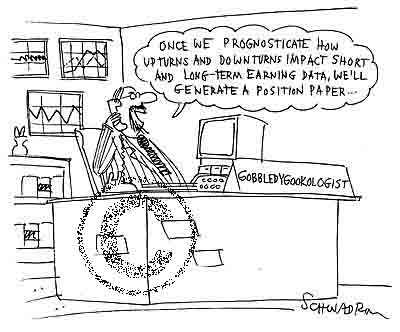
And there are some things I still can't do well in English. I discovered one of those things today. I can't get my jargon-generator and spin-engine to work in English. After a few years in politics in Finland I am pretty good at writing stuff that sounds impressive and important in Finnish. You know, stuff you'd put on reports, advertisements, web sites or funding proposals. How the "new institute has a proven track-record on capacity-building in various international contexts and how it's research output has attracted wide interest and how it intends to strengthen its multi-disciplinary connections and continue to attract the best talent by offering courses of unparallelled quality and scope with a strong individual focus and insight on the development of lateral skills..." You get the idea. It just doesn't seem to work, and flow. I've tried to write a chapter on the future directions of our research centre, and I find it very difficult. Would be easier to do that in Finnish.
There's a fine balance between a slightly sexed-up description that says all the right things and conveys the view of an exciting future, and horrible pretentious and clicheic bulls**t. I wonder if I got that right...
(Pic: cartoonstock.com)
Tuesday, October 17, 2006
One Day in History
 Today, hopefully thousands of people contribute to the British Library blog and help them record "One Day in History". You can also sign a declaration and post your views about why history matters, but that's an ongoing campaign. Tuesday, October 17th 2006, they wanted people to upload their blogs, or just write about their day, for the future generations.
Here's what I wrote.
A working day at the Faculty of Music in Cambridge, as usual. Seems that a PhD student trying to write up never gets a day off. Even at weekends the voice inside keeps nagging to me... It used to be that Mondays were the awful, as the whole working week was still ahead, while Fridays brought relief. Now it's the other way around - Mondays feel OK for the very reason that the whole working week is still ahead, while on Fridays you realise that yet another week has passed without not much visible progress. Time surely flies, as the deadlines crash one after another... Graduate guilt - must end soon.
Today was good, though. Progress in work, finishing some reading I needed to get done. More importantly though, the first supervisions for undergraduates taking the "Introduction to Music and Science" -course. Teaching is great, as you get to interact with people rather than just immerse yourself in your own world. It's also like mwoing lawns or sweeping footpaths - you get an immediate gratification for being able to answer the students' questions.
Now I'm preparing for a seminar - some dynamic systems stuff on interpersonal interaction, how body movements of two interlocutors can be plotted together and analysed in dynamic terms and then it shows how they are synchronised... making the obvious visible in quantifiable terms. Interesting but might be just a fancy and complicated way of telling what everyone knows already. but if that's what it takes to convince a cognitivist that communication is about bodies and that the meaning is constucted in human-human interaction, so be it.
It's also my father's birthday, so I called him - they are in Lapland, and I'm not at all envious... Oh, I must remember to write a blog entry about the One Day in History to my own blog as well.
Thursday, October 12, 2006
Microsoft update
 It was Patch Tuesday this week, and so Micro$oft rolled out a new set of security patches. I hate Microsoft Update. I had severe computer problems when at the conference in Bologna, and the culprit turned out to be Microsoft automatic update that had hanged. And today, I've lost a couple of hours of good work time getting my laptop and the desktop I use at work updated.
Especially the laptop (running XP Professional) is a mess. It takes absolute ages. And I hate that a) you need to use IE to update b) you need to lower the safety and privacy levels for it to work c) you first need to add the windowsupdate.com etc. to your "trusted sites" list. Funnily, normally the IE7 trusted sites function comes with the "only allow secure (https) servers on this list" -option checked, but you even need to uncheck that, as the windowsupdate is on non-secure server...
Most computer users know to expect security updates on the second Tuesday of the month. If not from anything else, from the stories in the press that start to mount every month about a week after the Patch Tuesday that there is a yet another new vulnerability identified and perhaps Microsoft should speed up the release of the next patches and not wait for Patch Tuesday. And usually Microsoft refuses, because it wants to keep thigs clear and predictable.
Oddly enough, then, the Microsoft automatic updates thingy doesn't know about Patch Tuesdays. It shouldn't be too problematic to program it to check for updates on the morning of the second Wednesday each month. But, alas, it doesn't. It usually wakes up to it's task when I'm already manually updating the computer via IE, causing the whole thing somehow to slow down. I'm not sure if that's what happens, but I only manage to update my computer by turning the automatic updates off completely for the duration of the download and installation of updates.
On my old computer the microsoft update page didn't work at all. I occasionally downloaded updates manually and installed them, but since the process is supposed to be automatic, it is not easy to find which updates you have and which you don't. Also, you have no choice but to download and install every stupid update, even if they are for porgrammes you never use, like the abysmal Outlook. I once tried not to install the ones I thought I didn't need, but the automatic updater never stops nagging about it until you give in and install everything. And finally, now that the updates and security patches are installed, Firefox and Thunderbird are no longer set as default web and mail applications. Luckily these two can restore the setting when I restart them. This is yet another reason why I like Macs more and more...
Wednesday, October 11, 2006
Chimps are people too
 Check this out. The host, Danny Wallace is a loudmouth and does this partly tongue-in-cheek, but he is discussing a very interesting point: Chimpanzees are not human, but are they people? This is something the BBC is pretty good at: the follow-up of the programme broadcast yesterday is on the web, and you can see the main points and give your opinions. I saw just a part of this yesterday (because CSI was too engaging...), but it featured some interesting experiments with chimpanzees in captivity, and ground-breaking research among wild populations. The "usual suspects" were at play, the labs in St Andrews and Max Planck Leipzig are the main hubs for comparative studies in cognition.
The most interesting parts to me were the experiments on cooperation and culture. I'm not really impressed by the fact that we share a lot of our genes with chimps, as we also share a lot of them with tapeworms and algae. Brain size and physiological comparisons are somewhat trivial, and I'm not too impressed by the stuff done on language learning (with Kanzi or other human-reared animals for instance, reported at length in the show). But what gets me is the capacity for culture, and the complexity of mind required for collaborating and sharing goals, organisation and goal-oriented planning.
As was discussed in the programme, humans wouldn't really be people without the social relations to others, without society and culture. A bunch of tissues becomes a person largely due to the upbringing and learning by other humans. The complexity of human society, its achievements (in good and bad) are the result of generations of humans having been able to cooperate and learn. Language was the key to this process, as information needs to be transmitted from indivudual to another to share responsibilities in a task, and from a generation to another, to give the offspring a better start to life, but language is still only a tool; the interesting bit is how that tool is used.
This is the hotspot of research at the moment - animal culture and collaboration. Only a while ago, it was suggested that animals didn't possess a theory of mind, the understanding that you have thoughts and beliefs, and so do others around you. Now new research suggests that this isn't the case, and most of the subsequent demarcations are falling down as well, as more and more sophisticated experiments are pursued. Cultural learning has been demonstrated, as well. There are issues with these experiments, and the debate is hot about what they actually prove, but in my opinion we are clearly moving towards accepting the idea that in terms of cognition, the difference between humans and apes is more like the difference in degree, not so much a difference in kind.
(Pic: BBC)
Sunday, October 08, 2006
Sine qua non
 Educated people like to flex their mental muscle so that others around them can see how wonderfully smart they are. One of the best ways to prove your worth (and silence others) is to quote stuff, preferably in Latin, or in ancient Greek.
I remember a cartoon by the late Kari Suomalainen, The Political Cartoonist of his days, where he criticised the show-off yuppies for toting their mobile phones in public in order to look cool. This was at the time when they were so expensive and huge that only the rich could afford them and only the strong could carry them. In the cartoon he says: small bosses show off their mobile phones so that people would think they are big and important. But big bosses don't have mobile phones, they have secretaries. Spot on.
And, there's also an inverse relationship between the size of your briefcase and your status. The smaller the case, the more important you are, as you have someone else to carry all the files for you, while you only need the case for the actual contract. Or, if you are important enough, like the Queen, you only have a small handbag and never have to carry anything else.
And it goes with the education and upbringing and enculturation as well. If you have something really important to say, you don't need to shout. If you are smart enough, people will notice it without you telling them, and there's no need to try to make others look stupid so that you could stand out as the smartest. Actually, truly wise people make other people in their presence feel smart, not dumb.
I'm not sure where I'm heading with this. I think I wanted to say that there are different ways in which you can try to change the world. You could climb the ladder of power, use sharp elbows and in general silence everyone who doesn't agree with you. You make "your way" the only way, and make sure that those who don't recognise your wisdom will feel stupid. This is the zero-sum game of life: if you have something, other's can't have it. Therefore you must take it from them in order to get it. The have's and have not's.
Or, if you believe in added value instead of the zero-sum, you can try to inform people, get them to make up their own mind, equip them to analyse and come to their own conclusions. If what you are doing is smart, they will see that and support you. Or if they don't agree, you can learn from them, because you might be doing something wrong. Says the idealist.
Whether it is democracy or science, openness and acceptance of other people's opinions is vital. You can not advance either of the two unless there is some sort of a core of values, a method for discussing competing evidence, a method that ensures transparency and at the end of the day accountability. Drawing analogies between how society and science work is an old hobby of philosophers, Thomas Kuhn's writing's about the structure of scientific revolutions is possibly the best known for us. But, you could also say that one could not survive without the other, and either can survive for long unless they both subscribe to the principles of openness, transparency and accountability; the method being simply the freedom of speech.
The freedom of speech is the sine qua non of both democratic societies and progressive scientific communities. There's my latin quote. It was the one thing that came to my otherwise empty mind when I, in disbelief, read the sad news. Anna Politkovskaya was one of those writers whose stories are so important that they have a need to be heard. And now, they will be heard even louder. Every loudspeaker is made of a vibrating element and a resonating box. A coffin as a loudspeaker; it is so very sad but also true.
Her torch will hopeufully be picked up and carried on. Without Anna Politkovskaya and her stories there is no Russia.
Friday, October 06, 2006
Happy New Year!
 The new academic year has begun. This means that the city has again come to life, as thousands of students are frantically going from event to event and induction to another, finding their place in the social soup of Cambridge. Eager to add new people and groups to their Facebook profiles, they're all contributing to the manic feel the city has at the moment.
And there are so many societies and clubs. Literally hundreds, 40 more than last year, at least if presence at the Freshers' Fair is a good indicator. They were all there, from the macho alpha-males of the university army/navy/airforce clubs, sportsmen and -women from tennis to tiddlywinks, the international societies (including the Finnish Society, of course) and a number of other societies, groups, initiatives, projects and clubs. There they were, the palefaced velvet-corsetted CU Goth Society reps, alongside the inbred-looking folks of the University Heraldics and Genealogy society. I suppose the Ramblers' Society and Hillwalking Club reps needed to explain people what the difference between the two was, as they were next to each other trying to encourage people to go for walks with them.
All this in a sports hall full of people after freebies, drowned under staggeringly loud bad popmusic. Anyone would be dumbfounded. And yet, as the evening comes, they all roam the streets of Cambridge dressed as angels, demons, pirates, schoolkids, or in their pyjamas, heading from one society squash to the next college bop, and then to the afterparty by a drinking society, in order to meet people and learn what the Cambridgin words "squash", "bop", and "drinking society" mean.
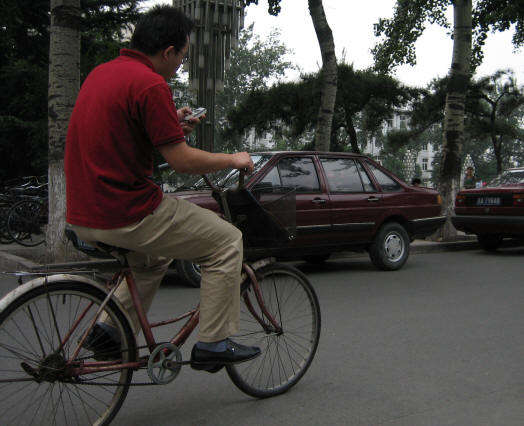
Next morning, nobody is out before 10. And when they are, they are blocking the streets with their new bikes and stopping in the middle of cross-roads reading the maps upside down. Nothing wrong with that, but I still feel I would like to stop and tell them that if they would rise the seat in their bike a bit and pedal with toes rather than heels, they would be going faster where ever it is they are trying to reach. This style of cycling that I call the "Chinese swagger", is very common especially among the Chinese contingency. The seat is at its lowest setting, regardless of the height (or lack thereof) of the cyclist, the heels are on pedals, and the knees are pointing outwards, just like cowboy's, also so that they wouldn't hit the cyclist in their face. As this is a very uncomfortable, slow, and unstable position, the bike swaggers along the cycle lane incontrollably, but you can't pass as the whole thing is so wide and could be turning across the lane at any time. Well, at least the student discounts are back!
(Pic: brianf.com)
Friday, September 29, 2006
Great Divas
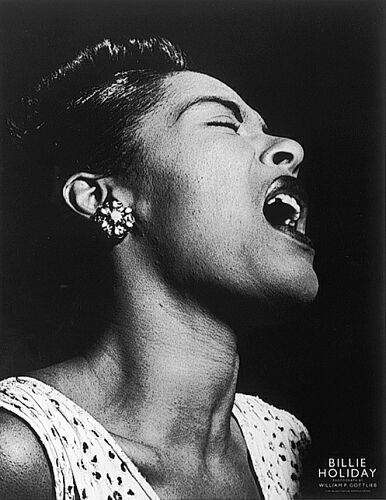 Why do we even have male singers? Who likes them? Who needs them?
I'm looking at my iTunes library and Sting is pretty much the only male singer there, and definitely not for his singing, just for his songs. OK, there is Lenny Kravitz who seriously rocks, and R.E.M. / Michael Stipe, and U2 with Bono, but there we go again to the songs rather than the singing being the "beef".
Could be that it's just because I'm a guy and like girls in general, but I think in jazz this should be a strict rule: female singers only. The various cringe-inducing scatting franksinatras can take their scooby doos and scaba dahs and go to Country Clubs and sing to the overweight and post-middle-aged matrons. And wear a thong for tips.
But, as I'm passing the evening hours at work trying to finish a paper, I'm being mesmerised by the great Divas. Ella Fitzgerald, Nina Simone, and of course the unfortunate, delicate and spellbinding Billie Holiday. How can Lady Day sound so strong and so fragile, so harsh and so tender at the same time? The list of amazing vocalists goes on: Aretha Franklin, Patricia Barber, the contemporary Billie Holiday-soundalike Madeleine Peyroux, Diana Krall, Susheela Raman and on the more pop-py side, Patricia Kaas, Eva Cassidy, Lisa Nilsson etc.. They rule.
And even though all these songs have lyrics, I can easily ignore them and just listen to these voices as instruments, wrap their smooth sounds around me and keep tapping the keyboard in the dark, autumny evening.
If you haven't already, go and buy Verve's Ultimate Diva Collection. Now.
BTW, thanks to DJ Bunny for most of these songs and having a great voice herself.
P.S. Found the exceptions to the rule (the general rule, not the jazz-one): Jeff Buckley and Rufus Wainwright. I listen to both because I like their voices. Funnily, both are (or in Buckley's case were) gay. :-)
(Pic: William P. Gottlieb)
Wednesday, September 27, 2006
Funding
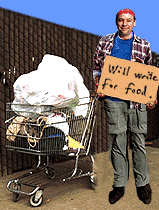 Agghh, I guess nobody likes it, but I hate it. Asking for money. Which involves filling in applications, writing research proposals, polishing the CV, asking people to be your referees and then printing, copying and mailing everything somewhere, in X copies.
The most awkward part is the asking for referees -bit. This means asking for professors, supervisors and other very busy people to write a couple of pages of praise of you and your work for some other busy people who are not likely to read it anyway. Putting overworked and underpaid people under even more stress so that you can also get to be an underpaid and overworked person for a while.
It's that time of the year, the new academic year starting and deadlines for every possible source of funding coinciding with this nerve-wracking season (great planning, whoever is responsible for this...). I'm only trying to find someone to pay for my last months as a PhD now, but soon I'll need to become a professional beggar to secure a post-doc somewhere. Not looking forward to that process at all.
(Pic: www.lonelyplanet.com)
Monday, September 25, 2006
Work update
 So, this blog was supposed to be about tracking my progress towards PhD. As even a quick glance of the index of the blog tells, I've been rambling about, blogging about this and that and even avoiding work-related stuff. It's time to change that.
So, where are we, now that the end of the final year is getting closer?
Not quite at the end. I promised to make sure I'd generate more text to my thesis than to my blog. That hasn't quite worked, as I realise there isn't much more text that I could call PhD thesis now, compared to when I started the blog. While, of course, there is a lot of stuff in the blog. Luckily this doesn't mean I haven't been working, and it doesn't mean I have skipped work to write this blog either. It just means I haven't reached the writing-up phase yet, not properly anyway.
I feel so much better about my work now than what I did a couple of months ago. I have now run enough experiments, so I don't need more data for my PhD. Remember when I was contemplating whether to learn to use the gear properly or just get on with the experiment? I actually ended up learning how to use it, as it was the only way to proceed, but needed the extra unit anyway, as it was somehow broken and couldn't stretch to doing what I needed it to. So, not either or, but both... :-)
The BIG conference in Bologna was a success and I'm pleased to report the follow-up has been interesting. I've got many emails from people, wanting to know more about my work, I've been emailing people I met there and whose work I've been interested in, and in general I feel much more confident about my work now than ever before. I think I have been putting off writing up, and I have been putting off writing those articles I need to churn out, partly because I haven't felt I have the "command of the field" that I need. Now I feel that I know what I'm talking about, and while there are still a lot of things that I need to clarify and learn more about, I know that my data is good, the methods of analysing the data are solid "industry standard", and that I have enough knowledge to interpret the data and discuss the implications of the results.
So, what's going to happen now? I'm currently looking at a couple of promising analysis methods, but they might be superfluous and not worth the trouble trying to apply now. Once I've checked them out (sounds much simpler than it is, as there's a lot of physics and maths involved, plus some new software etc.) I will write up the first article: I've decided to submit the new data as a "brief article" which means the referee process is much simpler and the paper should come out quicker than normal.
After that I will progress to reanalysing and writing up two other articles. These will form the core of my thesis data chapters. I know I will need to do a different write-up for the articles and for the thesis, the latter taking priority. So, if it seems like I'm running out of time, I'll just focus on the thesis and leave the articles for later. The fact is, I will need those articles to get a job afterwards, that's why I'm even thinking about them.
Hmm, there's a scary thought, a job. I haven't really given it much thought yet, but of course I should be applying for post-doctoral positions as we speak. Again, I will try to, but at the moment it seems that my head is not big enough to hold both thoughts at the same time, finishing the thesis and finding a new job.
In general, I'm approaching the cut-off-point. That is the point to which your thesis is up-to-date. The point up to which you know everything about your field, but after which you don't include any new stuff, no matter how relevant that might be. It's the point where you stop searching for new methods to analyse your data, stop adding to the theoretical background and stop honing your "approach". No more approaches, it's all about arrival.
(Pic: © Voodoo8Witch)
Amazing work...
Happy ends are great. Remember the Chinese vases in Fitzwilliam museum that were smashed to pieces by a spectator? The first one has been fixed, and the two others will be soon. The first restorated vase was displayed in an exhibition called "Mission Impossible", where the "ethics and choices" of restauration were displayed. I saw it on Saturday, the second last day it was on.
The exhibition occupied only one gallery, but it was a very interesting entity, showing how different materials decay over time, how environmental factors like excess light contribute to the damage, and most interestingly was asking questions about what is the "right thing" to do with a number of exhibits. Fixing old things is not always as straight-forward as you might think.
For instance, a number of paintings have been restorated over the years, some better than others. As modern technology such as x-rays and ultralight would allow you to see what's original and what is added, would you try to restore the painting to its original state or just keep it as it is? What if the painting was last fixed 300 years ago by someone now famous? Or, if you have an old musical instrument, which of course is not a display item but whose function stems from it being used, and using it would mean that you would eventually need to replace its moving parts, strings etc., and perhaps eventually lead to structural damage, would you keep using the instrument as it was supposed to or do you deprive it of its function and make a showcase item out of it?
The centerpiece of the exhibition was the Qing-vase now glued together by the amazing Penny Bendall. The vase was safely inside a strong glass box (that looked bullet proof...). Accompanying it was a video that showed the process of fixing the vase, from dividing the staircase into areas, collecting each piece and spec of dust that might have come from the vases into labelled boxes, then proceeding to assemble the puzzles, glueing them together, restoring the glazing and decorations...
Brilliant work, but I didn't realise she needed to do so much repainting of the decorations. This issue was BTW discussed in one showcase, where they showed examples of Eastern restoration style: in China and in Japan they also traditionally have fixed broken vases and plates etc., but unlike in the Western tradition, where the restauration is made as invisible as possible, they tend to make the restoration as visible as possible, and the items become demonstrations of the conservator's skills. The cracks are filled with lacquer, and the lacquer is eventually gilded with leaf gold, so that the fault line shines and at the same time the object gets a new life.
Tuesday, September 19, 2006
Allsorts
First for everything
Being an atheist and having diametrically opposite views on some things with the Catholic church, I have to say to my surprise that I do side with the Pope on the recent "clash". Being misquoted on Islam seems to be easier than falling downwards nowadays, and thus one could perhaps argue that he/his speechwriters should have been more careful with the wording of his original speech at Regensburg. But, I think the damage control was done in an excellent way, the Vatican immediately issuing clarification and then the Pope himself regretting his words, which is pretty generous, especially considering that the Pope is supposed to be infallible. Those who didn't accept his apology and keep demanding that he'd jump through more hoops they arbitrarily have set, are just plain insensitive and have no respect for the Pope or his status, or the religion he represents. How can they ask for respect for their prophet when they themselves are not willing to show any for other religions and their leaders?
(I oppose organised religions in general, but accept the fact that we can't really get rid of either Islam, Christianity or Judaism, and also think that that would not solve the problems in the Middle east or anywhere else, as the source of the problems is not the religion, even though the problems are exacerbated by hostlie actions, inflexibility and bigotry fuelled and excused by religions and differences thereof.)
No such thing as a stupid question
Hmm, not sure about that... Here's a top 3 of funny questions tourists have asked me when trying to find their way in Cambridge.
3) Excuse me, how do I get to Mill Road?
(a guy in the van, about 2 miles from Mill Road, on the exactly opposite side of town, facing the wrong way)
2) Excuse me, where is Trumpington street?
(a lady on Trumpington Street (one of the main entry/exit roads to the city centre))
1) Sorry, is this restaurant called 'Browns'?
(a girl, pointing to the sign on top of the restaurant door saying "Loch Fyne Restaurant". Browns is almost next door)
Bubbling under: Mate, can you tell me where the station is?
(a guy in a car, next to a sign pointing to the Railway station)
Well, at least these people found what they are looking for (perhaps apart from the first guy, because he was so far off that I could only point him to the general direction, tell him he has to drive around the whole town centre and then stop again and ask for new directions). I wonder how many men are still aimlessly wondering around Cambridge as they are too proud/stupid to ask for instructions.
Food. More food.
I made sandwiches at home and brought them to work to eat for lunch. Then on the way to work, I stopped at a sandwich shop to get some sandwiches to eat for lunch. All I need to do now is to forget to eat any of them. Seen my brain anywhere?
EDIT: the food is proving useful as my supervisor came back from holiday today, wants to have a meeting with me tomorrow and so I'm basically pulling an all-nighter to get ready.
EDIT2: forgot to include the following item:
Drivers counter safety measures by being more reckless
This phenomenon has been documented before, I think. When ever new safety systems are put on cars, people driving them get more careless and take larger risks that offset the safety measures. The introduction of ABS brakes, airbags and all sorts of computer-based safety features have made cars safer, but made drivers more complacent and willing to take risks. Now it's been shown that car drivers are offsetting not only their own safety measures but also those of cyclists. Overtaking drivers leave more room for people cycling without helmet and women cyclists. (The male researcher was actully run over twice in the course of the experiments, both times he was wearing a helmet, luckily.)
Maybe I should wear a wig under my helmet so that the Barrys and Nigels in their white vans would give me some space...
Monday, September 18, 2006
More ding dong
The "premature Christmas" -watch continues. It seems that the policy to start carefully by putting up one shelf of X-mas stuff is a general one. In addition to Co-op, at least Debenhams has it already. Travel agencies are also on the move, which is a bit more understandable as hotels and flights are generally booked more in advance than boxes of chocolate.
Friday, September 15, 2006
Ding dong merrily on high...
 And so it is Christmas. Soon anyway. In fact, only 102 nights until Christmas day, and the shops are getting ready. Of course, this shop in Edinburgh is always ready, but yesterday our local Co-op supermarket started their yuletide promotions with boxes of candy on sale, on a shelf appropriately decorated in red and green ornaments saying "Buy Early for Christmas". At least they admit it's a tad early with temperatures over 25 outside and people shopping for icecream and barbeques.
(Pic: Kevin Duffy)
Tuesday, September 12, 2006
Climate change - links to hurricanes
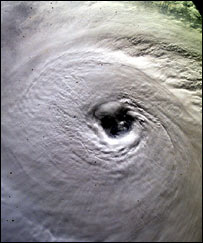 Now that even the most stubborn sceptics have accepted that human activity is causing global warming which in turn has potentially catastrophic consequences, they are still not convinced that the recent increase in the intensity of storms and the damages storms and hurricanes cause have any links to human activities.
The theory has been out there for a while. We know how hurricanes work: they are vorteces that spiral around the eye where the air pressure is very low. Warm, humid air from the bottom rises up in a spiral, while cool, drier air from higher up falls down the eye, as it gets sucked in by the low pressure. Hurricanes are born and bred over the sea and they will rapidly weaken as they hit the land, as they quite literally run out of steam, or the warm and humid air. The theory linking global warming to the intensity of the storms is that even a modest rise to seal water temperature would boost these systems, as the air down at sea level would be warmer and more humid.
While the hurricane season, incidence of tropical storms at certain time of a year, is a natural phenomenon that would take place regardless of human activity, the question is whether the amount and intensity of hurricanes have actually risen, and whether this is due to global warming (which now finally is accepted to be largely antropogenic, or originating in human activity). Showing that this link exists would have a major impact on the debate on climate change and what could or should be done about it. To be blunt, it would allow a price tag to be put on how much the American taxpayers are currently paying for the damage their carbon emissions cause. This, in turn, would help to put the costs of lowering those emissions into proportion and make the economic impact of carbon emission cutting more acceptable for politicians, businesses, and citizens.
So far it has been an uphill battle to show that a) climate is changing, b) this would have bad consequences, c) the change is our fault and, d) we can do something about it and finally f) we can afford to do it, in fact, we can't afford not to.
Recent studies, as reported by BBC today, suggest that the link between human activity and storm intensity exists. The researchers at Lawrence Livermore National Laboratory in California concluded that "84 percent chance that external forcing (such as human-caused increases in greenhouse gases, ozone and various aerosol particles) accounts for at least 67 percent of the observed rise in SSTs in the Atlantic and Pacific hurricane formation regions." SST means sea surface temperature, the critical factor in brewing strong storm systems.
So, 84% chance that two thirds of the rise of SST is caused by humans. Doesn't sound convincing enough? Well, to put it the other way around, it is very unlikely if not completely impossible that the rise could have happened without human involvement. And this is the crucial message to take home.
Of course, since climate research is a science, not religion, there is no such thing as "proof" and as the systems involved are mind-bogglingly complex (remember the chaos theory pet example of a butterfly fluttering wings in the Amazon causing hurricanes in the Gulf...) we will never get more than a probability and a theory corroborated by some data. A field day for sceptics, who can complain that the models are missing crucial variables, the results are not bulletproof, historical comparisons of measurements is dodgy due to lack of reliable old data etc.
But, the evidence is cropping up to support the antropogenic theory. And while the cost to deal with the issue is huge, not dealing with it is even more enormous, and is more likely to involve massive loss of human lives, not just inconvenience or loss of property. Just how much more costly it would be not to act, we are beginning to find out.
(Pic: BBC)