My favourite bit comes at around the 3 minute mark... :)
Friday, December 05, 2008


Thursday, October 30, 2008
Synchronized Debating - both candidates seem to be pro-recycling
So, they have their stump speeches and favourite verses that they keep recycling... Very funny. I have to say, I'm a bit mixed up with these elections, I'm watching the 7th season of West Wing at the same time as these real election news, and not sure whether it's Obama vs. Vinick or Santos vs. McCain or what? :)
Saturday, October 18, 2008
Marathon de Paris

Anyway, the idea of running through the centre of Paris, from Champs-Élysées through Jardin des Tuileries, La Louvre, a loop in Bois de Vincennes, then back on the bank of the Seine, by the Eiffel tower, to a final loop in the Bois de Boulogne captured my imagination. With Paris being one of my favourite cities, a city where I've always felt at home, seems like a good place to start running marathons.
Monday, October 13, 2008
Pace
First of all, congratulations to president Ahtisaari for the well-deserved Nobel peace prize. The list of his successes is long and impressive, ranging from Namibia to Kosovo and Aceh. The one aspect of his work that epitomises his qualities as a statesman is the work he has done in building the international infrastructure for crisis management and resolution. In this work he has provided many young people the chance to learn international cooperation at a top level.
Then, from the Italian to the English pace. I'm slow. Way too slow. Lately, everything has taken me ages. To write an email, to decide which article to use as course reading, to formulate the essay question... It's all process writing for me, even a simple note. Writing involves pauses, drafts, redrafts and leaving the work for a while, then coming back with fresh thoughts (ha!). And anything, even when done in a focused fashion takes a lot of time, just like the poster I just finished which took literally all night to put together. Looking at the finished product, I really can't say where all that time went. It's not that special, au contraire.
Every book has its own pace. I think I've written about that before. Thrillers, the Grisham or Clancy -type of affair needs to be read quickly, you get physically pumped up not just from the unrelenting pace of events, but also the speed at which you race through the plot, your mind's eye rushed along on a dolly from fight scene to the car chase. Then others slow down time, and slow down your reading speed as well. Shadow of the Wind by Carlos Ruiz Zafón is a good example of this genre of books.
At the moment, something slows down my writing all the time. It's like wading in a pool of jelly and is very annoying because I have a lot to do and so work keeps accumulating faster than I clear it from my desk. Hmm. Maybe it's the long distance running, my resting heart rate is now slower than it was a few months ago? Not enough/too much caffeine/sleep/chocolate? Or perhaps it's the autumn, cold weather and growing darkness? Perhaps it's just laziness or lack of focus. I don't know, but it's annoying, as it's not even good and proper procrastination, just everything happening in slow motion.
I need to wake up.
Sunday, October 05, 2008
Mesmerising...
Here's how to make a valve or a vacuum tube. Very hypnotic. These valves can be used as electronic amplifiers and do the same thing as transistors nowadays. But way, way cooler.
Monday, September 15, 2008
Running as social activity
Long distance running is a solitary pursuit. It suits people who are solemn and serious and like to spend a lot of time alone.
I suppose that's the usual view of it, or at any rate the view I used to have about it. It didn't stop me from taking up long distance running, as I pretty much see those as positive things, but I've discovered it's only a part of the picture.
The most obvious manifestations of the social nature of running are the mass marathons. The biggest ones draw tens of thousands of runners, and even the small, local event I took part in the weekend had 2500 participants. Add to this the friends and family members that show up to cheer for the runners and you have a big crowd, and a big event. And in the events, there are the locker room chats and mass warm-ups, the nervous jokes on the starting line and of course the comparisons of experiences afterwards.
Of course, there are now many online forums (fora?) and services for runners that create communities of runners. People share training tips, experiences, race information and just hang out. The proliferation of GPS-trackers and other performance monitors has created a new family of services, where you can keep track of your training online. All the data gathered during your run, your heart rates, speed, course, cadence etc. are logged to an online journal that you can then share with others. And people find others to run with, which is convenient for keeping your motivation up between races.
The feeling of community stretches beyond all boundaries. Running is hugely popular and there are runners everywhere. And when you meet, your shared identity transcends all the differences. This became very clear when I was running in Sapporo, where I otherwise felt very alien, and then came across this other dude who was jogging. There was this quick "hi there" when we passed each other, but there was also this moment of connection that I hadn't felt in days. We both knew what we were going through and was we were about at that moment.
So most importantly, there's the experience of running together, and that's of course amplified when running together with a horde of people. As you push through the kilometres you are inadvertently syncing your pace and even your steps with those running around you. And syncing steps has pretty much the same function as dancing or playing music together. Pushing the boundaries of your endurance together with others is a strongly meaningful experience.
The field of social psychology was in a way started by observations that cyclists would go faster when there was an audience - record times were seldom broken in practice, but often in races. This social facilitation (and it's opposite, social inhibition) was later studied in experimental manner, and the tradition still lives on in much of social psychology (study of social anxiety, groupthink, team dynamics etc.) .
I do enjoy the quiet me-time I get on a long run, though.
Saturday, September 13, 2008
Brilliant!
Just a quick note, finished the half marathon in just over 2 hours (haven't checked the exact time but was probably 2:03 - 2:04 or thereabouts. I'm very happy about the time. My initial aim was to go under 2 hours, but considering the last three weeks, this was very good.
The event was very well organised and there was a great atmosphere among the runners and also lots of people cheering along the route. This was my first mass run, but definitely not the last one.
Pizza has never tasted this good! :)
Underprepared
Whenever possible (and unfortunately in the teaching job I do, that's not often the case), I like to follow the modified version of the scouts' motto: Be overprepared.
The half marathon is today, in the afternoon, and I'm feeling very underprepared. My training programme was shattered to pieces about three weeks ago, and so I will start today without any other targets but to complete the distance.
Having to travel to conferences, cross six time zones twice was already a bit difficult, as a jet lag tends to make all activities feel unappealing, except for sleeping. And of course all the hassle that goes with starting a new academic year has taken quite a lot of my energy, and as I've felt a bit ill as well, I've decided to just try to get better rather than force myself to run.
So, although you're supposed to lighten the training before the race, my training has been seriously underweight. Nevertheless, I'm really looking forward to the race.
It's going to be a great social event, and as half marry isn't an extreme distance, I think I'll just go with the flow, enjoy the early autumn by the lake (trees are starting to get their yellow and red colours) and get that first big race under my belt.
Thursday, August 28, 2008
Konbanwa
OK, I think it's about time to end the blogging break...
The summer didn't really leave a mark in any way, and now it seems to be gone. A new academic year is just around the corner and an unimpressive summer weather seems to have turned to autumn, at least judging by the amounts of rain.
But enough of the weather, greetings from Sapporo, where I'm on a one week conference trip. It's been great, the standard of the talks and posters is very high. There have been very few disappointments in terms of the content, and in a true Japanese style, the organisation has left nothing to be desired.
Of course the flight over here plus the jetlag that ensued were taking their toll for the first three days or so, but somehow the social and scientific buzz have helped to get through the days. It's always great to meet friends and colleagues, meet new people and hear about their research.
And since we are in Japan, food is of course great. I'm a fan of sushi, to use the generic term, and like other Japanese food as well. And of course, the food not only tastes divine, but looks good as well, is often served in nice surroundings. The way the food is served one mouthful at a time slows down your pace of eating, which is also a good thing.
However, in a conference with 400 guests, dinners are also always a bit of a hassle. You decide to have dinner with someone, and so they ask if person 3 can come as well, as they've already agreed. Ok. So, person 3 then brings their colleagues 4, 5 and 6, as they happened to be there. Once you try to decide where to go and when, 7 comes by and says he knows a place, and that he's going with "someone" and they wouldn't mind us tagging along. Then it turns out, that "someone" was actually diners 8-16.
There are other issues with eating out, though. I only speak about three words of Japanese, or four if you count "thank you" and "thank you very much" as two different words. And since I can't read their writing either, I'm feeling more lost than in a long time. Dictionary doesn't help, as it is impossible to find the word that you don't know. A phrase book is handy, because then you can actually ask the right questions. Not understanding the answer is of course another problem. Also, my phrase book is a pocket version and doesn't come with useful questions such as "although there are 16 of us, we can of course sit in three or four separate tables" or "what is the difference between the 1000 yen and 1500 yen drinks packs that you can include in the menu", or even "excuse me, can you help me find the correct box where I've left my shoes".
But, with sign language, pointing to pictures in menus, making various animal sounds, and with a generous helping of patience from behalf of the waiters we've managed to have great food almost every evening.
But at some point it gets tiring. The conference runs from 8.30 in the morning to 7 in the evening, and after that three hours of light dinner is quite a lot. So, today I decided to switch to antisocial mode. When the program ended (a bit early today, so that people could go and visit sake factories and tearooms and go shopping) I went for a long run. After coming back to the hotel (hoteru in pseudo-Japanese, my 4.5th word), I decided to have a Japanese evening in my room.
That consisted of getting a burger from the Mos Burger next door (they say in the sign that they are Japanese burgers), a Sapporo beer and Häagen Dasz green tea ice cream from the convenience store and watching Japanese major league baseball on TV. Thoroughly Japanese experience, then. Very relaxing, setting me up well for the remaining two days of intensive networking and then the three flights home on Sunday.
Wednesday, August 13, 2008
One month to go
I just realised that the half marathon is now exactly one month away. Or, in a month's time, I'll be recovering and healing sore feet, hopefully after completing the first running race I take part since the third grade.
Training is going OK. There have been weeks when I haven't been able to do the 4-5 runs I've planned, but as I don't really have any other goals than to finish, that's not too bad.
Well, in a week I'll take off to the training camp in Japan (otherwise known as a conference), while our professors are conspiring to wreck the penultimate training week by planning a trip to Belgium for me.
What this month-or-so of training has shown, running with a specific goal in mind makes it more interesting and increases motivation. Having a training program with different kinds of training sessions (intervals, speed endurance, fartlek, basic endurance) provides the required variability that will keep monotony at bay.
One month to go, so far so good. The route was published today, one and a half laps around the lake, using the new and still partly in-progress scenic route for pedestrians and bikes. The route is very popular, and every evening there's a good number of runners, walkers, nordic walkers, inline skaters, skikkers, cyclists and dog walkers, enjoying the lake and the exercise.
Friday, July 25, 2008
Nerdy but funny
Summer in the office - time to finally do things. And as we know, procrastination expands to fill in most of the empty space.
Monday, July 07, 2008
Half marathon in September
Last year has been horrible in terms of physical activity. Back in Cambridge I at least had the 2*20 minutes cycling to work and back to keep me going, even though I had already stopped training actively with the boat club. Here, I live practically next door to work, and so I get virtually no exercise as a part of the day-to-day routines.
There are many excuses and real reasons why I've been a couch potato, mainly the horrible winter (just sleet and slosh, making both running and skiing unpleasant if not impossible) and the workload, but in the end it is always simply about motivation (or lack thereof).
And this is where I start to feel stupid. I know for a fact that I feel better and have more energy when I exercise regularly. It is also very important for my health, as it helps control my blood sugar (and keep my diabetes in check). I also like it. So, the motivation should be there, but this time I didn't want to leave it to that, but wanted to have a clear goal towards which I could work.
And so I signed up for a half marathon in September. I feel that marathon would have been too much, but that this 21 kilometre race would be survivable. Back in the day when I was properly fit, I actually tried to sign up for one already, but the Bristol half marry was fully booked and so I had to give it a miss. This would be the longest continuous run I've done, but it's not that much of a stretch. I've done runs that are well over 10 kilometres and feel confident that I could run for the 2 hours this would take. The only question is my current poor shape.
But, according to the numerous running websites and automatic training program generators, the goal is realistic. To get started, I used this generator to give me a training program that would take me from where I think I am at the moment (it's difficult to estimate how fast I could run now or for how long) to sub-2 hour half marathon in 10 weeks.
A quick tour to web forums and running sites will tell you that the key to running marathons or other long distance races (half marathons are often classified as "short distances") is to practice "long runs". The definition of "long" depends on your condition and training phase. The key point of this is that speed or distance travelled is secondary, you just have to keep going for a given time. This could be hours, for a beginner like me it starts with 70 minutes.
So I did my first long run this Saturday. I had done a few shorter runs earlier in the week, but was a bit nervous about this one. Armed with an iPod, heart rate monitor and energy gel I headed off. I was trying to keep my heart rate relatively low, as you should, basically so that you prevent lactic acid from building up in your muscles (the science of endurance sports and the scientific approach to training is a big part of this scene, and probably the reason why it attracts so many geeks, such as myself).
I could feel my legs getting tired, just because I'm not used to such sustained activity, but in the end it went well and of course the endorfine rush afterwards was a great reward. I plotted the path on Google Earth (yes, this is a part of the geekiness of it) and it showed that I had covered almost exactly 11 km. A good start. Next week's long run will be 10 minutes longer, the next one 10 minutes longer than that, etc. Watch this space...
Sunday, June 29, 2008
Cops and Idiots
So, I made my first ever call to emergency services yesterday.
I was watching TV in the evening (quite late), when I heard someone yell "Help, police" from the park outside. The park is a venue for teenager get-togethers and there's quite a lot of noise there especially in weekend evenings. Yesterday as well, it was a warm night and there was a group of people drumming etc. (damn hippies, Cartman would say). When the guy yelled "Help, police" again, this time at the top of his voice, I went to the window and tried to figure out what's going on. There were about half a dozen kids, clearly drunk, and it was very hard to tell what they were doing, they were sort of circling each other as if they were about to start a fight or something, I couldn't tell if they were 5 against 1 or what. Anyway, I decided to call the police, although I thought it might have been just something yelled at a bout of drunken idiocy.
I tried to explain what was going on in the park to the dispatcher, admitted it was really difficult to see what exactly was happening but it didn't seem anyone was injured or in immediate danger. She said she'd ask a patrol to swing by. They came just under 10 minutes from the call, and the kids had already left the park. There was absolutely nobody there, I saw the police looking at the windows of our building, as if to see who had sent them there for nothing. They backed out of the park and left, for donuts or other dispatches, I don't know, but at that point I was really angry with the idiots in the park. Wasting everyone's time, worrying me and everyone else who heard their screams... Plus, of course we all know Aesop's story of the boy who cried wolf. I hate to admit it, but I'm afraid I might think twice next time someone screams for help and maybe waste valuable time trying to figure out if they really need help or if it is just horseplay.
Wednesday, June 18, 2008
Blue wings, white lies...
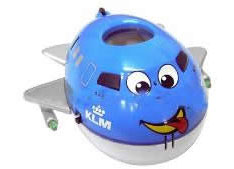 I flew to Edinburgh and back via Amsterdam, and on both occasions the departures from Schiphol were slightly delayed. This didn't really matter, as the delays weren't that long, but the reasons for the delays and what was told to the passengers were funny.
The Amsterdam-Edinburgh flight was flown with a small "City Hopper" jet, and so we all took a bus from the gate to the field where the youngling planes were herded together. We boarded (amazingly slowly given the small size of the plane) the Fokker that had been prepared for us, and then nothing happened. Fok.
Eventually the captain announced that we are waiting for some external equipment to help us start our engines, and we'll be off when it arrives, shouldn't be more than 5-10 minutes. He apologised for the delay and possible inconvenience, in that official tone that indicates it's not his fault and that he is making this apology for other people who also think these things just happen and are not that big a deal, while I dug in the New Yorker I had bought from the airport. In it, Haruki Murakami, one of my favourite authors writes how he started to run daily, without fail, when he was in my age. He had just sold his successful jazz club, moved to countryside and decided to become a writer. I had packed my running shoes, and while I was contemplating whether Jyväskylä counts as countryside and if running a jazz club could be a metaphor for a PhD, a van approached the plane and screeched to a halt next to it.
The insignia on the sides said "KLM Catering" and "Last Minute Deliveries". The driver opened the fridge door on the side of the van, took out a blue cardboard box that looked like a business class meal and rushed it up the steps. The air hostess received the box, paid for it with her smile, the driver gave her some change in the same currency, jumped into his car and sped away to make another delivery of external equipment to help start other airplanes' engines. The hostess knocked on the cockpit door to tell we're good to go, the engines were started and we taxied towards the runway.
On the way back, we flew grown-up planes, and so instead of the bus trip around the unisightly sights at the bowels of Schiphol airport, we got to do the usual anxious queuing inside a metal tube. The crew had problems in starting engines, and needed external equipment to get them going. This time, though, this involved being pulled back to the gate, lots of engineers and ground staff buzzing around the plane and various hisses and wails from the hydraulics of the plane. After 4 days in Edinburgh, one morning run and a jazz club later, I was reading reports of the latest cricket matches and eager to get home and back to writing.
(Pic: KLM MP3 player by Shanghai Shininess Industrial Co. Ltd)
Thursday, June 12, 2008
Back in Edinburgh
I'm in a student bar in Edinburgh, watching a football match and having a beer. It's all good.
I'm very excited to be back here. There are two (maybe three) cities that I somehow always feel at home in. Paris, Edinburgh and Helsinki. I really loved living in Cambridge, I really like it in Jyväskylä, growing up in Kuopio wasn't bad, and London is somehow at the same time terrifying, awful, and enchanting and absolutely wonderful. I like the wibes in Stockholm, Copenhagen and Amsterdam. Don't like Rome or Brussels at all.
But, Edinburgh I like. And here I am again. And will keep coming back with every tiny excuse I get. This time I'm here for a good reason, there's a fascinating conference. Scientists, therapists, b-girls and b-boys... Really. What else could you need? :)
I'm also excited at the moment, because my college has done amazingly well in Bumps today. May Bumps are the main event of Cambridge college rowing, and my old club has shattered all previous club records today and really done everyone proud.
Thursday, May 22, 2008
Corruption, correlation and causation
Transparency International has repeatedly ranked Finland as one of the least corrupt country in the world. The CPI ranking, or Corruption Perception Index, is based on interviews, and as it says in the name, perceptions, and so it is a somewhat subjective measure. At least the perception so far has been that Finns, and the Finnish political system in general, would be honest and fair. This perception is changing, as now, as The Dude would put it, new shit has come to light.
MP's have failed to report who has funded their campaigns, funders themselves have been hiding behind dodgy societies, neither seems to remember anything about the transactions that therefore had no effect, but still there seem to be very uncomfortable connections between the funders, the politicians, and some political decisions they are currently trying to make.
This reminds me of the cash for honours -scandal in the UK. Big party funders were given peerages and other privileges, in some cases as a direct compensation for substantive donations to party war chests. There was of course public outrage, heads rolled and rules were reformed. However, public perception was that there was nothing new here (see Yes, Minister & Yes, Prime Minister, any episode), it had just grown to be so ugly, unashamed and disgusting that it was therefore time to put an end to it. But, as the British are extremely cynical about their politicians, these "breaking news" were just confirming what they knew already - the system is rotten, everyone is there for their personal benefit, all politicians are corrupt and the country is run by tycoons.
I don't think the conclusions would go quite as far in the Finnish case, if not for anything else, because the sums are considerably smaller. In the UK, the sums donated were millions of pounds, in Finland the largest individual donation was 20 000 euros, although the totals for some of these groups are in the hundreds of thousands.
The discussion is now taking a rather unfortunate non-analytical turn. As is often the case, things get confusing, and some people confuse things deliberately. Is the political system in crisis, as the prime minister has said? No, the system isn't, but his government is. Several MP's, both government and opposition are. Mr. Vanhanen deliberately muddles things up and tries to hide behind his office, but the fact is that the rules have been there, the legislation has been at place already, and these individuals (en masse, unfortunately) just have failed to respect the spirit of the law, and in many cases even broke the letter of the law. It's all fine for them to now blame the unclear rules and try save faces by proposing changes, while amending their dodgy declarations, but they shouldn't get away with just that.
Any trust-issues the Finnish people might have about politics as a result of this, are not generally about the Finnish constitution or the offices it describes, but about these idiots who claim they don't have a clue who paid for 1/4 of their campaign and expect people to believe them. Similarly, nobody lost their belief in Finnish business because this bunch of "fundamentalist entrepreneurs" now claim they don't know who got the hundreds of thousands of euros they donated and to which they expect no return.
That's one thing, the other of course is, whether funding political campaigns is corrupt in every case. The issue here is pretty much the same as in the question of correlation vs. causation. It's understandable that businesses or labour unions want to see that the candidates that share their views do well in elections. In the "ideal" scenario, politicians have their opinions first, and funding follows, because someone with money likes those opinions. In the cynical scenario, receiving funding changes the politician's opinions to those of his/her funders. In both cases, there's a correlation between receiving funding from an interest group and having opinions that they like. The direction of causation is the key element that separates democratic fair play from rotten corruption.
Whether either extreme exists in the real world, I'm not sure. There is probably a continuum there, and many politicians today seem to dwell in that gray area in between. But, something close to the ideal scenario exists and it can even be seen as an important part of democracy (as a guard of marginal, and why not even mainstream interests). Therefore rules (and enforcement of them) are needed, and it wouldn't be a bad idea to set a limit to how much money a candidate can get from a single donor, and a total limit should be considered as well. And, as a precautionary measure to tackle future ignorance and amnesia, politicians and donors should be forced to keep better minutes of their campaign funding and spending.
The Finnish political system with strong corporations and interconnections between politicians and special interests isn't necessarily corrupt in the sense that, say, Somalia (179th, or last in the TI CPI), Albania (105th) or even Italy (41st) are, but it isn't spotless clean, and definitely it doesn't seem to be all that transparent, either. That's something that should be reflected in the next CPI. If Finland falls from its joined first spot, it doesn't mean we've suddenly changed to be more corrupt, it's because we're finally starting to take a good look into how the decision-making here actually works.
Monday, May 19, 2008
Reality check
What is real?
It's a deep philosophical question, and while for Plato or Descartes the question was whether they could trust their senses or not, for us the issue is further complicated by all things virtual.
If I'm having a conversation with someone about politics in an online forum, is s/he real? Are her opinions real, is the conversation real? How about the conclusions? Have we really agreed? Or has my nickname agreed with someone else's avatar? Have we communicated, if communication is psychologically defined as aligning each other's cognitive states?
It's well known that especially in anonymous forums (fora?) people take more extreme views and often play very exaggerated roles. Partly this is due to the low signal-to-noise -ratio in these boards, which means that everyone has to shout louder to be noticed, which in turn worsens the ratio etc. It's also common that people vent their frustrations and demonstrate their immaturity, or just deliberately sabotage conversations so that any conversation worth having falls apart relatively quickly. Bullying is very common, that of other board members, public figures, and more often whoever has online presence. Fat, thin, ugly, nerdy, odd, weird clothed, spotty, ethnic, poor, different... any of these apply to you, and you have posted your pic online to any social networking site, chances are someone has linked it somewhere with insulting comments, for other idiots to laugh at.
As if you're not a real person.
Would they do this to a person they know? Are they just cruel idiots or can they not tell the difference between reality and their virtual world? I'm not sure which answer is the more pessimistic, given the ubiquitousness of virtual presence and social interaction.
TV and papers are very good at blurring the borders of reality. The so-called reality shows are a big hit, but here reality means something different. Media tends to make virtual caricatures out of real people (sports personalities, politicians etc.) and real people out of fictional characters (soap stars: some papers write news stories about tragedies that happened in the show to the characters, as they would write about what happened to the actor) and the semi-fictional people in semi-reality shows are just a big mess anyway.
When people bring flowers to the cross-roads where a soap character had an accident with a tram and died in the show, why is that? Are we so fed up with reality that we need to pretend that the stories into which we like to escape for a while are actually true? Or, if our feelings for the character are real, why not express them as we would in real life? Nothing wrong with that?
Is that the reason why these reality shows are so popular? Because they claim they are true, their virtual world is closer to the real one and easier to sink into? Is that why the events and outcomes of these shows are so eagerly discussed in papers, speculation gets to epic proportions and everyone is supposed to have an opinion of these people?
Fundamentally, there's nothing new in any of this, of course. Storytelling, legends, songs, epics, and fantasies have always been an important part of being human. Our very ability for imagination is what sets us apart. We turn to fantasy for guidance, seek solace in stories, purpose in prose, emulate social interaction in songs, and all in all, need all this to keep our sanity. We can't turn the imagination-engine off, and so we need to constantly feed it.
Also, sports isn't real anymore, neither is music. Both arguably used to be, but we have chosen to pay for the pleasure of observing them and not do them ourselves. Sports heroes and pop stars (and the Royal families) live constantly in the Big Brother house, for us to criticise, vote, identify with and have feelings for. Newspapers write about them as if they were real, often forgetting that they are.
Our opinion of our colleague or neighbour is not necessarily any more real than our opinion of the runner-up in Amazing Race. Most people work with ideas and fantasies rather than bricks, mortar and other concrete things. And I don't necessarily have problems with more fantasy, it's the less reality -part of the equation that bugs me. If we only see each other as avatars or virtual characters, and if more and more people behave in public like they are in a first-person perspective video game, what will happen to the way we treat each other? If people talk about politics and look at politicians as if they are useless celebrities and tv-show characters from that soap opera they call the 20.30 news, what will happen to democracy?
And don't get me started on what's true and what isn't, or what's important and what isn't. :-)
Friday, May 02, 2008
East Germany
Unfortunately I left my camera cable at home, so I can't show you the Ossie-charm of my hotel room in Leipzig. The high point is the lonely cupboard with one (1) coffee cup and one (1) schnapps-glass. The view outside is also puzzling. Completely renovated jugend buildings alternate with derelict and abandoned ones. And then there are sprinklings of GDR-concrete here and there. And amidst the buildings, trees with budding leaves. The spring is about a month ahead of Finland.
So, Leipzig. Never been here before, didn't really know what to expect but it seems to be all here. And the hotel room is actually nice. The bathroom's been completely refurbed, along with most of the room and all the furniture, but there's some "gloom" under all this, sounds of past.
Our workshop and symposium starts tomorrow morning. The last two-three weeks have been riddled with technical difficulties and all sorts of obstacles, and so I needed to change my presentation plan. So, after promising so many times "never again", here I am again, still writing my presentation when the meeting is already about to start. Never again.
P.S. Oh, Deutsche Bahn is amazing. The new Berlin Hauptbahnhof is one of the most stunning buildings I've ever seen. No, absolutely the most stunning building I've seen. Inside, trains go criss cross in three levels, it's full of shops and restaurants and escalators and elevators and steel and glass... Stunning. I took the ICE, which was very comfortable. We briefly hit 200 km/h but most of the time we were rolling along at a leisurely 180 km/h across fields with forests of windmills. It takes an hour and 10 minutes to get from Berlin to Leipzig. I've also tried Berlin buses and Leipzig trams, along with Finnish trains and buses, so the day has been a public transport extravaganza. Oh, almost forgot, there was also the flight from Hki to Berlin. Rather not mention that, trains are much cooler.
Wednesday, April 09, 2008
Probably too difficult
 If there is one theme which illustrates the need for formal research over "simple" common sense it is the theory of probability. It is ubiquitous, but difficult at best and counterintuitive at worst.
We like to see ourselves as basically rational beings, and the homo economicus that form the basis of most economical theories is supposed to be capable of making rational choices. Yet humans are mainly emotional, not rational beings. We use tools for our rational and logical needs, as we do most of our thinking and choosing with emotions.
The dichotomy between sense and sensibility, reason and emotion, is mostly a false one. It might work on paper and in folk psychology, but in order to understand the human mind it is a big mistake to pry the two apart. Emotions are quick and automatic reactions to changes in our environment and as such serve our survival. Sudden noises make us startle, infringements of our territory make us angry etc. Basic emotions (happiness, sadness, anger, fear) are physical states and tend to colour our perceptions. So-called secondary emotions (pride, jealousy...) are often called social emotions as they have to do with our relationships and attitudes towards others in our social environment. The ways in which we seek or avoid these emotions, the tendencies we have in feeling them form the basis for our personality. And cognition for that matter.
So, where is logic, where is reason, where is the "information processing" that the cognitive psychologists say we do all the time? Well, it's there of course, in that same mind-body. Again, even the most basic perceptional processes are about spotting patterns, regularities, similarities, structures - the building blocks of a "rational", logical and structured world view. Our perception is based on expectations that we can only cast in presence of regular, predictable structures. We get emotional satisfaction and pleasure out of symmetry, structure and regularity (and when these are violated within limits).
So if our emotions are logical and our reasoning emotional, where does it leave us? And what does probability have to do with it? Well, it means we are complicated and it is not easy to study us, especially if you start by leaving one half out of the equation, as psychologists often do. One example of this is the research on our rationality, which often entails making choices. The premise is that there is a "best choice" and we arrive at our choice after deliberation. The best choice is often defined as being the most likely to be beneficial, which means you need to understand probabilities to make that rational, correct choice.
I'm messing things a bit, I didn't mean to write about emotions but couldn't help it really. The original idea was to write about probabilities, as people generally fail in estimating the probabilities of different outcomes in even the simplest cases. Emotions crept in as I was trying to think what would explain these failures. And then I wanted to avoid the reason vs. emotion thing and it all got out of control.
Why do people take part in the lottery, even though the probability of winning is close to zero? The answer: they don't care about the probability as such. They know someone wins every week, and it could be them. And if they'd win, it would change their life completely and as the price of the ticket is low, why not take that chance. It's just a game...
OK. Although, when you start adding together the cost of lottery tickets over, say, 15 years, playing the game has actually prevented you from making some of the life improvements you've dreamed about. The casino always wins in the end, but the possibility for an individual player to win life-changing sums of money draws people in. Fairgrounds and markets have always been full of games where the odds are against the player, and internet has brought a new surge of these systems, some of them legal, some illegal.
They share two things: first, they appeal to you emotionally to get you involved; second, they rely on your poor sense of probabilities to damp the voice of reason telling you not to play.
Probabilities are hairy. Imagine you are flipping a coin. Nine times in a row you get heads. What's the probability that the tenth flip produces heads as well? Alarmingly many would answer something else than 50%. There are two factors at play here. First, people confuse the probablity of getting ten heads in a row (0.5^10 = 0.0009765625) with the probability of getting heads in any one flip (0.5). The second problem is the idea that in the long run, there should be an equal number of heads and tails. This is true, and if you can test this by flipping a coin a couple of million times (or get the computer do that for you) and the score should be relatively even. But this doesn't change the odds for any one throw, as the history of flips isn't stored in the coin. The coin itself doesn't know which way to land, and there's no natural law to force it to start producing tails after a long run of heads.
The other problem is that very few things in "real life" are actually random like a coin flip or a roll of dice. Also, we are rarely as attentive in keeping track of events as we are in the coin-flipping experiment. In fact, we tend to remember events that have emotional significance (ha! emotions!). So for instance, anyone making paranoid theories about the traffic lights being always changed red for them might suffer from both problems. First, as the lights are not random, it might be that they arrive at a certain crossroads always at the same time of its cycle, depending on some other set of lights somewhere else. Also, they might be more likely to remember the times they had to stop than those times they could just drive through the crossroads without thinking about it.
This is still easy, but now we get to the really weird stuff that throws even maths professors off. Have you heard about the Monty Hall problem? That wikipedia-link gives the problem and a number of solutions, as well as explains what the hassle was. In short, you have this game. You have to choose one of three doors, there is a car behind one of them, and a goat behind the other two. If you guess correctly, you get the car. The twist is here: after you make your choice, the game show host opens one of the two remaining doors and reveals a goat. He now asks if you want to stick with your original choice or if you want to switch. The question is, should you switch or keep your original choice.
And, counter-intuitively the answer is, and even with a very clear margin, you should switch. This problem featured in a recent NY Times article, and there's a game you can play to actually see that switching is the better strategy.
I'd think most people say they wouldn't want to switch. This is partly because they have miscalculated the odds (thinking it is a 50-50 chance) but also because they abhor the potential situation where they have undone a correct choice by changing later (and shown lack of belief in their initial choice etc.). As the NYT-article tells, this Monty Hall fallacy (when the problem was first presented, even maths professors wrote in to the paper claiming they'd made a mistake, and that switching makes no difference) has now been spotted in experimental paradigms used to study decision-making.
The research on cognitive dissonance is an attempt to look at all the factors that are involved in making simple choices, and one of the paradigms is to choose (or have monkeys choose, as in NYT's example) from three initially equally favoured items, first one of two, and then one of the remaining two. The researchers have shown that the item that loses in the first duel is likely to lose in the second as well. The explanation has been essentially the same as in the Monty Hall -case where people don't want to switch - there's a need to justify the first decision, or as some say, second-guessing isn't evolutionarily a good idea.
However, if you have even slight differences in the initial preference of the three items, then the odds in the second choice aren't 50-50, but 1/3 - 2/3, just like in the Monty Hall -problem. Let's take the example used in NYT: there are three Smarties, red, green and blue. Let's assume the first choice is between red and blue, and red wins. The second choice is now between blue and green, and green often wins. Now, if there is even the slightest order of preference, this is not just a case of wanting to justify the first choice, but also statistically the more likely outcome. Look at all possible orders of preference of these three, where red is higher than blue. There are three: R G B, R B G, and G R B. In two out of three of these, green is higher than blue, therefore making the odds of green being picked in the second choice 2/3 rather than 1/2.
This is all fascinating, and the fact that even trained scientists get these wrong is on one hand very relieving, and on the other hand very scary. It shows, however, that no matter what you think about sense or sensibility, in some issues there's no substitute for diligent research and learning.
Monday, March 17, 2008
Fifth freedom
According to the EUobserver, the EU leaders in their Spring Summit have suggested that a "fifth freedom" should be added to the four existing ones that form the basis of the Union. So far, persons, capital, services and goods have been given free movement (or rather, providing it is the work in progress) and now "knowledge" should follow suit.
This is to boost the competitiveness of Europe, an initiative launched with the Lisbon declaration. This has struggled from the beginning, and it has turned out to be very difficult to turn words into actions, not to mention results. This time, the plan is to increase the mobility of students, teachers and researchers, and further reforms of higher education system are promised.
This sounds good in principle, it remains to be seen what this will mean in practice. But on a more symbolic level, adding a fifth freedom is big.
And did we hear about it in the news? No. But that's not a surprise, we didn't hear much about the decision to take part in the NRF, or even the decision on next years budget (including controversial decisions on university funding. All we hear in the news these days is this or that about the minister for foreign affairs, this idiot "dancer" and the text messages. Again, and again, and again...
Subscribe to:
Comments (Atom)