A couple of additions to yesterday's post. In the coalition speculations I forgot that the Christian Democrats exist as well. They have 7 seats and although they lost some votes they didn't lose any seats. As a very conservative right wing party they would probably fit into the coalition with the Centre, the Conservatives and the Swedish PP. The True Finns however, have already declared that they will aim to be the loudest opposition party and are not interested in joining the coalition, whatever it will be. How surprising...
Prime minister Vanhanen (current and most likely the future one) has said that there should be 3-4 parties and about 120 seats in the coalition. He wants a relatively large majority, and is likely to get it. I'm pretty sure that the only open question is whether it's the Greens, the Christians or the Swedes that join the two big ones.
Anyway, to he main point of this post. I've looked for ways of organising information, mainly to make sure I have a proper organisation in the thesis. The thesis itself is of course a boring old linearly organised (one-dimensional) book, but as the material is so diverse and there's so much of it, I need a way to keep track of it and organise in more dimensions. Three would be nice, but two will do.
I have a flip board, but it's not currently in use as I don't have the necessary wall-space in the lab. But, I have something better. Freemind is an open source project, a Java-based mind map program you can download. There are a number of these software packages out there, most of them commercial. The two things they need to have to be better than pen and paper are an intuitive user interface and the ability to expand beyond being a static map.
Freemind ticks both boxes. It is very simple and easy to use, and there is depth in it (in the form of having nice options to use various visual cues to sort things and make the maps look nice) if you take some time to learn the options. The most useful function for me is the ability to link to other files in the computer, and also across different mind maps. So I have now made all my thesis chapters into mind maps, linked them to the word-documents (yes, I'm an idiot and writing my thesis in Word. I'm sure I'm going to regret it...) that are the drafts of those chapters. Also, you can "linearise" a mindmap, so that you can obtain a structure for the chapter from the mindmap you've drawn. Great program, highly recommended.
I also like the fact that the project page has a wiki with lots of tips for using the program, galleries of other people's projects to give you ideas etc. There is also a continuing stream of new versions, with added features. And a new visual look. I'm using the 2005 0.8.0 version, 0.9.0 is already in beta phase, and the logo will change from the butterfly to a lightbulb. And I thought we were banning the bulb...
Another way of organising myself is to actually use the Moleskine notebook I have now finally bought. And while writing this I've just realised that I forgot to make an important phone call today and send some equally important papers. Also, I'm supposed to be presenting some results in two hours and haven't yet decided how to present them, and I'm supposed to take part in an hour-long experiment before that. It seems that I still have a bit to go before I can say my organisation is actually working.
(Pic. FreeMind)
Tuesday, March 20, 2007
Organisation


Monday, March 19, 2007
Election
 A new parliament was elected in Finland yesterday.
This time there was a marked shift to the right, as the centre-right National Coalition gained 10 seats and became the second largest party by overtaking the left-right-left social democrats who lost 8 seats. Other winners were the Green party with 15 seats (+1), the right-populist True Finns with 5 seats (+2) and the Swedish People's Party with 9 seats (+1). Alongside the social democrats, the Left Alliance lost 2 seats. The ruling Centre party also lost 4 seats but maintained the important position as the largest party, although with only one seat difference to the National Coalition or conservatives.
An interesting but not very surprising result. Even from afar, it's been clear that the Green party and the Conservatives had the best campaigns. Both also had positive campaigns, the Greens were proposing new models for social security, the Conservatives wanted to reform the working life. In contrast, the social democrats and their so-called friends in the trade unions were mainly scaring people not to vote for the "right wing" without really explaining what they would do if elected. The rise of the extreme right (in Finnish terms) was based on EU-skepticism and charisma of the leader of the True Finns -party and reflects people's frustration as much as support for the party's program. The phenomenon is the same as in other European countries but the party is still marginal in size and importance and not as openly racist or anti-immigrant as some of it's brothers.
The shift to right (relatively) is a part of a trend, the same happened in the Swedish elections, and is very likely to happen in Britain. The rise of green ideology and growing awareness of climate change boosts not only the green parties but also the new conservatives that have adopted the ideology quicker than the labour/social democrat parties. The latter (at least in Finland) seem to be more concerned about the potential job losses in heavy industry than reducing carbon emissions. In Britain, Gordon Brown is trying to dam the stream of moving voters from Labour to Conservatives by branding the budget proposal that is to be unveiled today as "greenest ever". The other driving force is globalisation, the conservatives have been much more upbeat about it and emphasised the opportunities and needs for reform, while the left has focused on maintaining the status quo.
One interesting phenomenon in these elections was the "return of the dinosaurs". A number of former politicians who have been away from the parliament for a while (in the European Parliament, in the European Investment Bank, as ambassadors, in business...) made a return to the national parliament. I'm in two minds about this. While on one hand it is good to get that experience into the parliament, on the other hand there is a risk of turning back the clock. There is plenty of old stuff that's linked to these people and they are still associated strongly with some of the policies and decisions they made the last time around. They all have their enemies, some among the other dinosaurs, and I hope they can be forward-looking and not let the old things get on the way.
By far the most important question now is, which parties will form the government coalition. It is clear that the basis will be the Centre and the Conservatives, as the former is the largest party and the second the largest winner. While these parties occupy the same centre-right segment of the political spectrum, their programs have marked differences. While the Conservatives are traditionally the most EU-positive party, and in terms of foreign and EU-policies progressive, the Centre party has a strong EU-skeptic faction. Almost automatically the Swedish People's Party will fit in the coalition. The party is above everything else driven by its willingness to compromise and will undoubtedly continue in the coalition, and continue having power beyond their size.
This coalition would have 110 seats, which would be enough to form a government. The big question is, will the Green party be included. They do want to get into the government, they are one of the winners of the election, and in spite of their reputation as being relatively left-wing, many of their policies are actually very close to those of the Conservatives. Both get the majority of their votes from the big cities, both want reform and both are EU-positive. Getting the Green party in the coalition would boost the majority to a very solid 125-75, but issues such as nuclear power and the details of the social policy reforms might turn out to be hurdles too high in the negotiations that start this week.
The other, far more unlikely option would be to include the True Finns to the coalition and thus make it cover the whole right wing, but first of all I don't think the Conservatives or the Centre would be willing to risk giving them the platform (they might be too blunt about their anti-EU and anti-immigration policies and not politically correct in any other way either) and second, I don't think they really want to get into government. For a protest party it is much more beneficial to remain outside so that they can blame everything on the government and just criticise everything, and keep on getting the protest vote, than actually taking responsibility and risk losing the next elections for not being able to deliver their promises.
As always, a number of ex-sportsmen and other celebrities were elected. Some of them will have no impact whatsoever in the parliament, as they are completely clueless as to how things work there, or what they can do and what they can't. Some don't even know what their opinions are. But, as I didn't manage to get to vote this time myself, I'm in no position to complain about other people's choices.
(Pic. YLE)
Friday, March 16, 2007
Comments
 Just a bit of mind-clearance before biting into some serious work.
Education
The British government is worried about there being so few people from working class families or from other unprivileged and underrepresented backgrounds applying for universities. So, now they are suggesting that in the application process data would be collected about the employment of the parents of the applicant, so that those with working class background could be "positively discriminated" and selected over those applicants who are from middle class professional families.
I do understand that Britain is a class society rather than a meritocracy, but still, this will not solve the problem. As with applications to Oxbridge, or the Russell group unis, the problem isn't so much in unfair selection, but in the fact that people from state schools, or from working class backgrounds don't even apply in the first place. Perhaps the government should reconsider their last year's decision to treble tuition fees, and perhaps they could think about re-introducing student grants and see if that would help. Investing in the state secondary schools wouldn't be a bad idea either, so that graduates of these schools would have the same knowledge and abilities as their public school counterparts.
Traffic
There are two "pests" of traffic that make my blood boil. One is the "nobody's coming, it's just a bike" -person, who turns ahead of you from a side street, changes lanes over you or turns left to your face. I could even understand it if they simply hadn't see me, but when they do that after clearly looking at me, it is just too much. "He's on a bike, I'm sure he doesn't mind me cutting him off." What are they thinking? Bikes don't count?
The other genus of pests are the "slow but blaze" cyclists. With or without bike lanes, you are supposed to be on the left of the lane. There's usually just enough space to have a bike and a small car next to each other on the lane, so overtaking a slower bike can be tricky. Therefore I hate it when I overtake someone, then stop on red lights, and this person then overtakes me, runs the red lights and keeps going slow, so that after the light turns green I need to overtake him again. And yes, there are almost always men, lazy, fat, "couldn't care less" guys who cycle with their rusty mountain bikes with seats too low and their knees wide, and it seems they are doing a record attempt for the slowest cycling in the world. They have no helmets, but usually do have baseball caps.
Nuclear weapons and war against terrorism
After being detained in Guantanamo and other nice places since 2003, Khalid Sheikh Mohammed has confessed having masterminded or personally executed pretty much every terrorist act in the last 15 years, including some that were never carried out. I think someone wants to be remembered as the superterrorist... Which doesn't mean he wasn't involved in some or even most of these acts, but then again, we knew that much already. It will be interesting to see how this will be used in the US and here, as the political support for the war in Iraq is in record low, and both administrations need good news about the success in war against terrorism. This isn't it, and definitely can't be called progress, while smelly substances are fast heading towards fans in Afghanistan and Pakistan...
The confession has already been branded as boasting, as Sheikh is known for having an inflated ego, but what this is also is al Qaida propaganda - they do like it when they are depicted as a centrally run, global organisation, where the might of the whole machine is always behind their every act. This is the real world SPECTRE, The Enemy. Actually, al Qaida is a loose network, more an ideology than an organisation, a weird mix of ideologists and anarchists. In business terms, probably more a chain of franchises rather than a centralised company. Will US and UK take the bait and use the opportunity to give al Qaida this promotion Sheikh is trying to push?
Meanwhile, the UK has just decided to renew it's nuclear weapons system. At a cost of £20bn CGE (CGE = current government estimate, which should be added as a standard to all government figures, cf. the Olympics, whose budget was upped from £2.4bn to £9.35bn yesterday), Britain would have a system to replace the submarine-based Trident warheads in 20 years. I'd have thought "nucular" weapons were so cold war... I know North Korea probably has then, and Iran wants them, but any same person would get rid of them. As the cold war nuclear doctrine was based on MAD, or mutually assured destruction, meaning that if anyone uses them, we all die, and so nobody should use them. Not the balance has changed, rogue nations want them for bargaining power, they are trump cards that can extend the life-expectancy of your dictatorship in the environment where Western imperialists are about to get you.
What would Britain use them for? As a deterrent, they say. So, they are not to be used, but to be had, as it gives you bragging rights in the global political scale. Critics say that the world has changed and the money would be better spent on conventional forces, making sure the troops currently in Iraq and Afghanistan have proper gear and they get the treatment and facilities at home that they deserve. The proponents say that we couldn't anticipate the current threat of global terrorism 10 years ago, we have no way of knowing what the world and it's security needs will be in 20 years. That's right, but I'm pretty sure nuclear weapons will be a major problem even then, and this decision is not helping us to deal with it.
(Pic: MTA Maryland)
Monday, March 12, 2007
Unifnished books
 BBC 1 Morning Show covered the story this morning: someone has listed Britain's least finished books, i.e. those that we are most likely to put down after reading a few pages and never to pick them up again. The whole list (plus digest finishes of them, for those who lacked tenacity the first time around but might still be interested to know how it ended) is in Guardian.
John Crace (the author of those and other digests in Guardian) and Kate Mosse (do note the silent e at the end of the surname) were in the studio to comment. Both agreed that it is no longer considered "wrong" to pick up up a book and then not finish it if you don't like it. There are books you buy because everyone else does, with all those 3 for 2 offers around that happens to everyone. There are books you get as gifts, and therefore might not be up your alley.
I must say, I do belong to the (I suppose old-fashioned) group that feels very bad for not finishing a book, although I agree that if you don't like the book there's no reason to struggle with it, there are plenty of good ones to read instead. There have been a few I've not finished, mostly because they've at first progressed slowly and then were forgotten little by little as I had no time to read, and then something else came along and I started them instead. Joseph Conrad's Nostromo goes to this category, but I'll take another go at it one day. There are others that I've borrowed while on holiday and then had to leave when the holiday ended, as I couldn't take someone else's books with me.
And there have been one or two that I've just decided to close after finding no connection with the book whatsoever. Tuula-Liina Varis, a Finnish author is in this category.
I'm surprised to see that they've included non-fiction books as well. Having been in the business of devouring academic books for a while now, and also enjoying popular science books and other non-fiction, I'm not sure they are meant to be read from beginning to the end, in a linear fashion. For instance, the punctuation rant by Lynne Truss, 'Eats, Shoots and Leaves' (might have got the punctuation wrong there) is a good book, but it's more like something you read from here and there, and perhaps use as a reference book every now and again, but it doesn't necessarily work as a novel.
Reading changes. Internet organises information in network form, rather than hierarchically and in a linear way as books do. Young people used to the chaotic "organisation" and linked hypertext in the web have a different take to learning and reading than the book-generation. With Google, the information is always there, and to be able to use it, it is more important to learn to be good in accessing it fast, and less important to remember things by heart. Moreover, you can't necessarily trust anything you read these days - being critical of your sources and double-checking for validity is much more important these days, regardless of the media. Now that magazines and newspapers are fighting for reader's attention with more and harder scandal stories, TV is more entertaining than information, the internet is a playing ground for teenagers, blogs are overtaking established news organisations in the speed of their response to news events, and anyone can print professional-looking books on demand, the quality control that lies in the hands of the editors now covers a narrower band of the publishing spectrum than it used to.
Our relationship with books changes as well. Paperbacks are inexpensive, and there are more of them around. Competition for readers is hard, and it is also difficult to make good choices. Competitions are a way of lifting some books ahead of the rest, and big prizes like the Booker prize have a big impact on sales figures. And once everyone is buying A book, it becomes THE book and so you are more likely to include it in your 3 for 2, and then perhaps not finish it as it wasn't what you expected. (There are unhealthy repercussions of this as well, as every bookshop now offers the same books (not so good), competes with prices (good), and plays safe with commissioning new books and just doesn't take risks with interesting novels that don't "market" well (very bad).)
The one thing that doesn't change is the reason why reading novels is so important. It feeds your imagination, enhances your ability to see the world with other people's eyes, live their life choices, try to understand them and learn to see differently. We all need to be reminded that the world we see and how we see it isn't all there is.
P.S. There are bad reasons not to finish a book. The BBC-man (technical term, trust me) commented Louis de Bernières' 'Captain Corelli's Mandolin' that was on the top 5 of unfinished books by saying that "it was a blockbuster film but probably the book wasn't as good". A-hem. Having read the brilliant book and heard a number of people ridicule the idiotic film, I'd beg to differ. But I can see how people who liked THAT film didn't like THAT book. They probably only realised it was a book when Hugh Grant read it in the end of Notting Hill. And most likely they are probably the same bunch who bought the David Beckham "auto"biography (third on the list of unfinished non-fiction) and didn't finish it either. The difference being that THAT book should never even have been born.
(Pic: "brittle book" from Joan M. Reitz's ODLIS.)
Thursday, March 08, 2007
GTD
 If you look for the world's most popular blogs, the top ones are either blogs about gadgets and new technology, or have something to do with GTD, or both.
GTD means 'getting things done'. It's the opposite of procrastination, and tries to eradicate it from the lives of GTD'ers, which of course makes me a bit sad.
It seems to be an ideology, with the air of a cult around it. The founding father is David Allen who wrote a seminal time management guide called Getting Things Done. On one hand, it has to do with technology and software that helps you manage your time and projects, tackle the daily information load and influx of emails and new tasks, assists you in multitasking and keeping all the balls in the air. But on the other hand it's much more than that, it's not the gadgets and widgets but what you do with them and how you use them. Many GTD-people are in fact decidedly low-tech, promoting the use of paper notebooks and hipster PDA's, to mark the difference between the gear and the idea.
The idea, in short, is that there is a systematic way to organise how you work, keep track of what you are doing and help plan the actions you need to take. Getting the organisation right means that you don't need to spend time thinking about what it is that you should do next, and it also helps you to avoid being overwhelmed by the massive number of things that you need to do.
As I need to get things done (or rather, I need to get The Thing done), I looked into some of the software that is available. I still haven't got around to buying that Moleskine, which would be ideal for me, but as I've also seen and tried a number of time managers (most of which have turned into timewasters or have simply been forgotten) I wanted to get something for my computer that would help in keeping track of things, deadlines, and hopefully make managing all the non-thesis stuff easier so that I could focus more on the primary task at hand.
A doctoral thesis is too large and too static to be managed with GTD, that stuff really only works in an environment where you need to do a number of different tasks each day, have people to call and places to visit, meetings to have and memos to prepare. GTD isn't about project management, it's about life management, and time management.
I do need to sort out my system of project management to get the thesis done, keep track of what I've done and what I still need to do, but I think I'll manage with an old-fashioned to do list and that notebook where I can write down ideas as they arrive. (And mind map software that helps me visualise all the connections between things, and I'll probably move my flipboard to the lab as well.)
But I actually found something GTD-like that might help me with all the other stuff. There's a Firefox extension called GTDGmail, which brings a number of features to Gmail that can be used in living a GTD-life. The system revolves around labeling email in your inbox, sending yourself tasks by email and then it is of course up to you to follow the principle of doing the thinkgs on your list, working from top to bottom and doing anything that takes less than 2 minutes immediately rather than deferring it for later.
I've installed the system and now have to see how it works. I might direct my work emails to Gmail for a while so I can properly testrun this. My main problem is information integration between email, calendar, notes and to do lists, and perhaps this will help, although it doesn't have a calendar in it, so I'm just as likely to miss meetings now as I have been.
(Pic: the action workflow in GTD, by David Allen)
Wednesday, March 07, 2007
Micro$oft update II

I complained about Microsoft update a while ago already, but can't resist to do that again. There are a couple of features in XP and the Update that are so absurd that I can't fathom how anyone OK'd them to be rolled out.
First, the XP setup. XP is actually a pretty impressive heap of software, with a huge number of features for the varying needs of the huge number of people using the system. As I said before, I do respect MS for what they've done, but the downside of all this is that you end up having a lot of components you will never use and will never need. Also, as there are alternatives to email readers, web browsers and media players that often have smart features that the MS products lack (like safety), it is good to know that MS provides a Setup utility where you can remove those XP components you don't need, and if you want to reinstall them, you can do it via that same interface.
This is smart and allows me to disable the fax, remote desktop, cryptography and other XP features I don't need, and to get rid of the Outlook Express that is basically a red carpet for viruses that you can also use to read your emails.
However, when you open the setup, it says (and I quote): "To add or remove the programs, click the checkbox." Yes. That's right, you can do either, the problem being that you don't know which one of the two you are doing. I might just be thick, but especially as this same setup opens via Setup, add/remove programs, and the "Disk cleanup" -utility, it is not as clear which is which. Following the path from cleanup, you'd think that you check boxes to remove items you don't need.
Now I know that if you check a box, it installs the component in question. If you have a component unchecked, I think it is supposed to remove them, except that it doesn't. So, if you want to get rid of Internet Explorer, the prime target for all virus writers in the world, you leave the box unchecked, and the shortcut from the desktop disappears.
But, if you then click "Microsoft Update" in the start menu, it launches ... Internet Explorer. As it is the only browser allowed to access the sacred Microsoft Update website, that is a good thing, but the whole point of cleaning up diskspace isn't really happening, is it? What I'd like to see is a same kind of utility for XP components as the Add/remove programs is for other software. Items listed and then a selection of deleting or fixing the component.
Well, I've now relocated the Calculator that I lost earlier when I failed to check Accessories from the Windows component list, and have now the latest version of Windows Media Player, which always tries to hijack most of the audio formats to be played with it by default.
To get the new WMP, I visited the Microsoft Update website. It found that I was missing a very important, critical, high priority update. This was the "Windows Genuine Advantage". ?, I thought, and clicked for more info. For only 1.2Mb, this loverly program would check that my copy of Windows is legit, and if not, it would advice me as to how to obtain a legitimate copy of Windows. What? I know my Windows is OK, as I remember paying for it. I don't need this update, I decided.
Wikipedia revealed what MU had not told me: in addition to checking the authenticity of my XP, it would regularly contact Microsoft and tell them about the status of my XP. In other words, it is spyware (US lawsuits pending). Update lets you pass installing things, and provides a box you can check if you don't want that update offered again. Checking it means that the update now has a large warning sign on top of everything saying I've decided to hide a critical update and my system might now be in danger and that it is highly recommended to repent and install the bloody spyware. At the same time, a number of upgrades for XP, WMP, IE, and other components are classified as non-urgent and optional, so they are hidden under a separate tab. Priorities first.
I honestly can't wait to get rid of XP, my PC laptop and the whole pain in the neck that running these computers cause. The PC vs. Mac -adverts are funny, and try to emphasise that there is a difference in the design ideology of these two systems. Factual inaccuracies of these ads aside, I think they are showing an important point. I don't see the main difference being that Macs are for fun and PCs are for serious work, but there is a similar difference. It's like between two possible student grant systems, or rental companies, or banks. One focuses a lot of resources on making sure nobody swindles the system and so every applicant needs to go through a thorough and arduous vetting process and at every stage of the way getting the idea that you are a potential problem for the system, you should be glad they are even considering your application and piss all for how you feel about it.
The other option is to spend more resources on the actual service, expect that unless something else suggests, you are innocent and valued customer, and while the security is in place, it's tailored to be as invisible as possible, as ease of use is the guiding principle.
The result often is that the system that treats its users as potential hazards, will make them such, just out of frustration of all the stupidity you need to tolerate. Sort of the same thing as every action the US makes to increase its security angers more and more people and pushes them to disrupt it.
Friday, February 23, 2007
New words
 In The Interpreter, the brother of the main character Silvia Broome (played by Nicole Kidman) used to write down words that he liked as a kid. There are great words in all languages, the best ones are those that are untranslatable to any other language. I remember (from primary school, or somewhere very far away) that there are two types of meaning that words have, denotations, or their literary meaning and connotations, the suggestive meaning. Semantics are more complex than that, but that will do for now - the untranslatable words are so impregnated with connotations, contextual associations, emotions and often have a history that is entwined with the history of the people using that language.
Good words also taste good, they feel nice when you say them. Words in second, third etc. languages tend to group into good and not so good on different grounds than those of the mother tongue - probably because some of their connotational "luggage" isn't translated, and the judgement is done more on purely aesthetic grounds or just for their entertainment value. It's a bit like kids when they find words that are fun to repeat and chant out loud, irrespective of their content, sometimes to their parents' horror...
For instance, of all the French words I know, the one that comes to mind in this context is inoubliable. It's silly, but I like it, and it somehow reminds me of Paris, but probably the kind of Paris I've never actually seen. (And it would make a great mocking chant for kids.)
In English, I'd have a list of words that I especially like, but I never get around to writing them down. If I buy that Moleskine I've been thinking about (my mind is like a sieve these days, or more like a black hole), I'll probably start writing the list.
There is one word that I sort of love to hate, as it is such a perfect embodiment (I don't think you can say that about a word...) of the phenomenon: one-upmanship. It's a brilliantly coined term (by Stephen Potter, according to Wikipedia) and describes the behaviour of people who compulsively try to outdo others in everything, no matter how insignificant the task is. My association of this is the fussy parent baking cakes to their son Rupert's school fair, and instead of just baking a cake, s/he has it glazed with the school logo and motto in Latin, and then brings it to school on a Royal Doulton plate as "anything else would look too... Ikea-ish". The term somehow manages to perfectly convey the smugness and artificiality of the people who do these kinds of things.
By the way, there are also a lot of words I absolutely hate and loath and would like to strike out of use and into oblivion (oblivion is a good word); most of them are the ones that occur regularly in the vocabulary of estate agents and management consultants. The worst one is wow-factor. I just don't get how a bathroom or a loo can have that, apart from perhaps in the case that they top the listings in ratemypoo.com.
I almost forgot the word that I learned today, which also prompted me to write this entry. I really should get that notebook. The word is steampunk. Yes, it's sort of related to cyberpunk but less dystopian (another great word). It's a genre of literature/film/lifestyle that idolises the technology and style of the steam-powered era, the industrial revolution without bounds. Brass, mechanics rather than electronics and steam power instead of combustion engines are all the hype. Jules Verne's science fiction and the works of the greatest Victorian engineer, Isambard Kingdom Brunel (can there be a greater name...) are inspirations for adorers of steampunk. The term is about 20 years old, as the trend began to emerge in the turn of 80's and 90's, but I only learned it today, after stumbling across a link to this project: modifying a computer keyboard to look like a 100 year old typewriter.
After taking a look at the page, and reading about the term, I realised that I'd just seen a brilliant steampunk film: Miyazaki's Castle in the Sky. This Studio Ghibli (of Spirited Away and Howl's Moving Castle -fame) epic animation features robots, planes, trains and flying ships that are like straight off Verne's pages. And I guess my fascination (don't like this word, sounds like fascism) with Babbage's difference engine suggests I might have a strain of this bug as well.
(Pic: screenshot from Castle in the Sky, copied from animeyume.org)
Tuesday, February 20, 2007
Brighter future
 Australia has decided to ban old-school incandescent light bulbs. This is an excellent decision, as the modern fluorescent ones last much longer and are thus more efficient. This decision will undoubtedly be well received in the Ban the Bulb -movement that has campaigned for a similar decision in the UK, although focusing more on trying to sway the consumers to make the environmentally friendly choice.
This decision stems from the growing awareness of the effects of carbon emissions to the environment, and follows the recent decision made by the Spanish authorities, by which every new and renovated house will soon need to be equipped with a solar panel. So, there's a shift to more environmentally friendly way to producing energy, Australians are trying to get more efficient in using it, and we can all easily try to use a bit less of it. It's not that difficult to turn off those lights and get those TV:s and other gadgets off the stand-by.
Meanwhile, the Finnish government is worried that cutting carbon emissions will lead to loss of jobs in the Finnish heavy industry. Luckily the elections are only a couple of weeks away.
Edit: the ministers of environment of the EU have just agreed on a unilateral 20% emission reduction goal by 2020, and have also decided to push forward an international 30% reduction plan.
(Pic: www.cs.utexas.edu)
Sunday, February 18, 2007
Tuesday, February 13, 2007
Offset your carbon emissions
 Last year, buying goats and cows for Christmas became very popular. A number of charities and development organisations provided possibilities to directly invest in rural Africa, on a small scale, and very concretely help individuals and families, while also providing a way of getting pleasure from giving during the holidaytime.
The next big thing, and by no means limited to Christmas or other holidays, will be offsetting your carbon emissions, or offsetting someone else's carbon emissions for them. Prompted by the growing awareness about climate change and the sense of urgency to do something about it while governments and political and business leaders debate which course of action to take, people are taking the matter in their own hands. Businesses are also realising how important this is not only for the environment but also for their image. So, a number of schemes are now available to calculate your carbon emissions, and donate money for projects that offset these emissions. These projects range from planting trees to developing wind power.
Many businesses are now doing this on a large scale - they are offsetting the emissions from all the flights that their employers take, for instance, and all the emissions from the fleet of their company's cars and the offices produce. One of the providers of this service, carbonneutral.com, has a 5-step program that it offers to companies. First, their emissions are calculated, second, they suggest ways in which to cut down these emissions. Third, they figure out schemes that would help offsetting those emissions that would suit the company, and fourth, the company donates money via carbonneutral to these projects. Finally, the company gets a certificate for being "carbon neutral". Companies like Honda and The Rolling Stones do this already, and the ranks are growing.
I like the combined approach, where you in the first instance try to cut down your emissions (which usually saves you money), and then pay for all the rest, which of course not only promotes the projects but gives you an extra incentive to keep cutting your actual emissions.
Individuals can do this, too. There are calculators for analysing and offsetting the emissions from your flights, your driving and your home. I just checked, and to offset the emissions from a return flight from London to Finland costs you just under £5. And, you can offset someone else's emissions as a present. They'll send that person a certificate and some bits and bobs so that the "material" side of the present is there also.
Of course, there are two things that worry me about this. First, that this becomes just a way of buying a clean conscience and doesn't lead to reduction in emissions. As the UK environment secretary David Milliband said: “Offsetting isn't the answer to climate change. The first step should always be to see how we can avoid and reduce emissions – through thinking about how we use energy in our homes and businesses, and the way we travel. However, some emissions can't or won't be avoided. That's where offsetting has a role to play. It's a way of compensating for the emissions produced with an equivalent carbon saving.”
The second thing that I worry about is that this becomes the new brand of eco-fascism: anyone not offsetting their emissions would need to explain their actions. There is a similar issue in the UK with the Poppy campaign, where before Remembrance Day red poppies are sold for the benefit of veterans of the wars, and you have the hell to pay if you for instance appear on TV without one. Given what Milliband said about offsetting, and given that just like in supporting veterans there are more than one ways of doing it, I'd be very worried if this became a "must" thing to do, even though I of course hope this would take on. I guess it's about doing it for the right reasons rather than just going through the moves that counts - just like with any presents you give.
(Pic: www.oplin.org)
Saturday, February 10, 2007
Mac coolness
 Yesterday, I forgot the power unit of my laptop at home. It was still in the suitcase where I'd packed it for the trip. So, I was forced to use the new MacBook we have here in the lab. It's for portable experiments, but as nobody is running them right now, it just lies on the table, being adored and admired by everyone. She is soooo cute... :-)
I do like Macs. They have this air of quality, they are the thoroughbreds of computers. I'm not a Microsoft-hater, on the contrary, so I don't have ideological reasons to prefer macs. My current computer is a PC, but as I've advertised earlier, the next one will (hopefully) be a Mac. I am not at all ashamed to admit, that I like macs because of their design. Not just the case, the user interface, the OS, the programs. I know that what's beneath the skin is what counts, but I still think the magnetic power cord plug is one of the coolest features of the new MacBooks.
So, today, when I came to work I took my power unit. But, alas, it still has the Euro-plug instead of the three-prong UK one. So, here I am, writing with the MacBaby, and enjoying every minute of it. There are adaptors and extra UK-cables at the lab, and I'll need to switch to my old trusty warhorse of a PC, but before that I couldn't resist playing around with the Mac's Photobooth -program. These little things are just too much fun...
This is me as a rugby-player. 
This is my "rabbit in the headlights" -imitation.
And this is someone very tired.
Hmm, I really AM tired, perhaps I should just go back to the boring PC-world and get the work planned for today done.
(Pic: Apple-history.com (just the first shot, obviously))
Friday, February 09, 2007
Trains rule
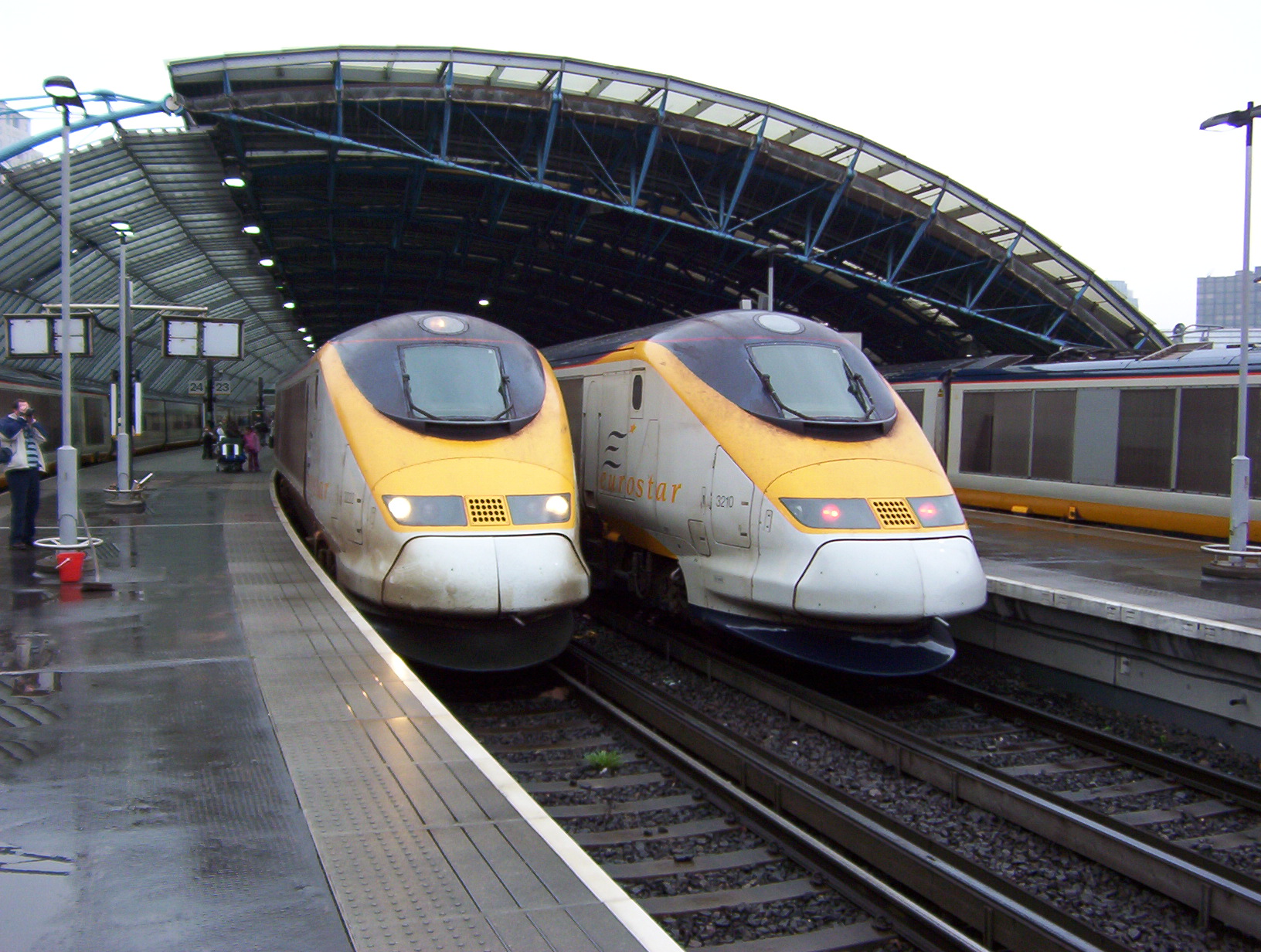 There are many things that should have ended up on this blog in the last few weeks, but I never got around to writing the entry. Mostly, I've been too busy. A couple of times, I've started an entry but decided not to post it, or simply forgot the stub to a window buried beneath all other windows on the desktop. Sometimes things just go wrong and technology fails. For instance, there's a cool video in youtube that I want to share with you, but the automatic embedding didn't work. I'll try again soon.
The entry about Pekka Kuusisto's amazing gig in Cambridge (that I promised someone I'd write) never materialised, and might not. (Just got to say, it was amazing, he was amazing, the music was amazing. Go buy all his records. Twice. Give them to all your friends for all the occasions you'd normally buy a present for. And most importantly, go to all his gigs. One old guy asked us (a group of Finns) after the concert when we were waiting by the stage backdoor to get to thank the artist, whether we "follow him around or just came to see this concert". That sounded funny but I suppose the idea wouldn't be totally out of this world, especially after that gig.)
Anyway, to newer things. More recent, that is. I returned from Amsterdam yesterday evening. I was the only one of our group of 5 to arrive yesterday, the others took the plane. Or tried to, but due to adverse weather conditions and loads of cancellations they had to spend an extra night somewhere in Holland, and I still haven't heard of them so don't know when it was that they finally arrived, if they indeed have. Both Stansted and Amsterdam were hit by the cold snap and heavy snowfall, and loads of flights were cancelled or at least severely delayed. In contrast, I was at home at the scheduled time, as I took the train. There was a 30 minute delay in Schiphol (where the train stops after leaving Amsterdam) due to a signal failure that was undoubtedly caused by the ridiculously dense snowfall, and another shorter delay in Brussels with the Eurostar departure (probably due to bad weather in the UK), but other than that, it was smooth running.
Originally I decided to take the train rather than the plane because it is so much more ecological. Also, on short distances like this it is more convenient. The train takes five and a half hours from London to Amsterdam, and this means from centre to centre. A flight takes an hour, but when you factor in the 2 hours check-in time, passport and baggage reclaim queues and of course the train or taxi rides between the airport and the city centre at both ends, you actually end up spending about the same time. Of course, I have to factor in the time it takes me to get from Cambridge to Waterloo station and back, which is about 1 hour 15 minutes, and the 30 minutes you need to reserve for checking in to the Eurostar. So, on a good day you get from Cambridge to Amsterdam in about 4.5 hours, and the train option takes about 7.5-8 hours, depending on train changing times.
But this time, the train proved to be about a full day quicker than the plane. With all the cheap flights, more and more people are flying more and more often, and the airports are getting more busy, the queues longer (also due to security issues) and delays more and more likely. Also, with more people on the move, any disruption is likely to cause a lot of hassle for many people.
While flying seems to get slower and slower, with extra security checks and heavy traffic, the trains are getting faster. A faster track is being built for the Eurostar on the UK side. In the so-called CTRL-project Channel Train Link), the terminal is also going to be moved to St Pancras stations from Waterloo. This is good news to Cambridge-people, as the fast trains from Cambridge arrive at King's Cross, which is literally next door from the St Pancras terminal. And since the new track cuts the travel time to for example Gare du Nord to 2 hours 15 minutes, I really can't see any point in flying to Paris after November, when the works are scheduled to be completed.
Already, there are practically no flights between Paris and Brussels, thanks to the fast trains. Similarly, fast Thalys train (the Belgian fast train) operating between Brussels and Amsterdam (although slower connection in average km/h) makes flying between the two cities pointless. The only point, and that is a big one, I must admit, is that the flights are often cheaper than the trains. My commuter-train - tube - Eurostar - Thalys -combination cost about £160 return, whereas flights at the time of booking were selling for £47 return. Add to this the £15 for trains to and from Stansted, and whatever it costs to get from Schiphol to Central Amsterdam, and you still save about 50% compared to the train option. This, from the point of view of the environment, is insane.
If we disregard the fact that the plane-takers were stranded in the airport for a day, as that is still luckily unusual, I still find a whole host of reasons why trains rule over planes. In short, I found the train-ride much more pleasant than any short-haul flight I have ever taken. First, there are practically no luggage limitations, and so I could take my computer with me in a backpack, which I no longer can take into plane as it is too big for the current regulations. Also, I brought a ton of books (all the same title, my friend's PhD thesis) with me, as she was flying and therefore couldn't bring the books herself due to the luggage restrictions. Second, I'd much rather spend the few hours of travel on the move than waiting in a lobby or queuing. I find it impossible to work in planes (apart from long-haul flights) with all the restrictions for use of electronic appliances, non-existing legroom and the said waiting and queuing. On a train it's a different thing, and the modern, fast ones are built for comfort and as the faster services stop relatively rarely, working is usually good and productive. And when work ends it's possible to sleep.
Third, the view. On a plane, and if the day is clear, you get great views for about 3 minutes, when the plane takes off and when it lands. While it is true that cities don't usually show their prettiest face to the railway tracks, there is something to watch all the time, great sceneries and places going by - although sometimes at 300 km/h.
Finally, as trains have much lower carbon emissions per passengermile than planes, and are more environmentally friendly than cars (more efficient, lower emissions, and railways take less land than roads), you get back the pure enjoyment of travel, and lose the guilt you feel about flying.
Tuesday, January 30, 2007
Betting
 BBC reports today that Manchester was chosen as the site of the first "super casino" in the UK.
BBC wrote: "The decision is a blow for Blackpool and London's former Millennium Dome, which were the bookmakers' favourites."
'Nuff said. At least there seems to be a natural demand for these establishments.
(Pic: wiki)
Monday, January 29, 2007
Deadline - facing the music
Long time, no post. I have a draft of a post that I've been editing a couple of times, but it doesn't work. It has to do with some observations about "the British", as if such collective identity existed. But I can't get it to work, possibly because it still sounds too serious, and when such a text sounds too serious, it starts to sound prejudiced and ignorant, and just stupid.
I think therefore, the only form in which some of the things I wanted to talk about (bi-polar attitudes on celebrity and money; the weird ethos where extreme political correctedness meets ingrained racism; and in general the view of the world that revolves around the zero-longitude in Greenwich), is comedy. Perhaps that's why there is so much good comedy in Britain, there are inhibitions and unspoken and spoken rules that lead to absurdities, and the second best way to deal with such things and the problems that arise is of course to laugh at them. The best way usually would be to fix them, but they wouldn't be proper rules if they were made to be fiddled about.
Anyway... I have a final final final deadline, and that is the 30th April. If the book isn't done by then, something terrible will happen. I don't yet know what, but thinking about it makes me always visualise huge explosions and devastation on a global scale and very dramatic music. Sort of a Terminator meets Dr Strangelove and Megadeth writes the soundtrack.
So, better get typing. The Book, not the unfinished entry. It will appear sometime, or not. The entry.
Wednesday, January 17, 2007
Data hacking Part n
 This never seems to end... It really is funny how every batch of new data is just different enough from all the other datasets so that it needs to be done either by hand or by rewriting some of the tools I use for data processing.
I've just spent a fun morning in trying to figure out why some files always get corrupted when emailed, and while I still have no clue as to why, I've at least found a way to prevent it. Hopefully the data processing goes smoothly once the uncorrupted files arrive; this is one of those projects where I'm just a data-monkey and wouldn't want to spend too much time with it.
I was going to write about another experiment earlier, as I was pretty excited about it, mostly because it failed, completely and spectacularly. And yet it's probably the most important batch of data I have collected.
We were doing an experiment in a day centre for autistic people, and were mostly interested in looking at some aspects of the timing and synchronicity of their interpersonal interactions. We know that autistic people have difficulties in interacting with other people, although there are several theories as to what exactly is going wrong. Also, as autism is not just a single condition, but a wide spectrum of disorders and as comorbidity with other developmental disorders and learning difficulties is high, no two cases are the same. No two people are the same, of course, but what I mean here is that "autism", while a useful label, affects people differently and therefore it is problematic to do experiments comparing for instance autistic and non-autistic populations.
There is a more defined subgroup in the autism disorder spectrum, namely those with Asperger's syndrome. People with Asperger's (like probably Rainman) are usually otherwise "highly functioning", often very intelligent, and for these reasons most autism research using statistic inference and experimental designs are done with people with Asperger's. In our study, this wasn't the case...
So, our idea was to get the experiment mobile (i.e. use laptops, portable speakers, battery-power the instruments etc.), get a train to this centre and get as many people as possible to try out our experiment. They were having music and dance sessions anyway, so our drumming-based experiment fit in their schedule and routine well (which is very important). My partner in crime knows all the people in the centre, as she volunteers there outside the term, and so everything went smoothly.
And then the experiment started. We had a plan for the kind of data we needed; we were going to compare two factors, and otherwise keep things very simple (experiment design -wise). We had also thought out a strategy for giving instructions, doing practice rounds etc. so that our participants would understand what we wanted them to do and would be comfortable doing it.
It became pretty clear that some of them couldn't do the experiment at all, and others probably could but for some reason didn't want to. The only person who could and would, needed to leave before completing the experiment, as his transport arrived... But rather than sinking into despair, we just decided to change plans completely. Which is not usually a good idea in a small project like this that is part of coursework. But, we didn't really have a choice. All our participants were interacting musically, or had a specific take on musical interaction. Each of them would make an interesting case study, and each were different (although a couple of groups could be formed, for instance the "would but couldn't" and the "could but wouldn't".
Nevertheless, I'm going through the data we collected during that day, just to see if there's anything there that could illustrate the descriptive case reports. This is partly because it is interesting, partly because I'd need to find some quantitative data to be dealt with, as the course requirements are like that.
I know, this is a distraction from my work, and I don't really need any new ones, but it's also stuff I need to do and that interests me, so I'm spending one more afternoon with it.
Monday, January 08, 2007
Holiday reading
 It's time to get back to work. The break was good, even though the PhD-guilt kept coming back every now and again. Just thinking about work during the holidays is an illness that needs to be medicated with industry-strength escapism. As I was also mildly ill for most of the time and couldn't go skiing as much as I liked, the prescription was books, books and more books.
Now that I'm back and need to get my writing going, here are some musings of what I read, just to kickstart the engine.
Ilkka Remes: 6/12
This is the newest book by the Finnish master of technothrillers. 6/12 refers to the Finnish independence day and the President's reception I mentioned a few postings ago. Serbian nationalists storm the President's castle and take the whole crême de la crême of the society as hostages - demanding the release of a Serbian war criminal who is serving his sentence in Finland. They also have financial demands that are linked to a rare substance needed for a vaccine against the avian flu...
Condensating the storyline to such a short abstract makes it sound typically pompous and at the same time boyishly ridiculous. There's the James Bond -problem: how to make the stakes high enough, now that its no longer possible to scare people with global annihilation via thermonuclear war? Linking the avian flu to a "straight-forward" case of hostage-taking as a means of forced prisoner-exchange is actually a great idea. And the book is possibly the best Remes-production I've read, as it is highly entertaining, an engaging page-turner and at the same time manages to be a bit deeper than many other representatives of this crowded genre. And, it is actually a proper novel and not a bastard of a screenplay and a picture novel.
Minette Walters: The Devil's Feather (read in Finnish, "Paholaisen Höyhen")
They say Minette Walters is one of Britain's foremost crime novelists. I must admit that her newest book was my first contact with her. Some people compare her to PD James and Ruth Rendell, but I must say I was slightly disappointed.
This book was labelled as a "psychological thriller". Unfortunately, my psychology wasn't too thrilled, even though the story is well-constructed and builds suspense by giving the reader only morcels of information at a time, and runs two parallel "mysteries". But, as it happens, most of the book is description of two mentally unstable women gossiping and it became very quickly tedious to follow the story or even care. The two women just endlessly chat about what had happened in the village and in the house where the protagonist had moved to, who had said what and to whom etc. Instead of being a "whodunnit" it's more like a "whosaidwhattowhomandwhyandwasittrueandifnotsowhat". The "real" story is about a sadistic rapist-killer that traveled from one crisis-ridden country to another, in sync with the protagonist, a war-correspondent. He then captures the main character in Iraq but for some unexplained reason releases her, and she loses her marbles and withdraws to Dorset. She tries to get the authorities to investigate him and he in turn is moving closer and closer to silence her, this being the "horror"-part of the book. To me, it seemed that the book was probably operating on a level that is attractive to some people but not me. If you like gossip, like to follow the kind of thinking that gets people to talk about others behind their backs and then trying to piece together what is true and what is not, this might be your book. If you like thrillers of the Cape Fear-kind where the victims are in a remote place without communication devices and there is a maniac murderer stalking them, read something else, as this part of the plot fails in this book.
Slawomir Mrozek: Elämää aloittelijoille ("Life for Beginners", a compilation of short stories)
Mrozek is a Polish playwright, most famous for the play "Tango" (1964) that is still performed around Europe. Life for Beginners is a compilation of short stories. Some say his stories have relationship with Daniil Kharms's vignettes, but while Kharms is firmly surreal, Mrozek fourishes within the absurd. No grannies flying out of windows, then, but we do get the occasional drowning to death under a collapsing mountain of files in the Department for Unfinished Business. Mrozek's humour has a warm and humane quality, and just like much of the literature from the Eastern bloc, Mrozek also always takes the side of the human against the system, whatever the system might be veiled as in the stories. There's a relation to Eduard Uspenski's stories, because of the always noticeable silver lining in the stories, and Mrozek's political satire has a similar ring as some of the better Radio Jerevan -jokes.
Kjell Westö: Vådan av att vara Skrake (read in Finnish: Isän nimeen)
This book was shortlisted for Finlandia prize in 2000, and is one "part" of the series of books about Swedish-speaking Helsinki in the late 1900's by Westö. (Westö finally got the prize this year, with a book that's next on my reading list.) He manages to capture the essence of the era in a mesmerising way, and his "heroes" are those who somehow fall through the support networks of the affluent minority. Sex, drugs and rock'n'roll have their role in the stories (the said minority in its bourguoiseness being the opposite of any of these, usually), but the basic feel that Westö's books have is the stillness and peace of the "best" moments of the characters' lifes. Whether it is the angling trips as in this book or flying kites as in the previous Westö I read (Kites over Helsinki), when life is good, as it often is in the childhood, it's so simple and uncomplicated, and you'd wish that the moments lasted forever.
Which they of course don't, and the characters are often unable to recapture the once lost harmony, and most of the time (being men) too proud to solve whatever problems they might have. These are psychological thrillers proper, about fitting in and adapting; about growing up in the cross-pressures of expectations. They are also epics of families, this book probably more than any other Westö-book, as the protagonist aspires to understand himself by trying to figure out what his father was about, which leads him to have to dig deeper into his family and especially the history of the unfortunate branch of the family tree that consists of himself and his father, the man who gets extremely unlucky when he gets a bit lucky.
"In the name of the father" (as the Finnish title directly translates to) is a great book. While reading it, you start thinking that most of these stories actually must be true, because nobody could make them up. Surely, it must be autobiographical, he must have taken pieces from real events and people, possibly his own family... You belive everything the book says, and you symphatise with the characters and learn something about yourself. And the fictional reality the book creates is very much a kin to the next book I read - too fantastic not to be true, and a work that gave it's author a high literary prize.
Orhan Pamuk: Kar ("Snow", read in Finnish, "Lumi")
This wonderful book reminded me of why reading novels is so important. It's not just the entertainment, not just the things you learn, not only the language. Reading novels asks you to take someone else's perspective - identify with them, share their thoughts, motifs, beliefs, world views. Sometimes it doesn't work, as was the case in the middle-aged and troubled female author who had all sorts of issues with her late mother. I couldn't identify with anything, the writing was mediocre and so I left the book unfinished. Some authors, like Dan Brown, don't even try. They just describe the action and you are reading a description of a bad movie. Westö is good in this - you understand the thinking of the characters, you feel like they do even if you wouldn't make the same decisions they do. Actually, you start symphatising with them just for this reason, you see where they go wrong and somehow start appreciating the fact that you wouldn't make the same mistakes even though you so easily could.
With Westö, the familiar setting and time (to me) make it easier and amplify the effects of his great writing. In Pamuk's case the time, place and surroundings are totally, completely unfamiliar (to me), but yet he manages to make sense. In "Snow", a Turkish poet, Ka, travels to a remote town, as snowfall locks the place in. The town is a miniature version of Turkey, with its radical political islamists, secularists, Kurds, and Turkish people, their political views and agendae. What is amazing in the book is the open-mindedness with which it describes and deals with these different people, their interests, opinions and actions. Nobody is demonised, nobody is left without criticism. The events unfold with the claustrophobic sense of uncontrol. Ka is like the pianist in Kazuo Ishiguro's The Unconsoled, in a strange place, being torn by others keen on exploiting his fame for their own political aims. In both books things seem to slip through the protagonists' fingers, and events seem to be guided by Fate Bearing a Major Grudge, in the end they have to bear the consequences of their actions, of which they were surprisingly responsible.
One of Pamuk's great devices in this book is the voice. He starts to tell the story as if from Ka's perspective in third person, but relatively soon the "I" appears, first very briefly, almost as a slip of the pen. The "I" then takes even more control as the events progress, and as the actions of Ka become more certain and motivated, the uncertainty of the reader is kept high by the gradual understanding that there is a biographer at work here, piecing together the story based on what others have told and what Ka wrote and said. And of course, when Ka starts taking an active role in the events, he has less time (or opportunity) to ponder them, and as he was taking drastic actions and choosing his side, he didn't want the others to know what he did. The biographer is therefore left guessing, and the reader is put in front of another challenge, to extrapolate the motifs of the final events, based on the earlier identification with Ka and his psychology.
This was the first book by last year's Nobelist that I have read, but I'm now keen to read more. A masterful book with a lot of depth - a universe in a hardback.
A.C. Grayling: Descartes
This was my "travel-book", a paperback I picked from Stansted to read in the plane. It's a biography (a genre I usually avoid) of René Descartes, written by a British philosopher and author. As a philosopher, he is equipped to evaluate and discuss Descartes' philosophy and its impact to modern thinking, and as a writer manages a highly entertaining read (In his appendix 2 he talks about this being his aim, as too many philosophers biographies are either philosophically unsound or too academically dry). He gets the attention of the reader (and the book-buyer) by suggesting that during his early years of which not much is known, Descartes was a Jesuit spy. He admits that this is just speculation, but that it COULD be true, and that it would fit the known facts as well or at places even better than other explanations of, for example, why he suddenly moved from Paris to the Netherlands.
Whether you believe Grayling's theory or not, the book itself is very entertaining and the description of the religious battles of the 30-year War and at those times do definitely have an effect to Descartes and his thinking. And his thinking had an effect to them, and Grayling underlines an important point: while most people know Descartes from the "I think, therefore I am" -proposition, his biggest impact is in natural science, as he argued how it can be studied without jeopardising the central teachings of the Church. Being a devout Catholic himself, he teased the natural, experimental science and its results apart from the Scripture and the orthodoxy of the Church, and thus was a key figure in enlightenment, allowing scientists to develop their theories without having to worry about the fate of Galilei. Grayling isn't a Descartes fanboy and the bits where he describes how badly Descartes took any criticism of his work, even when he was clearly proven wrong, are very illuminating and entertaining.
Again, one of those moments when something sounds vaguely familiar but doesn't quite ring a bell: Marin "le Père" Mersenne, Descartes' friend and a Parisien "hub of knowledge". Grayling describes him as taking care of what academic journals and conferences do today: he was in close correspondence with most great thinkers of those days, especially mathematicians and philosophers, made them aware of each others' work and got them into contact with each other so they could learn from each other and develop their theories even further. It sounded like he was doing the kind of job I'd very much would like to do, especially as his own scientific contribution was significant, as well. So, off to Wikipedia, who is this guy? Turns out that he is the Mersenne who wrote Harmonie Universelle (1637), one of the first treatises on the science of music...
Happy New Year!
 Happy New Year!
My resolutions:
1) I'll write the thesis.
2) I'll write the thesis right now!
Good luck and prosperity all around!
Thursday, December 21, 2006

Helsinki by midnight
 Michaelmas term (Cam-talk for autumn term) officially ended on 1st December. For me, however, it only ended today. Or yesterday, to be exact. I'm not sure what the exact moment was when it ended, but I'm sure it did.
I'm sure it wasn't when I sent off the latest version of my part of the article we've been writing, because I had some errands to run and Christmas shopping to finish.
I'm sure it wasn't when I got home, because I hadn't packed my suitcase yet.
I'm sure it wasn't when we got on the train to the airport, as it was so fully packed we couldn't find places to sit together.
I'm pretty sure it wasn't when we got through the check-in and security, although it was surprisingly simple and quick, because we had still a couple of hours of waiting to do and Heathrow had already been paralysed due to the fog.
It could have been when we finally boarded the plane, because we were greeted happily in Finnish and there was a nice, holiday-like relaxed mood around the whole plane and its passengers.
It probably was when we sat down on our seats, breathed a long breath out and let our shoulders drop a couple of inches. At least that's when I kissed L and wished us Merry Christmas.
It definitely had ended before we got to Helsinki and made our way through the long corridors of virtually empty airport hoping not to miss the bus. At least by that time I wasn't thinking about work but calculating which would be the quickest passport queue (smartly (we thought) we went to the one without the rasta-haired bloke in baggy camo-trousers).
I was definitely out of term when I saw L to her bus and then went to get two riisipiirakka and a cup of tea at the only cafeteria that's open at this hour.
Now, sitting in Terminal 1 of Helsinki airport and waiting for the first flight out, I'm not only out of term but somehow extremely far away from it. Feels like - well, at least 1133 miles...
The first flight of the morning will take me to the arctic circle in about two and a half hours. I know that it will add even more distance between me and the term, the thesis that is not yet ready and (here's hoping) the nagging consciousness and guilt that piggybags every phd student.
(Pic: Björn Stabell)
Monday, December 18, 2006
I've been referenced!
I was reading a new book, a collection of articles published by Oxford University Press, and I found that one of the authors was referring to my presentation at a conference a couple of years ago! It's silly, but i was very excited, it felt like the research has been officially recognised and it's now on the map. The author of this article is also a sort of a guru in my field, and that made it even more special. It gave me a boost of confidence which is very good as I'm up for a final cruch of work before Christmas holidays.
(he said my name... *blush*)
Wednesday, December 13, 2006
Procrastinaddiction
I've discovered the most addictive brain-resetting game so far. The person I got this from commented the link by saying "don't start this if you need to get something important done in the near future". Thesis, schmesis, thought I, and started the Funny Farm.
It's a game of words and word associations. It's actually like a giant crossword, only organised in a mind map rather than a grid. The sense of accomplishment you get when a new map opens and the empty boxes start to fill, is immense. A bit like finishing a chapter of your thesis. Or how would I know... :-)
The parts of the map that are completed make perfect sense. Yet getting any new words in seems like a struggle. And that is the enchantment of this - it's at the same time totally impossible and perfectly attainable. Some of the associations are very, very difficult, while some are easier, and there can be long times when there is no progress at all, and then at other times a few boxes fill in very quick succession. It has all the addictive elements, and I'm afraid this will keep tormenting me for a good while, now... But with my loyal lieutnants, messieurs Google and Wikipedia, the battle goes on...
Monday, December 11, 2006
Pan's Labyrinth (with spoilers)
 There are songs and albums that grow on you. When you hear them for the first time they don't really seem to work, but after a while you begin to like them. Some earlier Sting-albums go to this category, and I've also been very slow to warm up to U2 in general. It's as if you didn't understand them at first, but after getting used to the sound the message opens up. Perhaps there are layers of meaning that need to be understood before the sheer appreciation of the layeredness and complexity wins you over. Or perhaps the context was simply wrong the first time around - you can't listen to soothing evening-music on the gym or in the car, and sunshine-music doesn't really work under cover on cold winter nights.
Mostly it's not so much about deep messages, layers or any other cerebral complexities. There are simple and stupid pop songs that are just somehow irresistible, and there is a lot of pseudo-deep rubbish and intolerably snobbish artsy-fartsy gunk that is simply irritating.
It's perhaps easier to give music a second chance than to go and see a film again, or to read a book multiple times. I never read books again, even if i like them, and pretty much the only films I see again and again are the Bond films, since they are pretty much just as good on the first and the tenth time. Emphasis on the term "just as good".
Pan's Labyrinth is one of the films that might benefit from second viewing, but I have no intention to see it again. The problem is, it has symbolism, layers and all that stuff, but I think I "got" most of it the first time around and it didn't really do it to me.
It's a film by a Mexican director Guillermo del Toro, about 1944 Spain and a girl whose mum remarries an officer in Franco's army, moves to his post, an old mill in the middle of a forest. While the fascist army is controlling all resources and trying to uproot all resistance guerrillas that have fled to the surrounding forests, the little girl escapes to the fantasy world and starts a quest to fulfill the tasks that the faun gives to her to unlock the gates to the underworld, so that she, a missing princess, could be reunited with her father, the king of underworld. Fantasy and the girls' tasks intertwine with the struggles in real life; the guerrillas against the army, rebels among the staff in the fort, army's efforts to maintain control, and the girl's mother's problematic pregnancy and the girl's refusal to accept her new stepfather.
It has layers, symbolism and all those things, but unfortunately the symbolism is just as direct and in-your-face as in the best Spanish tradition of Pedro Almodóvar and Bigas Luna, but without the heart-warming humour or self-irony of it (remember Jamon Jamon and those balls of the silhuette Toro...).
It's the end of the great war, but also just a beginning of the oppressive fascist regime in Spain. Food was scarce and under lock and key, and everyone was looking for a way out of the misery. No surprise then that the little girl's fantasies have to do with eating, keys and doorways, or both. There is a fat toad who lives in the roots of the tree, eating bugs and killing the tree. Perhaps he was Franco himself, perhaps the commander of the fort. She feeds the toad golden balls as cockroaches, and he explodes. Later she tries to poison her stepfather by spiking his drink. Then there is the child-eating monster, another stepfather-figure for the girl, who has a lavish table of delicacies just to attract victims. Not too far removed from the dinner party the commander organises just before. There's also the issue of obeying the rules - be they those that the commander sets at the fort, or the ones that the faun makes, perhaps the ones the girl's conscience gives and the discord of what she feels is right and what she sees at the fort.
We have lots of keys in the film, one uncovered in the stomach of the toad, one that the commander holds opens the food and medicine storage, and then there of course is the whole thing about unlocking the gateway to the underworld by doing the deeds that the faun sets.
There are also some pretty graphic and "unnecessary" scenes of violence, in my opinion there just for the shock effect. Yes, the world the film depicts is violent and bad, there is torture etc., but showing it in closeups is not actually making it any more "real", just more revolting, and it takes away some of the effect of the film.
My first comment coming out of the cinema was that it was OK, but I found it a bit pointless. I think the only "point" the film made (perhaps it was just me, not the film?) was that when the rest of Europe started breathing more freely and began reconstruction after the WW2 and the fall of fascism in Germany and Italy, in Spain the nightmare was just beginning. Never really thought about it that way, but imagine someone growing up during the war; they wasted most of their lives living under Franco's rule, had to make do under a fascist regime for another 30 years...
The film has a gory, dark tone to it and it is of the Grimm-tradition rather than (recent) Disney. Pan's Labyrinth had integrity and style, it all fit together, the actors were good, there was originality in the story, and the visual effects were cool, but I didn't like it. I think it took itself too seriously. The fairy-world wasn't enchanting or fantastic enough. Perhaps it was del Toro trying to say that even a gory fantasy like that was for the girl better than the reality, and death the best possible option, but especially since the film opens with the main character dying, some glimmers of light would have been good along the way.
OK, I can't really completely trash any film that makes me write about it. So if fantasy is your cup of tea and you like dark things, by all means go see it. It's done well. Guillermo del Toro, the director / screenwriter (so, should we call him auteur?) has a fascination in fantasy and fascism, as he is also the father of Hellboy, a fantasy series about a demon that the Nazis arise. I have no more intention to get to know Hellboy than I have to watch this one again.
Wednesday, December 06, 2006
Independence Day
 Happy 89th birthday, Finland! There's of course a party tonight, starting quite early, which cuts the working day short - we need to get the venue set up and most importantly set up the weblink so we can watch President's Reception from Helsinki. It's one of those traditions that seem perfectly normal, until you go abroad and try to explain it to someone.
"Well, yes, so we don't actually celebrate independence ourselves, we just watch a party on TV. Or, not so much a party but a queue of 3000 people in their white ties and ball gowns making their way to shake hands with the president. Then there will be interviews and lots of photos are taken and the ball gowns are being discussed and rated etc. And yes, there's a military parade and we light some candles."
Yet, it's one of the most important days of the year and something we are all very proud of.
***
So, some progress at work: the research centre report is ready. The student project brief isn't, as I ended up revamping some analysis protocols (or re-writing them, rather), as this new version can then be copy-pasted to the thesis almost as it is. Time well spent, I think, as it will hopefully form a part in our library of teaching modules that we are developing as well. This also ensures that there's some continuity in this line of work, even after I relocate myself to a less rainy environment. :-) Or, it could be yet another cunning plan to put off having to go through that data...
***
Spam. Funny thing that. 80% of the email traffic of the world is spam. Luckily my spam filters are pretty good. There's one layer of defence at the university server, it probably kills 90% of what tries to get in. The second layer is in Thunderbird, my email program. I have no clue how much gets filtered by the first layer, but I can see the stuff being caught by the second. And sometimes it is too eager. For instance our student association was sending so much email in the beginning of the term that it decided it was spam. (which was mostly true, luckily they now took my advice and are compiling daily newsletters instead of sending everything bit by bit.)
There has been an evolution in spam, and while loads of it endorses generic viagra and body part enlargements, the majority is now about stock. The so-called pump-and-dump -schemes. Someone has bought cheap shares, and are now trying to get other people to buy them so that they can then sell their lot with a profit. And when they dump their shares, the value falls through the roof, and the brilliant investment only materialises for those who initiated the scam. Another new development is that the actual spam messages are more often pictures. The text in the message is copypasted from a book or is just random, legitimate words to fool the filters to think it's legit. Also, the topics and headers are made to look like the message is actually a reply to a message you sent. But, the filters are kept up to date, and so the amount of spam actually making it through to the inbox is very small.
Why an earth, then, did a message that was sent by "Satan" from the email address "wzcxcqxzcw@freemail.com" get through? Mind boggles...
***
(Pic: sauna.org)
Tuesday, December 05, 2006
Neck 2
Sorry, couldn't update yesterday, as the computer crashed as I was closing things down to see a film.
So, supervision reports and feedback were done. The brief I needed to write about the other student project didn't materialise, as I needed to start putting the equipment together, only to find out that we will actually probably need to buy a new laptop to get the experiment portable. Going through all other options first, including taking a Mac Mini, a screen and all the paraphernalia, and ruling them out one by one, took some time.
Also, the yearly report was bounced to today's to-do, as we had a lengthy discussion about methodology with a colleague of mine, who is going to present a new project in today's seminar. I'm convening the seminar, and quite interested in the project, so I had to take interest. Also, I find it almost impossible not to take interest on other people's projects, it seems to give the perfect escape from thinking about my own...
Anyway, today I'll finish the stuff on yesterday's list and in addition try to get the re-analysis of my latest data on the way. This was done for the conference in the summer, and now needs to be turned into a paper, and eventually into a chapter in my thesis. But first I need to add some data to it, and as I'm also adding a factor to the analysis, I'll need to reshuffle the old variables around etc. Very tedious, and that's why I've been putting it off. No more.
Monday, December 04, 2006
Sticking my neck out
OK, it's a new week, the term has ended, and there are now two and a half weeks to get a lot of work done. The thesis isn't finished, in fact the writing "proper" hasn't really started. These Michaelmas terms are always crazy and it's hard to get anything proper done. So, now it's time to get the big guns out, bar no holds, bypass all safety valves and start brewing some plus-strength coffee. And enforce some new deadlines with possible (small) public humiliation, as it is probably the only viable threat that's going to get me going.
So, Monday, and here are the things that need to be done:
- write and file supervision reports for the 6 students I had
-> the issue with these is that it's sometimes so difficult to say anything but "just fine" or "nice", even though that is the stupidest feedback you can get. Well, these will only be read by their directors of studies and are simply instrumental so that they see I've done the work I was supposed to and they can now pay me. Would be different if there'd be massive problems with one or more of the students, as I could use this channel to flag them up and get the college to act.
- write feedback for the last essays the students wrote
-> this is more important than the previous thing, as good feedback is pivotal for improving in the future.
- draft the experiment plan for another student project
-> this just needs to be put on paper so that she can get on with her writing-up and I can get on with preparing the setting and equipment.
- finalise and send out the yearly report of the research centre
-> this is ready bar one little section that needs to be copy-pasted in. Then needs to be proofread and made pretty, then the pdf-version can finally be sent out, only half a year delayed. I'm thinking of adding myself as the editor of the thing, as it has taken much more work than I thought it would.
As you can see, no research today, but I'm hoping to clear my desk today so that tomorrow I can get to real business. And there shouldn't be anything else coming up before Christmas, apart from the one article I've apparently promised to co-author, that we'll start writing next Friday and has a deadline at the end of the year. Joy to the world...
***
Edit 1: lunchtime. Have now submitted the reports. Will get lunch now and finish writing the feedbacks on essays. It seems to take ages to try to put my words right. How do I give constructive feedback in a positive way, especially when there are only a few hundred characters you can use. It's like doing it over an SMS... And if I say something slightly negative, would it stick out? And if I only say positive things, will that be just too bland? Where's the value of the feedback if you can't use it to improve what you are doing? Am I overtheorising this and making it more complicated than it is? Probably. At least I'm hungry now.